Someone in the knowing once said that Banksy is a better author than an artist. It has some truth to it:
- Banging Your Head Against a Brick Wall, 2001.
- Existencilism, 2002.
- Cut it Out, 2004.
- Wall and Piece, 2005.
- Cut & Run, 2023.
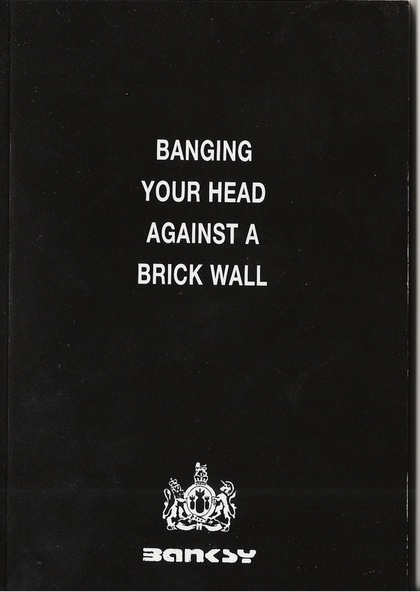

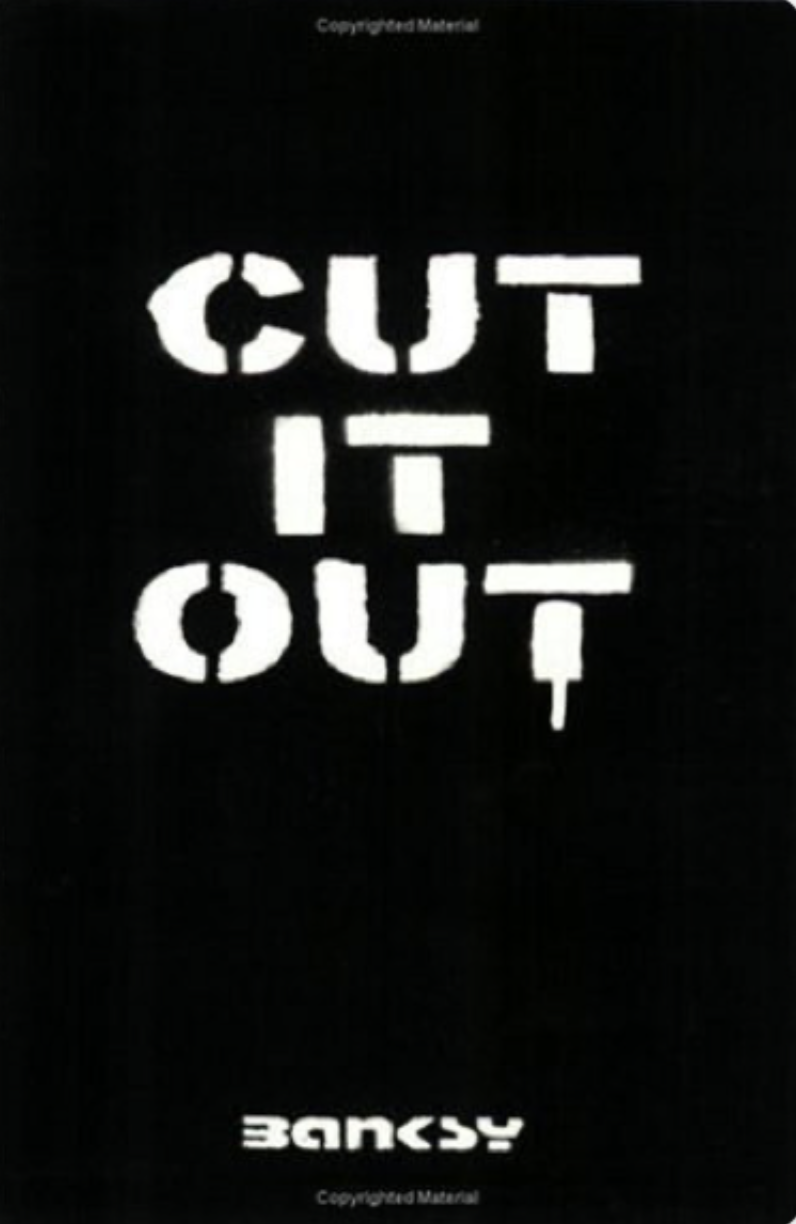
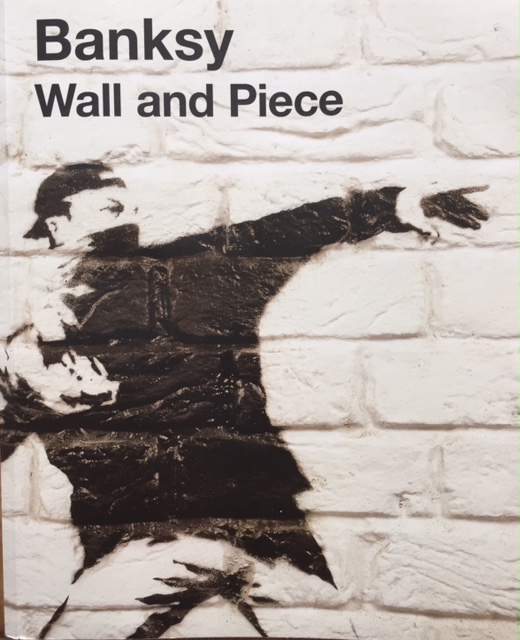

The three small black books are collectables and are hard to find in bookstores, but you can find them as e-books at https://www.scribd.com
The writing on the wall, The Guardian, 24 March 2006
Three years after his visit to Sydney and Melbourne, Banksy wrote an op-ed in the Guardian on the whitewashing of street art in Melbourne ahead of the Commonwealth Games.
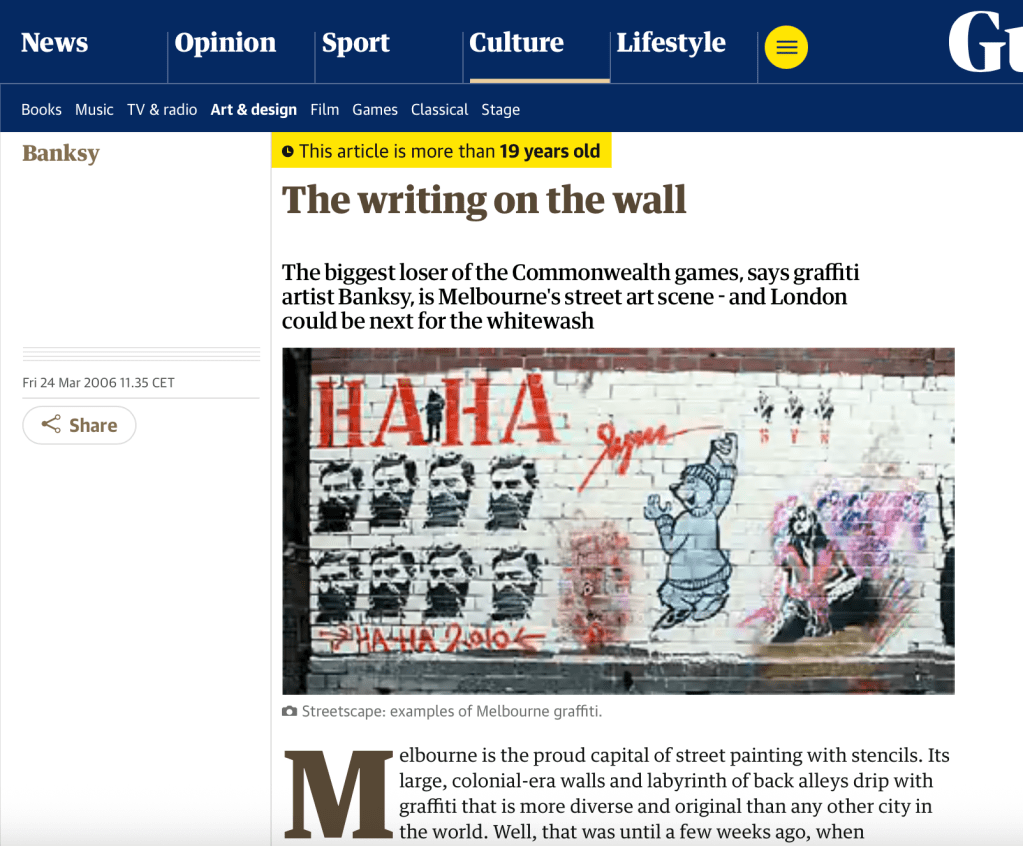
Source: https://www.theguardian.com/artanddesign/2006/mar/24/art.australia
The writing on the wall
The biggest loser of the Commonwealth games, says graffiti artist Banksy, is Melbourne’s street art scene – and London could be next for the whitewash
Melbourne is the proud capital of street painting with stencils. Its large, colonial-era walls and labyrinth of back alleys drip with graffiti that is more diverse and original than any other city in the world. Well, that was until a few weeks ago, when preparations for the Commonwealth games brought a tidal wave of grey paint, obliterating years of unique and vibrant culture overnight.
This may seem like no great tragedy to readers of the Daily Mail, but Melbourne’s graffiti scene is a key factor in its status as the continent’s hothouse of creativity and wilful individualism.
Melbourne became a hub of stencilling for reasons no one seems particularly able to explain. Its laid-back atmosphere and sense of isolation most probably have something to do with it. Painters there have never been as shackled to the New York school of large letters on subway trains that took a stranglehold everywhere else. Rather than scrawling their name across a window, most preferred to paint something a little different: a dog chasing a butterfly on a mailbox, for instance, or a couple kissing in the space left where an old poster has been ripped away.
Witty, playful, often angry, the free rein taken by Melbourne’s street artists became about much more than just daubing on a wall. It has drawn in generations of artists, thinkers and tourists to explore and experiment in the city. It gave fresh life to the worlds of fashion and music and is arguably Australia’s most significant contribution to the arts since they stole all the Aborigines’ pencils.
“The Melbourne scene is incredibly diverse,” says Alison Young, head of the department of criminology at Melbourne University. “The range of artists includes people in their 40s, in their teens and a relatively large number of women.” Young was commissioned by the city council to draw up a draft graffiti strategy last March in which she recommended tolerance zones be set up where street art and graffiti be allowed a small space within the city, where writers and artists would be at a lower risk of being arrested. “This was rejected by the city council, despite it generating lots of public support and despite evidence being presented that zero tolerance, for lots of reasons, wouldn’t work.”
Instead, the council doubled its anti-graffiti budget. “The clean-up is an imposition of a supposedly mainstream, or dominant, cultural view,” says Young, “in denial of the diversity of cultural styles that actually exist within a city space.”
What is disappointing about the authority’s attitude is that Australia is probably still the only country in the world to have elevated a graffiti writer to the status of national public hero. Arthur Stace was an alcoholic from the slums of Sydney who found God while listening to a Baptist preacher in a hostel in the 1940s and took to writing the word “eternity” on the ground in chalk. He rendered it in meticulous copperplate script more than half a million times across Sydney over the next three decades, becoming an urban legend before his death in 1967 at the age of 83. He has since been honoured by a plaque, a range of council-approved merchandise and was the centrepiece of celebrations when the word “eternity” in his trademark hand was lit up in 100ft-high letters on Sydney harbour bridge to mark the new millennium.
Then came the Commonwealth games and a redoubling of the city’s efforts to rid itself of the evil graffiti menace. “Cleaning crews have been at work all along the main railway line that runs from the centre of the city to the main sporting venue for the games, destroying miles of continuous artwork,” says Jake Smallman, who has edited a recent book called Stencil Graffiti Capital: Melbourne, compiling some of the city’s more inventive street art. In February, police were rumoured to have infiltrated an exhibition showcasing photographs from the book as part of an intelligence-gathering exercise. “Graffiti’s not art,” said the police minister Tim Holding, in response to the book. “It’s vandalism and it’s something we all deplore.”
Melbourne’s innovative painting scene has been a key player in the global development of street art in recent years. Rather bizarrely for an art form that requires a casual interpretation of the law, graffiti has been steeped in rules and conservatism ever since Taki 183 picked up a can of Krylon spray paint in New York in the 1970s. A strict code was soon established that decreed what a piece should consist of and how many you needed to paint to achieve a certain status. It is only since the omnipresence of tags (graffiti signatures) has turned them into a kind of forgettable urban wallpaper that the art form has started to evolve again. Modern street art is the product of a generation tired of growing up with a relentless barrage of logos and images being thrown at their head every day, and much of it is an attempt to pick up these visual rocks and throw them back.
The street art destroyed in Melbourne will survive on graffiti’s new best friend – the internet. The web has done wonders for graffiti; it perfectly reflects its transient nature, and graffiti is ludicrously overrepresented on its pages. The ability to photograph a street piece that may last for only a few days and bounce it round the world to an audience of millions has dramatically improved its currency. On the other hand, the internet is turning graffiti into an increasingly virtual pastime. It is now possible to achieve notoriety by painting elaborate pieces in secluded locations, without the associated risk of arrest that is usually attached. By posting photographs online you can become a significant graffiti writer from a town where none of your work is actually visible.
The precedent set by Melbourne does not bode well for London in the build-up to the 2012 Olympics. The games will be set in east London, where Hackney is one of the few remaining parts of the city where affordable studio space for artists still exists. After the warehouses have been flattened by compulsory purchase orders, the pots of grey paint will be opened and an area rich in street culture and frontier spirit will disappear. Factory doors whose flaked layers of Hammerite reveal history like the rings in a tree stump will be thrown on the fire. Disused cranes perched on top of foundries like skeletal crows will be torn down. Everything will be replaced by a cardboard-partitioned village perched on a pile of cheap laminate flooring. And if you think the graffiti will be removed so it can be replaced by vistas of clean urban space, think again. Every meaningful spot will be clogged with giant billboards by the likes of McDonald’s encouraging you to get fit by staying at home and watching the games on TV.
This is not to say that every city should aim to look like the south Bronx, or that regeneration cannot be a good thing, but society’s headlong march into bland conformity should not necessarily be welcomed with such open arms. In the 1990s, large sections of football grounds were demolished to make way for executive boxes – only then did people start to complain about the lack of atmosphere.
Melbourne and London are genuine epicentres of the skewed human touch that can bring a little sparkle into the drudgery of public space. A feat that is of immense value, despite its apparent worthlessness. And a feat that is not so easily achieved by trying to run around a track in under four minutes.
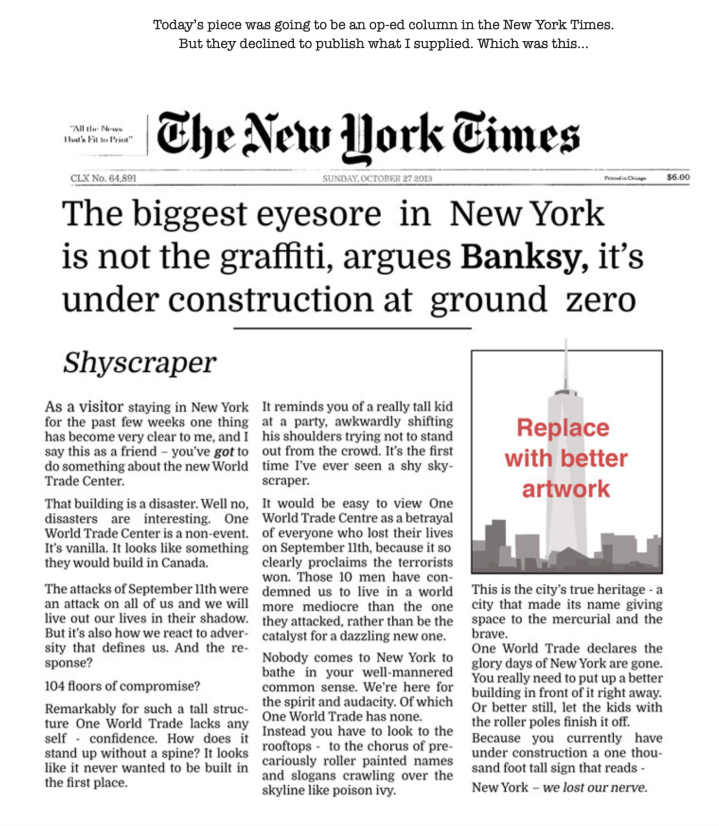
Op-ed in The New York Times. 27 October 2013
On day 26 of Better Out Than In, Banksy had written an op-ed for New York Times, which never got published:
The Dismaland programme, 2015
Another example of Banksy’s writing is the Dismaland programme, probably co-written with Simon Munnery.
The Artist – how to be famous in the art business
A special mention goes to a very special booklet that was published in 1993, two years before Banksy first appeared on the streets of Bristol. ‘The Artist – how to be famous in the art business’ by publishing legend Mike von Joel and Bristolian illustrator Joe Berger was printed in only 100 copies. Today, it has become a highly coveted collectable.
In this cult comic, von Joel writes about an up-and-coming artist by the name of Robin Banks, who takes on Banksy as his artist name. The plot is, in essence, about creating a new art genre and mocking the art establishment. Sounds familiar? A parody of the Young British Artist movement and Damien Hirst? Or a blueprint for the Banksy project? Here are a few samples from the extraordinary booklet:


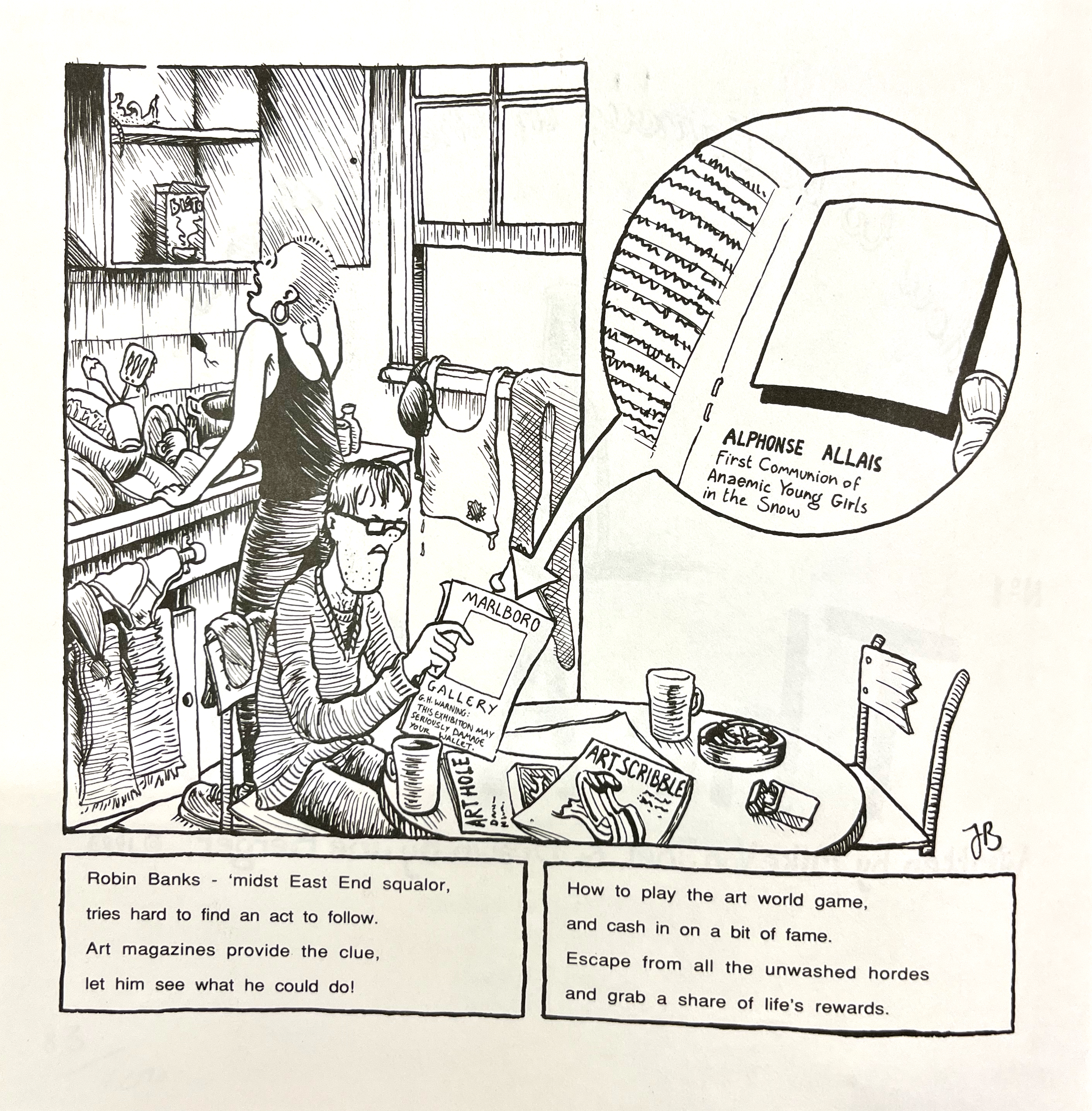
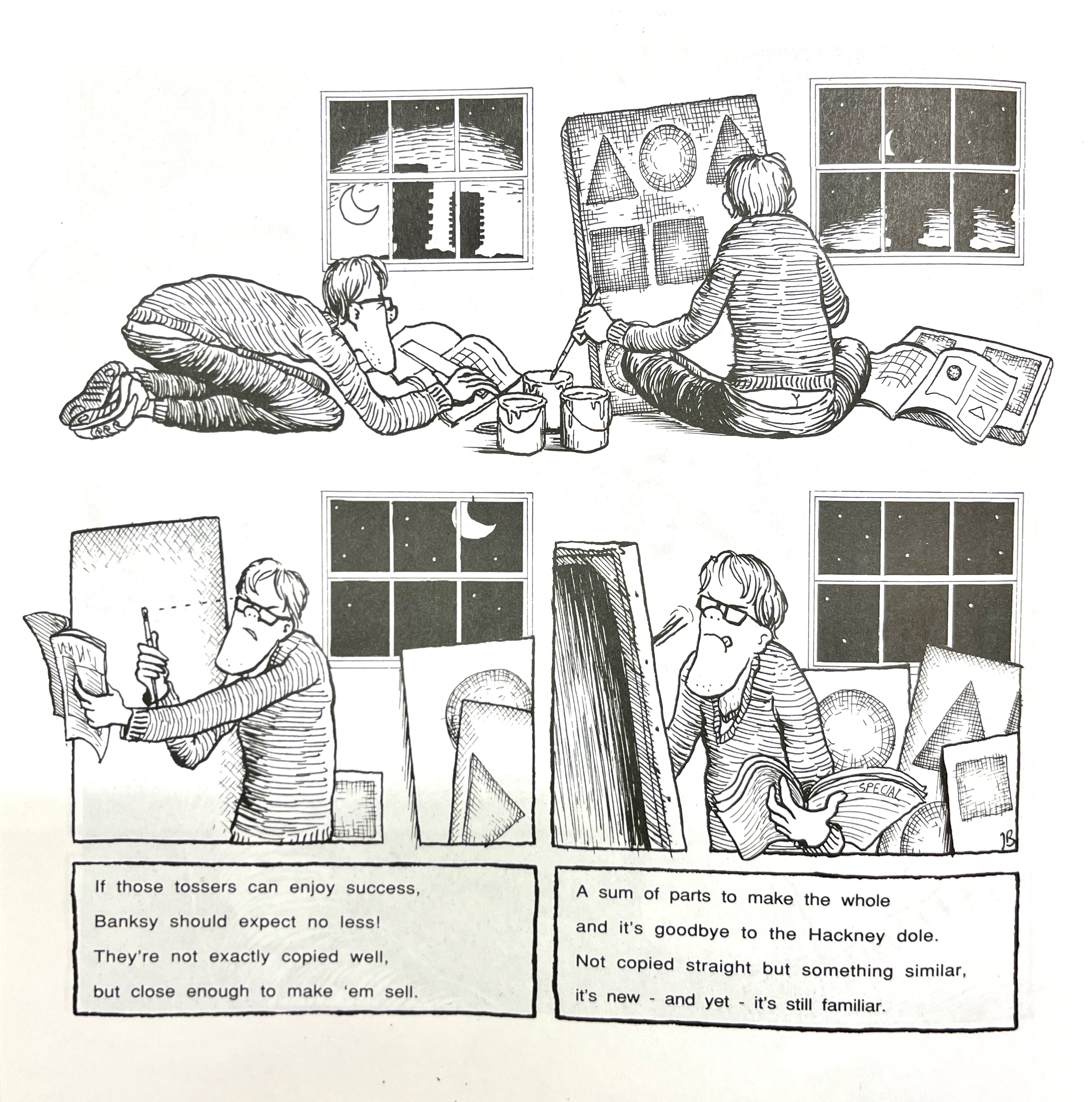
The Artist, by Mike von Joel and Joe Berger
Banksy Quotes
“Some people become cops because they want to make the world a better place. Some people become vandals because they want to make the world a better looking place.”
“Imagine a city where graffiti wasn’t illegal, a city where everybody could draw whatever they liked. Where every street was awash with a million colours and little phrases. Where standing at a bus stop was never boring. A city that felt like a party where everyone was invited, not just the estate agents and barons of big business. Imagine a city like that and stop leaning against the wall – it’s wet.”
“All artists are willing to suffer for their work. But why are so few prepared to learn to draw?”
― Banksy, Wall and Piece
“Nothing in the world is more common than unsuccessful people with talent, leave the house before you find something worth staying in for. ”
“A lot of people never use their initiative because no-one told them to.”
“The thing I hate the most about advertising is that it attracts all the bright, creative and ambitious young people, leaving us mainly with the slow and self-obsessed to become our artists.. Modern art is a disaster area. Never in the field of human history has so much been used by so many to say so little.”
“There are four basic human needs; food, sleep, sex and revenge.”
“Graffiti is one of the few tools you have if you have almost nothing. And even if you don’t come up with a picture to cure world poverty you can make someone smile while they’re having a piss.”
Banging Your Head Against a Brick Wall
“There’s nothing more dangerous than someone who wants to make the world a better place.”
“People who get up early in the morning cause war, death and famine.”
― Banksy, Banging Your Head Against a Brick Wall
“Think outside the box, collapse the box, and take a fucking sharp knife to it.”
Wall and Piece
“A lot of mothers will do anything for their children, except let them be themselves.”
Wall and Piece
“Art should comfort the disturbed and disturb the comfortable.”
“The greatest crimes in the world are not committed by people breaking the rules but by people following the rules. It’s people who follow orders that drop bombs and massacre villages.”
Wall and Piece
“Your mind is working at its best when you’re being paranoid.
You explore every avenue and possibility of your situation
at high speed with total clarity.”
Banging Your Head Against a Brick Wall
“I mean, they say you die twice. One time when you stop breathing and a second time, a bit later on, when somebody says your name for the last time.”
“Once upon a time there was a bear and a bee who lived in a wood and were the best of friends. All summer long the bee collected nectar from morning to night while the bear lay on his back basking in the long grass. When winter came the bear realised he had nothing to eat and thought to himself ‘I hope that busy little bee will share some of his honey with me.’ But the bee was nowhere to be found – he had died of a stress induced coronary disease.”
Wall and Piece
“The human race is the most stupid and unfair kind of race. A lot of the runners don’t even get decent sneakers or clean drinking water. Some runners are born with a massive head start, every possible help along the way and still the referees seem to be on their side. It’s not surprising a lot of people have given up compeating altogether and gone to sit in the grandstand, eat junk and shout abuse. What the human race needs is a lot more streakers.”
Cut It Out
“People either love me or they hate me, or they don’t really care.”
Wall and Piece
“People say graffiti is ugly, irresponsible and childish… but that’s only if it’s done properly.”
― Banksy, Wall and Piece
“A wall is a very big weapon. It’s one of the nastiest things you can hit someone with.”
Banging Your Head Against a Brick Wall
“A recent survey or North American males found 42% were overweight, 34% were critically obese and 8% ate the survey.”
“Speak softly, but carry a big can of paint.”
Wall and Piece
“People who enjoy waving flags don’t deserve to have one”
Wall and Piece
“My main problem with cops is that they do what they’re told. They say ‘Sorry mate, I’m just doing my job’ all the fucking time.”
Banging Your Head Against a Brick Wall
“You owe the companies nothing. You especially don’t owe them any courtesy. They have re-arranged the world to put themselves in front of you. They never asked for your permission, don’t even start asking for theirs.”
Wall and Piece
“the people who run our cities dont understand graffiti because they think nothing has the right to exist unless it makes a profit…
the people who truly deface our neighborhoods are the companies that scrawl giant slogans across buildings and buses trying to make us feel inadequate unless we buy their stuff….
any advertisement in public space that gives you no choice whether you see it or not is yours, it belongs to you ,, its yours to take, rearrange and re use.Asking for permission is like asking to keep a rock someone just threw at your head..”
“I’d been painting rats for three years before someone said, ‘That’s clever. It’s an anagram of art,’ and I had to pretend I’d known that all along.”
― Banksy, Wall and Piece
I never apologise. I’m sorry, but that’s just the way I am. – http://www.banksy.co.uk ca 2003
Just because we don’t care doesn’t mean we don’t understand – http://www.banksy.co.uk ca 2003
 Banksy unofficial