The internet started buzzing around 5 p.m. on 29 April, when the first photos of a new statue in central London began circulating. Around noon the following day, Banksy confirmed the work on Instagram: https://www.instagram.com/p/DXwf7pis6KT/
The style and scale echo the statues of kings and admirals nearby. One possible interpretation could be “Blinded by Nationalism,” which is indeed a growing concern not only in the USA and Russia. The statue has the potential to become one of Banksy’s most iconic works.
Photo: R.A.
Photos: R.A.
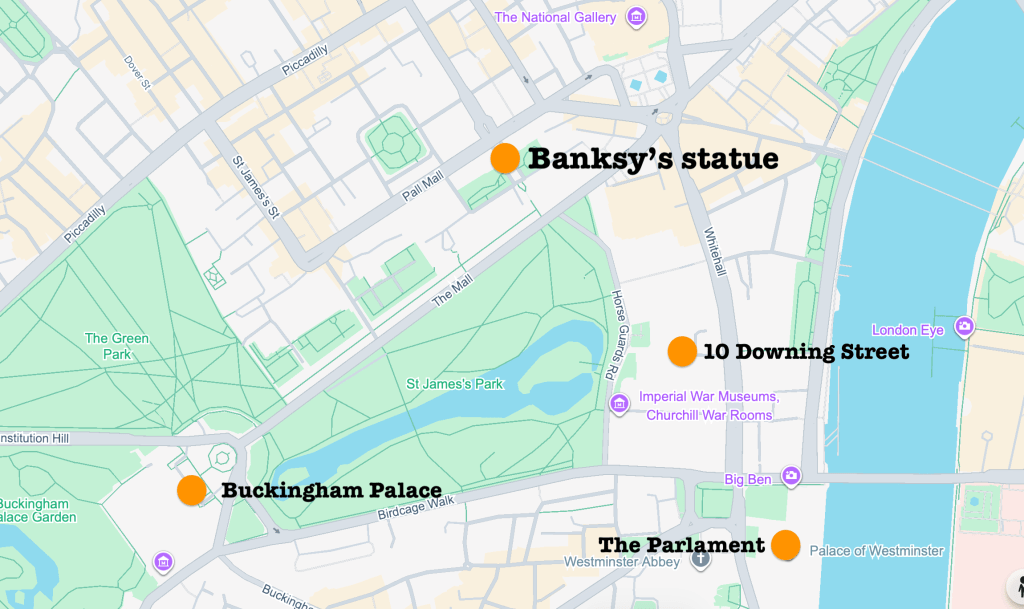
The location is triple A
The location is absolutely stellar, at the intersection of Waterloo Place and Pall Mall, just a few hundred meters from Downing Street, Buckingham Palace, and the Parliament – right in the epicentre of where the British Empire was once governed.
How did they do it?
This area, Saint James’s, is home to many government buildings and foreign embassies as well as some of the UK’s most select private members’ clubs. It’s a heavily guarded area, 24/7, not only by the police, but also by the military and by private security. How did Team Banksy manage to install a politically charged statue in the very heart of London, surrounded by CCTV cameras, police and military personnel everywhere?
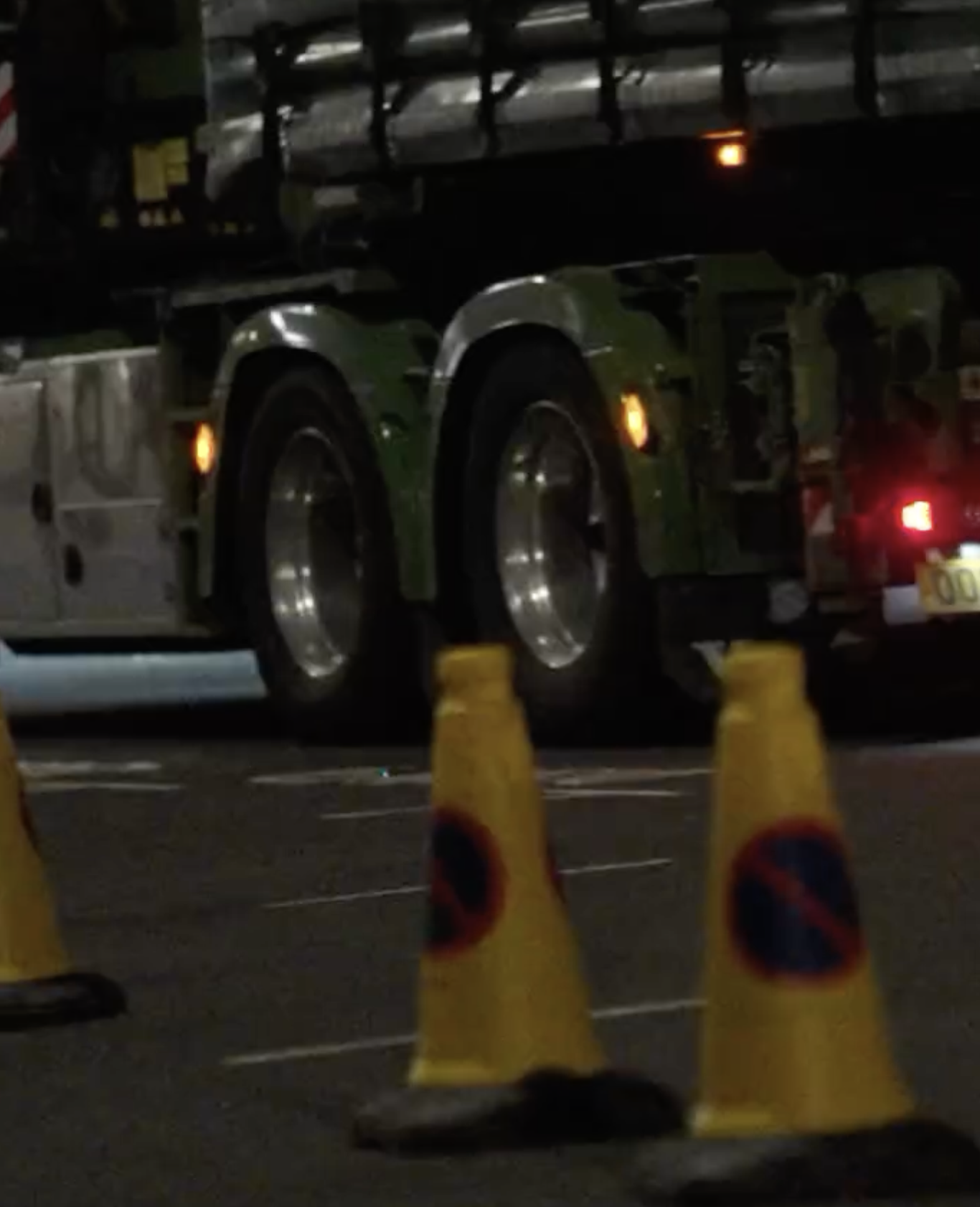
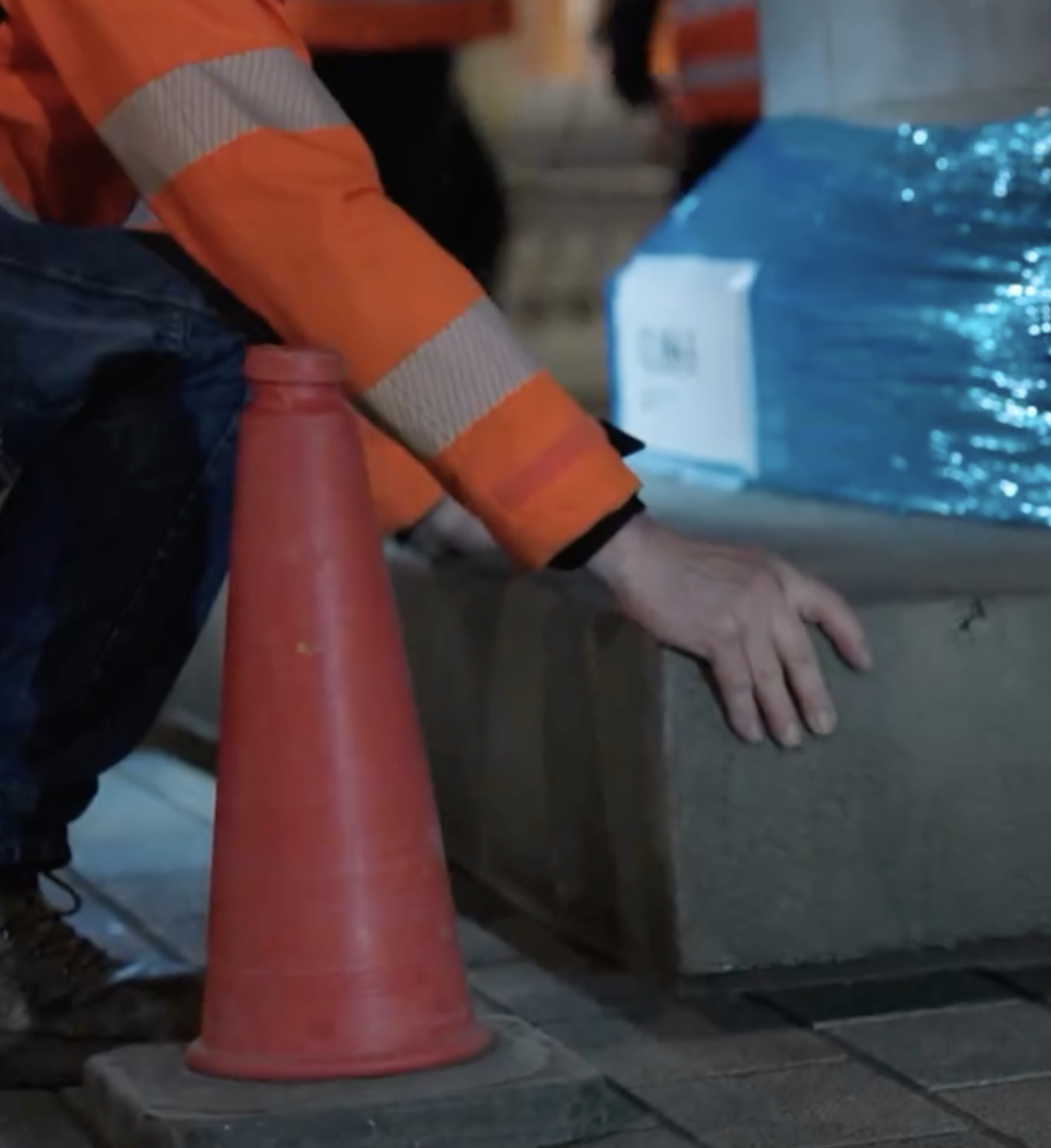
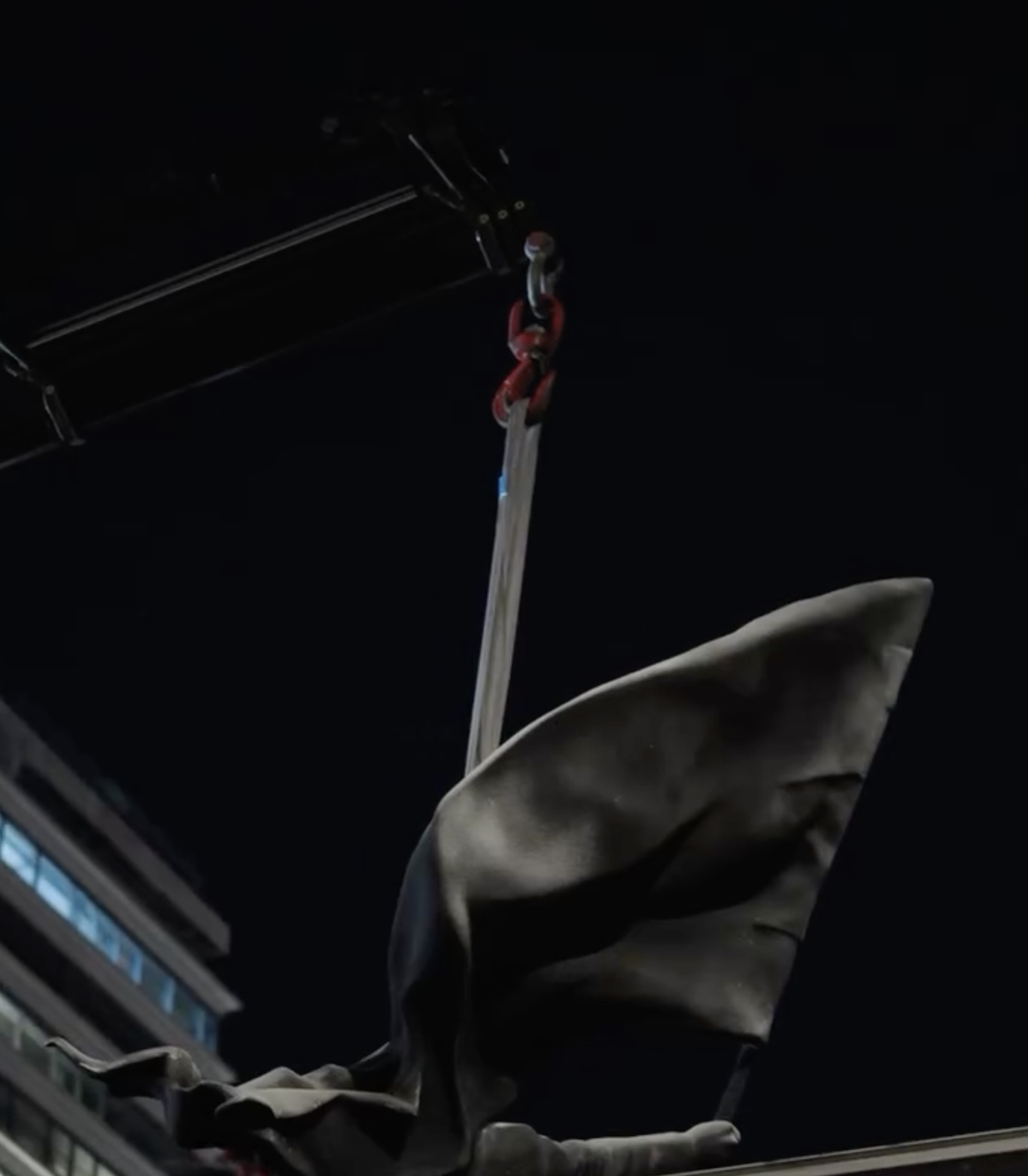
According to the footage published on Banksy’s Instagram (https://www.instagram.com/p/DXwf7pis6KT/), his team installed the statue in the early morning hours of Wednesday, 29 March. The statue and the plinth are made of fibreglass, with the plinth base made of cement. The footage shows that the statue was delivered by a crane truck. Team Banksy used cones, high-visibility vests, and other construction worker paraphernalia to give the impression that it was a legit installation. In central London, it’s not unusual to see deliveries of heavy equipment to construction sites in the middle of the night. And, effectively, one of the adjacent buildings is a construction site with the facade covered in scaffolding. That would explain why the police and security personnel in the area didn’t react.
Team Banksy returned with a film crew around 2 pm on Wednesday to film the statue in daylight using a drone.
The following images are screenshots from the footage Team Banksy posted on Instagram:
Left to right: The crane truck with the cones, a team member in a high-visibility vest installing the cement base, and the crane lifting the statue onto the plinth.
It’s not the first statue in central London
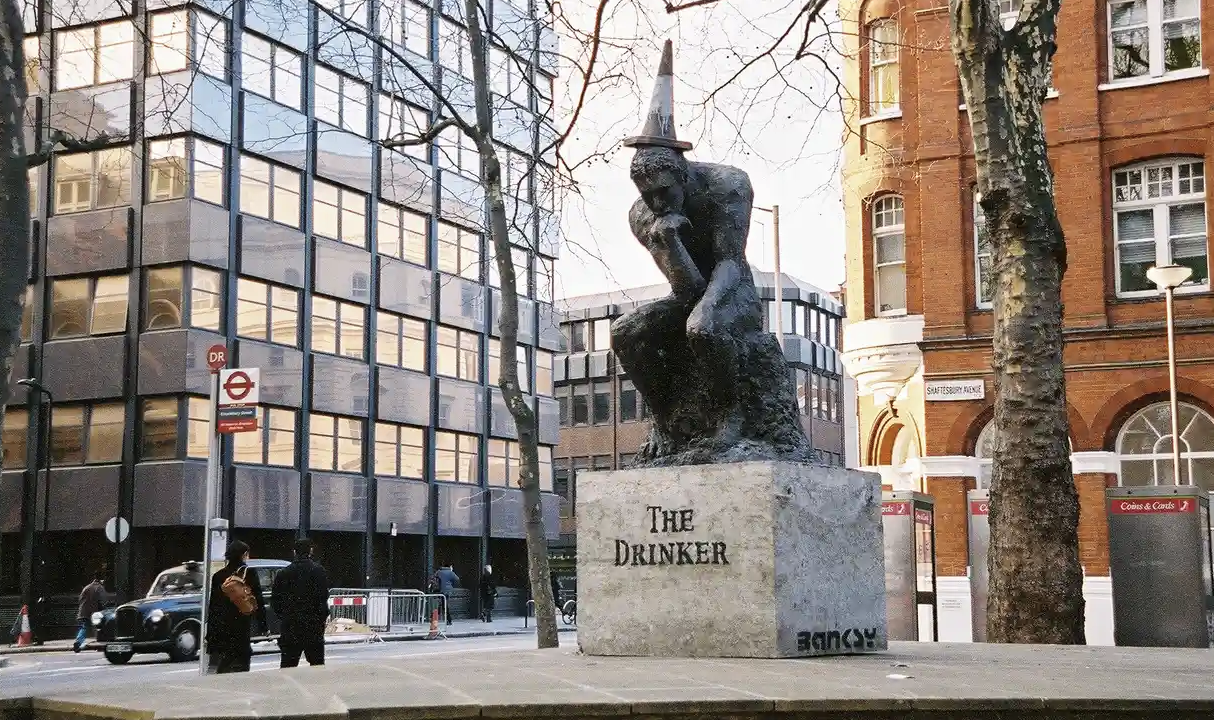
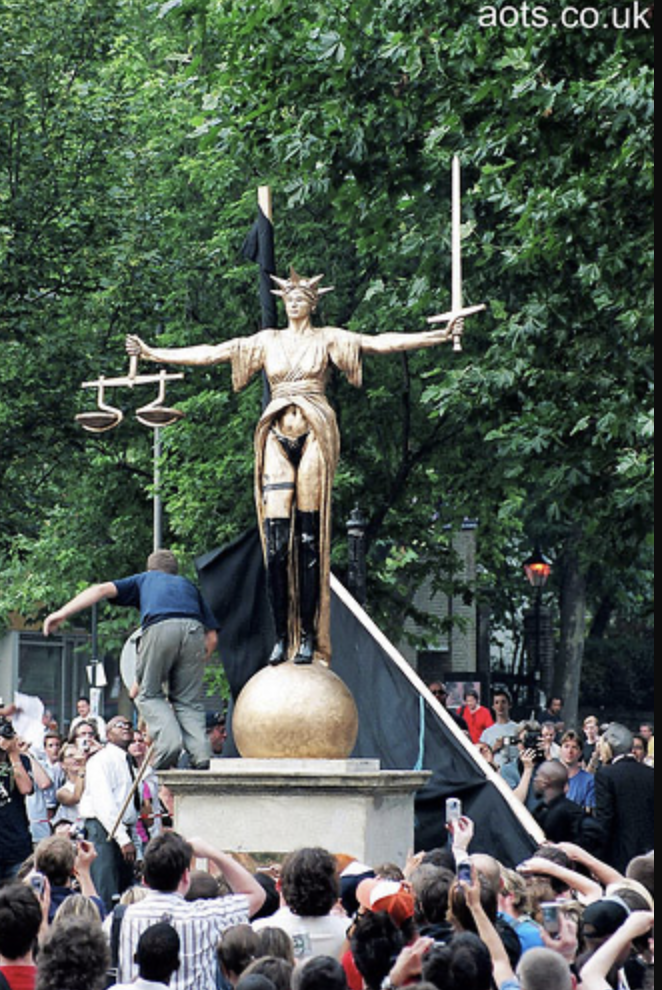
Back in 2004, Banksy installed two memorable statues in the centre of London: In February of 2004, Team Banksy installed The Drinker, a paraphrase of Rodin’s The Thinker, in a small square by Shaftesbury Avenue. In August of the same year, they installed Justice Unveiled, overlooking the Central Criminal Court in the City of London.
Left to right: The Drinker and Justice Unveiled. Photo: aots.co.uk
Plein air by Pete the Street
A few days later, Banksy posted a plein air painting by Pete Brown (a.k.a. Pete the Street) on his Instagram. It’s not the first time Banksy has mentioned Pete the Street – his rendition of the Valentine’s Day Mascaramural in Margate is included in Banksy’s book Cut & Run – 25 years of card labour.
Plein air painting of the statue at Waterloo Place by Pete Brown
The man at the centre of the story is Robin Gunningham, whose name first entered the public domain in 2008, when the Mail on Sunday published it alongside a photograph taken in Jamaica in January 2004. According to Reuters, Gunningham has since changed his name to David Jones. Steve Lazarides, Banksy’s former agent, confirmed to the news agency that he helped arrange the name change in 2008, though he declined to say what name Gunningham adopted.
Another key finding by Reuters is that Banksy travelled together with Robert del Naja, the Massive Attack frontman, to Ukraine in November 2022 – a trip that produced seven now-classical street art pieces around Kyiv. Reuters traced the new identity by cross-referencing immigration records at the Poland–Ukraine border crossing around the time of the Kyiv street art blitz. (One has to give it to Reuters; they are pros.) Gunningham’s role on the team was already widely assumed; what’s new is the confirmation, and the detail that the name change happened as early as 2008. With any luck, he has changed it again by now, if only to stay a step ahead of reporters.
Anyway,the real value of the investigation, though, lies less in the headline reveal than in the smaller stories woven through it: the Kyiv trip, the New York arrest, the Carlton Arms, the ex-girlfriend, the Sotheby’s shredding stunt. For serious Banksy followers, these details are the real payoff.
Anonymity: Banksy’s body of work is outstanding, and its artistic value doesn’t depend on anonymity. He will make it into the history books as the most important artist of the early 21st century. Like no other artist, Banksy has created an enormous narrative in which his anonymity is just one element. Banksy’s artistic (and physical) risk-taking in creating this narrative is unprecedented in today’s art world.
If Banksy decides to stay anonymous, it’s his decision, and he surely has many reasons to do so. One reason could be to distance himself from the celebrity cult. Another reason is, of course, that he is doing illegal street art, where illegality is part of the expression. (Banksy doesn’t do legal commissions from property owners as many of his colleagues do.) With that in mind, do we have the right to demand transparency and scrutiny simply because he is one of the most influential artists of our time, while he operates outside the law? It is an interesting question. I think it all boils down to the fact that nobody is above the law; therefore, going public would be signing his own arrest warrant. It probably will be a subject for future art historians to study.
Banksy business: Strip away the street art, and Banksy’s operation looks a lot like any other major contemporary artist’s, as this blog has noted before. He produces work in his studio and sells it to a base of collectors — his primary market. That’s how he earns his living, and there’s nothing unusual about that; even a subversive artist has to eat.
The secondary market works differently. Banksy makes no money from the resale of his studio artwork at auction houses or between collectors and dealers. Roughly 300 Banksy studio pieces change hands at London auctions each year, all in transactions between collectors in which Banksy has no direct stake. He does collect Artist Resale Rights of 2–4% on those sales, scaled to the hammer price, and benefits indirectly in another way: rising auction prices let him charge more for new work sold to his own collector base. That’s simply how the market works for most living artists.
So, it shouldn’t be a surprise that Team Banksy is a million-pound business and several of the key players are well off. Why shouldn’t they be? It’s well-earned money from 30 years of hard work. What differentiates Team Banksy from other big-revenue artists is that a lot of money is donated to various charity projects. Credit to Reuters for mentioning the many charities in the article.
One person or a team: Reuters frames Banksy largely as a single artist working with a small circle of helpers. Gunningham — or Jones — is clearly part of that circle, but it’s worth asking how anyone can be certain he sits at the top of it. Banksy’s peers in the art world — Damien Hirst and Jeff Koons among them — run operations with as many as forty people on payroll: craftsmen, logistics staff, marketing, accounting, PR. If Banksy’s enterprise is built along similar lines, the question of where Gunningham actually ranks in the hierarchy remains genuinely open. He’s the likeliest candidate for a leading role, but the exact pecking order isn’t known — and it’s fair to ask whether that’s even something the public needs to know.
Some collaborators on the street art side have been identified over the past thirty years: Ben Eine, James Ame, Robert del Naja (aka 3D), and John Tsombikos (aka Borf), among others. Some contributors to the studio work are known as well. Given the sheer range of Banksy’s output — street art, oil on canvas, sculpture, installation, prank projects, curated shows, books, film production, even a hotel — it’s hard to imagine the creative core of the operation as a one-man affair. A committee of some kind seems far more plausible. What can be said with confidence is that, beyond that, very little is actually known.
The takeaway is that Reuters has revealed only part of the story—there’s clearly much more beneath the surface. The harder question is whether we actually want to know more.
There are some minor inaccuracies in the article. One example:
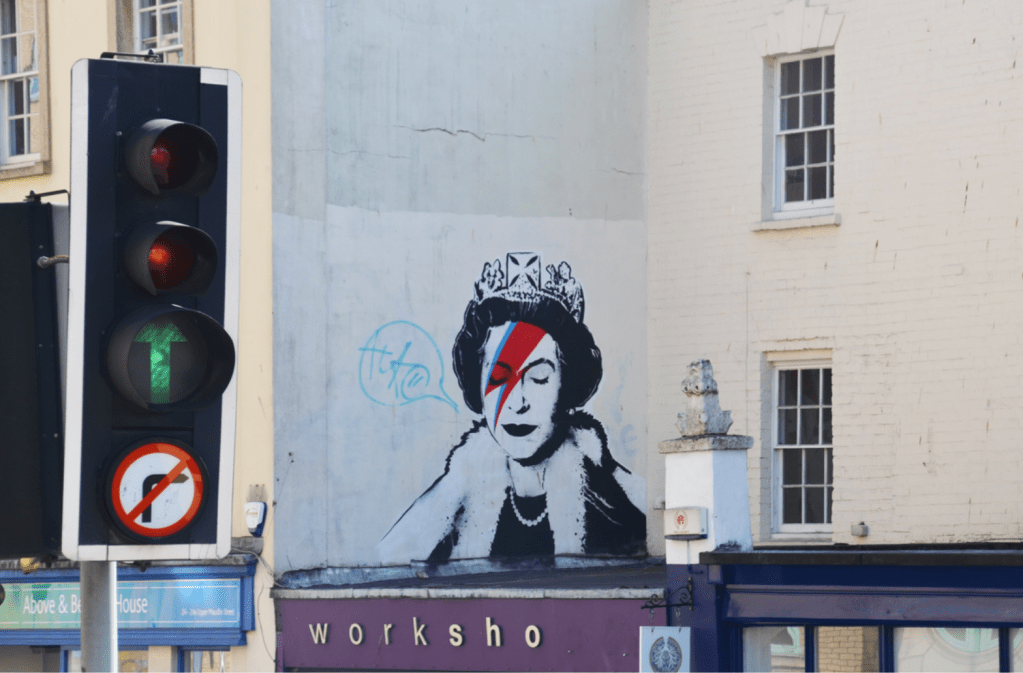
Reuter writes: “David Jones also is the given name of David Bowie, whose Ziggy Stardust alter ego inspired a Banksy portrait of Queen Elizabeth.”
The Queen Elizabeth piece from 2012, which Reuters refers to, with makeup in the style of Bowie’s Aladdin Sane, is not by Banksy – it was done by Inc Wel – https://www.instagram.com/incwel_official/
Queen Elizabeth by Inc Wel.Bristol, 2012.
Fake news:
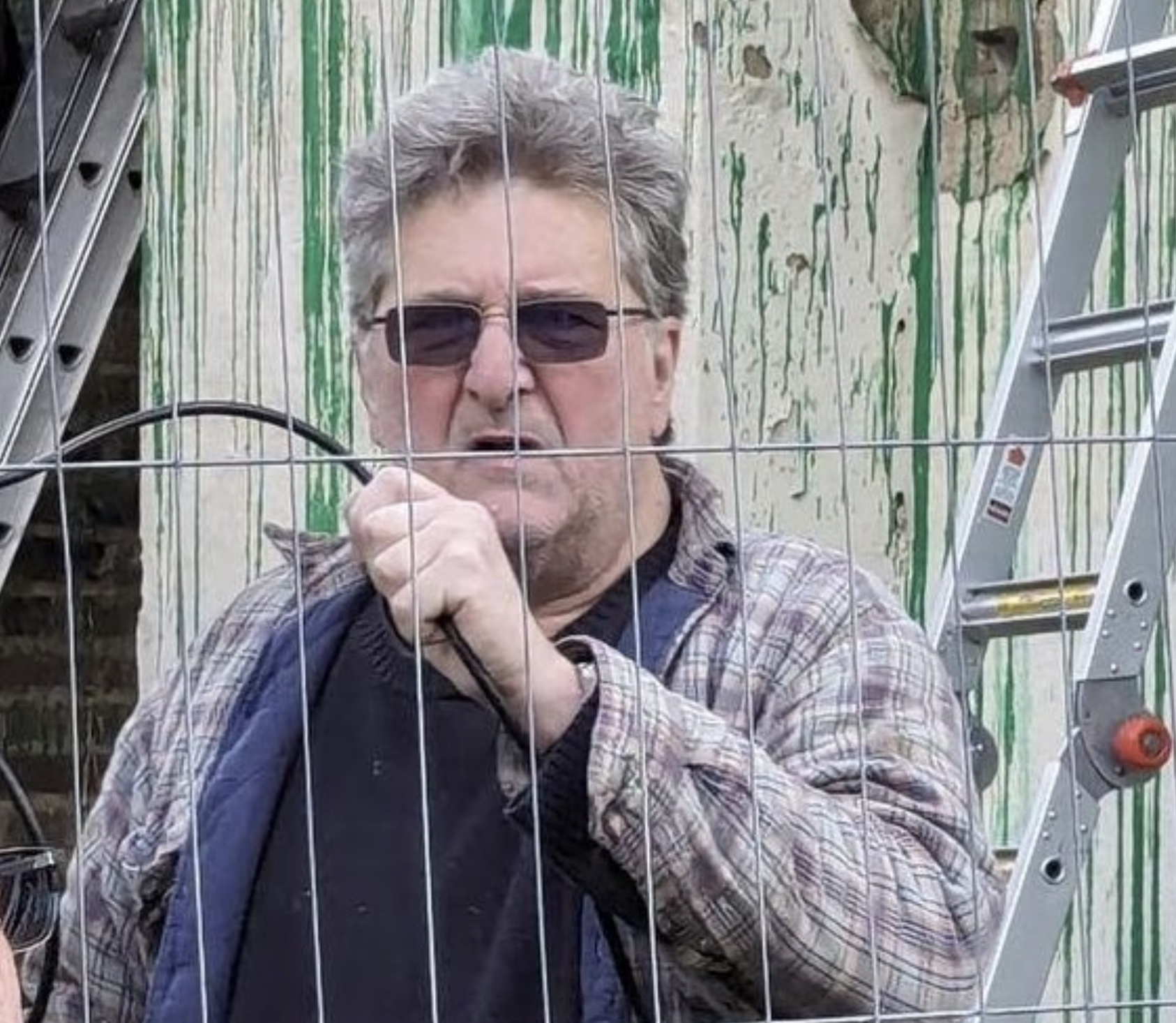
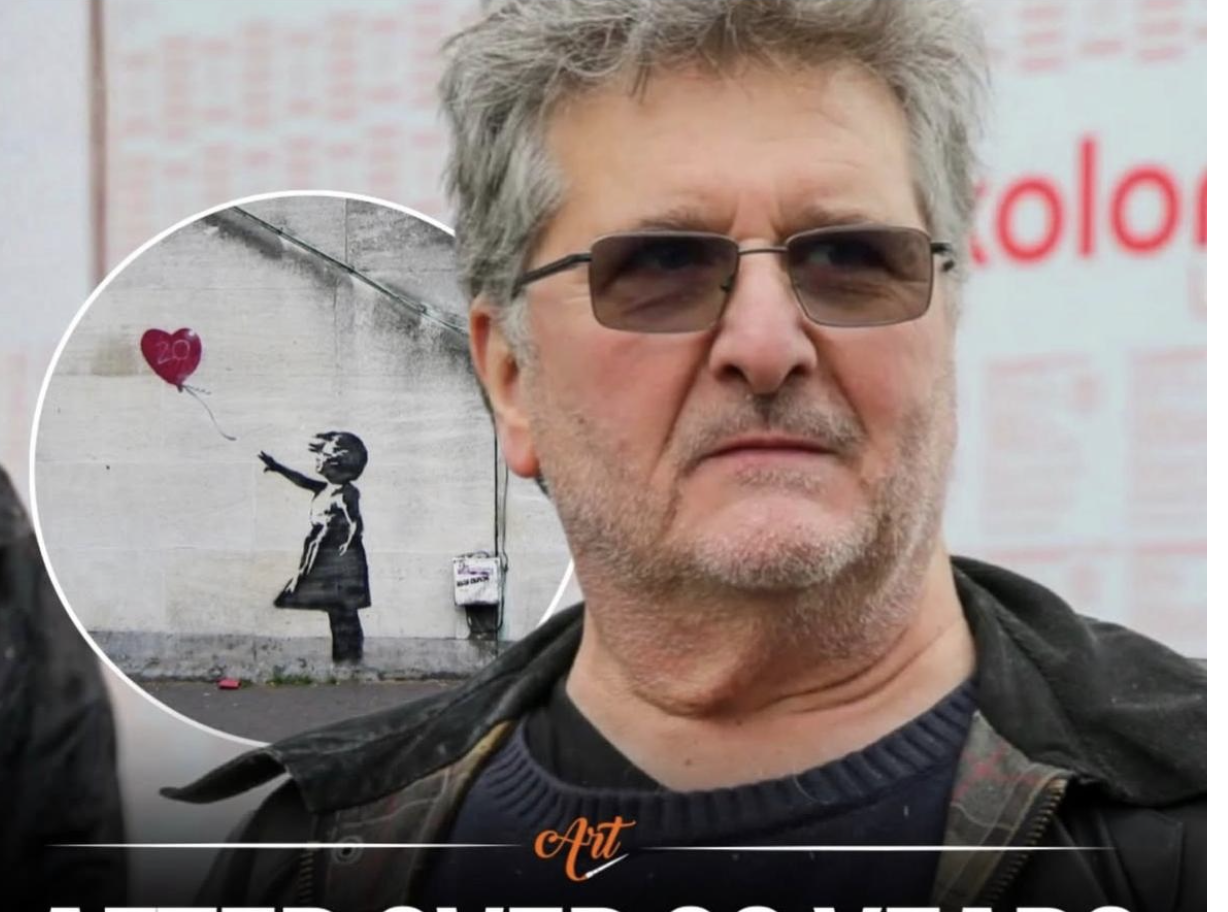
As a result of the Reuters article, many low-quality media outlets are circulating the following photos (Reuters are not to blame) as recent photos of Banksy:
The person is 100% NOT Robin / David. The guy in the photo is George G., a proud 67-year-old from a Greek-Cypriot family, living in northern London. He happens to be the father of the owner of the building in Finsbury Park, where Banksy painted a pruned tree in March 2024. His photo was taken while he was putting up protection on the recently painted street art.
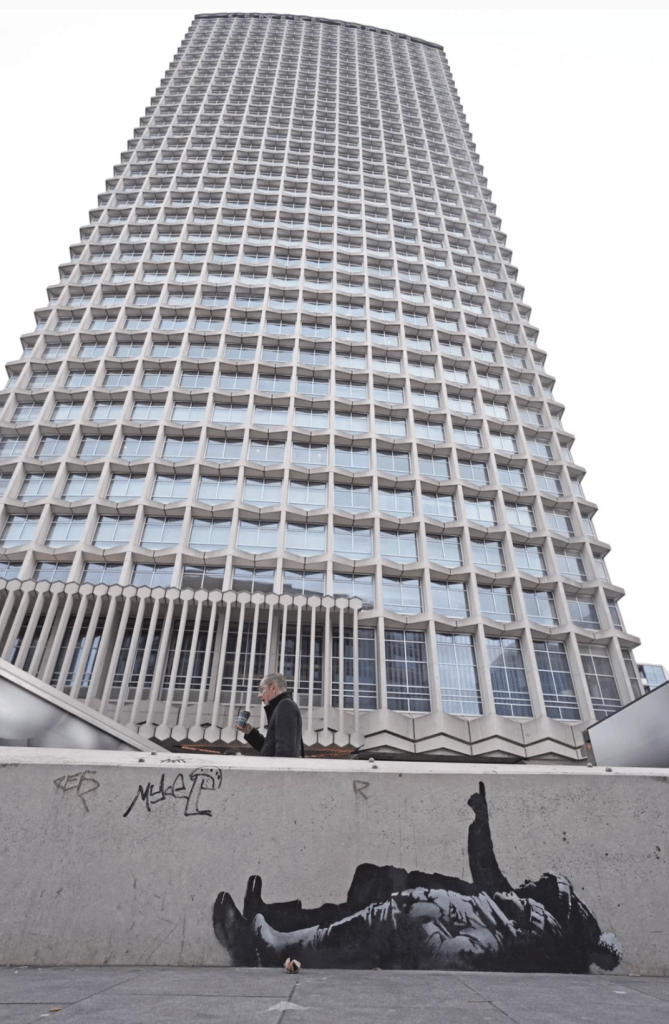
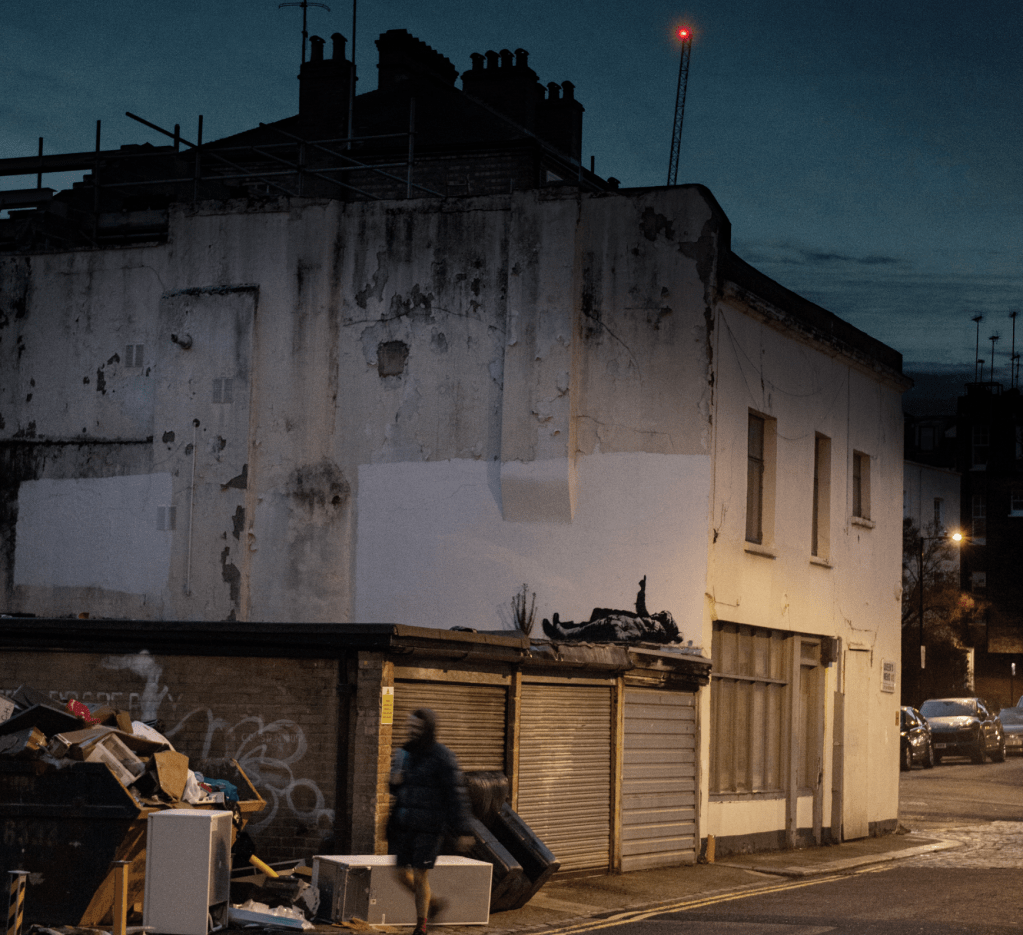
After two days of speculation, Banksy confirmed the murals on his Instagram on Monday afternoon. The artwork depicts two children lying flat on the cold pavement, wearing thick coats, winter boots and caps. One of them is pointing upwards, maybe at the North Star?
The same motive has been stencilled at two locations: One in front of the Centre Point Tower in Central London and another identical on top of a row of garages in Queen’s Mews in West London.
The first one was spotted on Saturday, 20 December, in front of the Centre Point Tower on New Oxford Street. Photo: BBC
The second one, on Queen’s Mews, a few blocks north of Hyde Park, was confirmed by http://www.banksy.co.uk on Monday, 22 December. Photo: @banksy
The placement at the Centre Point Tower has particular significance. As reported by the BBC on 22 December:
“Speaking about the Centre Point mural, artist Daniel Lloyd-Morgan told the BBC said he believed the location was chosen to make a point about child homelessness.
“Everybody is having a good time but there are a lot of children who are not having a good time at Christmas,” he said.
Mr Lloyd-Morgan said that people walking past the artwork were “ignoring it”, adding: “It’s a busy area. Quite poignant that people aren’t stopping. They walk past homeless people and they don’t see them lying on the street.”
“It’s kind of like they’re stargazing,” he said. “It’s quite fitting that the kids are pointing up like they’re looking at the North Star.”
Banksy enthusiast Jason Tomkins, said he also believed it was a “clear statement on homelessness”.
The Centre Point tower, at 101-103 New Oxford Street, has been a historic focal point for housing protests. Originally built as an office block in 1963, the Centre Point tower next to Tottenham Court Road underground station, remained unoccupied for over a decade, angering social justice campaigners.
The homelessness charity Centrepoint was named as a response to the building by founder Rev Ken Leech, who described the tower as “an affront to the homeless”. The block has since been converted into multimillion-pound luxury flats.
Banksy has not commented on the relevance of the location for either of the new works.“
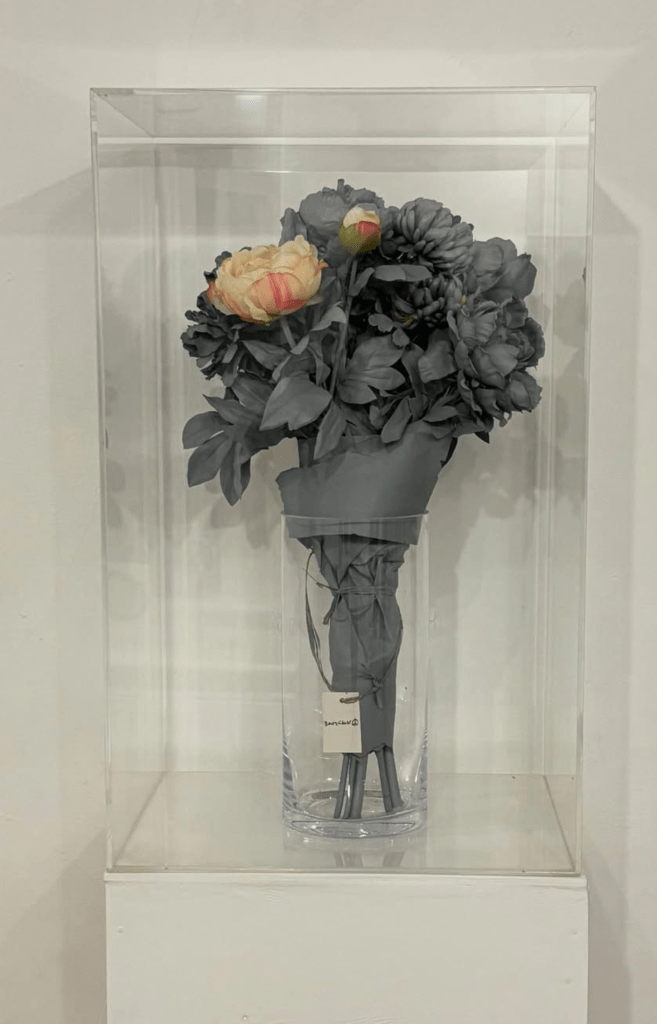
The sculpture is on display at Artmageddon, a group show at Pure Evil Gallery on Leonard Street in Shoreditch.
Banksy gifted the bouquet to Charles Uzzel Edwards — better known as Pure Evil — following a personal loss he suffered in 2024. The two go back a long way: Pure Evil was involved with both Pictures on Walls and the Santa’s Ghetto exhibitions, and was among the artists Banksy invited to take part in the Cans Festival, the collective street art show he organised in May 2008.
A new piece by Banksy was unveiled today at the Royal Courts of Justice, in the heart of London. At first glance, it looks like a version of his Crazy Hippies from Glastonbury 2010. But this time it’s a judge beating a fallen protester with his gavel while the CCTV camera is looking in the other direction. Given the piece’s location—at the UK’s highest court, in the very centre of London, surrounded by surveillance and security—one might suspect that team Banksy was in a rush to complete the work.
The artwork is most likely Banksy’s comment on the mass arrests of 890 non-violent protesters on Saturday, 6 September. BBC did a feature on the piece: https://www.bbc.com/news/articles/cgrq0r0y878o
Now we know where all the animals came from. The animal kingdom series obviously has a lot to do with the summer riots in London in the previous weeks. One can discern a stoic approach: nature is the only true force, and when you encounter adversity, face it with resilience, humour, and a charitable spirit.
The second week of the Animal Kingdom series starts with a life-size rhino mounting a Nissan Micra with a cone on the bonnet. Old-school Banksy. This is getting better every day!
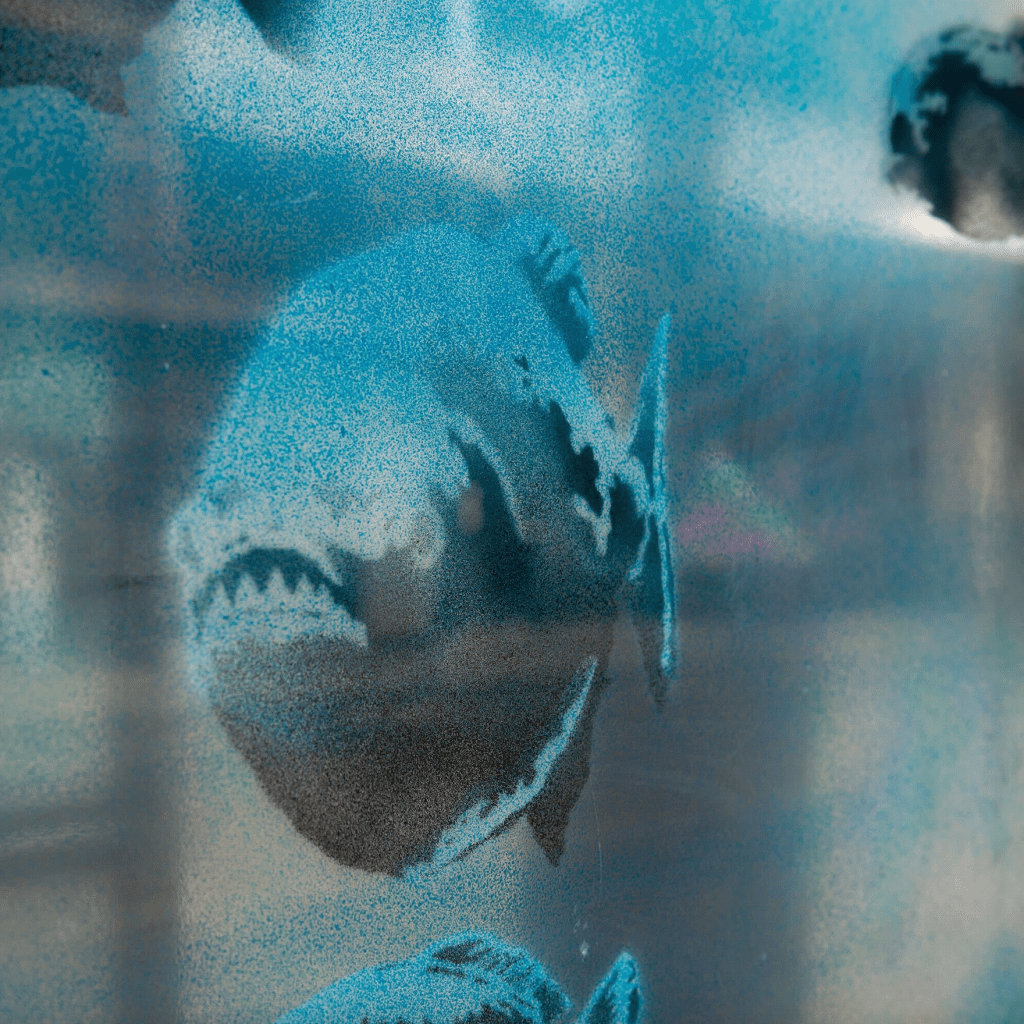
The piranhas appeared on Sunday morning at a police box near St. Paul’s Cathedral, in the City of London. As expected, Banksy confirmed the piece at 1 p.m. sharp on his Instagram.
The leopard is doing the morning stretch while sharpening the claws on a scratching post. Someone might say it’s a panther, but isn’t the panther just a leopard with black fur?
Anyway, there are quite a few leopards in the Banksy imagery:
Walled Off, canvas
Banksy’s handling office, Pest Control, issued a statement on the meaning of the London series of animals:
“The artist’s vision is simple: the latest street art has been designed to cheer up the public during a period when the news headlines have been bleak, and light has often been harder to spot than shade. Banksy’s hope, it is understood, is that the uplifting works cheer people with a moment of unexpected amusement, as well as to gently underline the human capacity for creative play, rather than for destruction and negativity. Some recent theorising about the deeper significance of each new image has been way too involved, Banksy’s support organisation, Pest Control Office, has indicated.”
Banksy confirmed the two pelicans at Bonners Fish Bar in Walthamstow with British punctuality, 1 p.m. sharp. The novelty of today’s piece is that it’s not monochromatic; they’ve employed a few spray-strokes of white in the pelican beak.








 Banksy unofficial