List of Banksy’s official exhibitions:
- Walls on Fire. Bristol, 22 – 23 August 1998. Collective exhibition, co-organised by Banksy.
- Early exhibition in Easton. Bristol, January 1999.
- SEVERNSHED. Bristol, February 2000. Banksy’s first major solo exhibition.
- Rivington Street. London, May 2000.
- Peace is Tough. Glasgow, March 2001. Collective exhibition.
- Cargo Club. London, 22 June – 5 July 2001. Exhibition in a cafe/nightclub in Shoreditch.
- Existencilism. Los Angeles, 19 July 2002. Only Banksy work.
- Santa’s Ghetto 02. London, December 2002.
- Semipermanent. Sydney, 11 – 12 April 2003. Collective exhibition.
- Bad Press. Vienna, June 2003. A warm-up show for Turf War.
- TURF WAR. London, July 2003. Banksy’s second major exhibition.
- Santa’s Ghetto 03. London, December 2003. Collective exhibition.
- Santa’s Ghetto 04. London, December 2004. Collective exhibition.
- The segregation wall. Palestine, August 2005. Banksy’s international breakthrough as a political artist.
- CRUDE OILS. London, October 2005. The third major exhibition.
- Santa’s Ghetto 05. London, December 2005. Collective exhibition.
- BARELY LEGAL. September 2006. The fourth major exhibition and the first big US show.
- Santa’s Ghetto 06. London, Oxford Street, December 2006. Collective exhibition.
- Santa’s Ghetto 07. Palestine, December 2007. Collective exhibition.
- THE CANS FESTIVAL. London, May 2008. Collective street art exhibition in London.
- VILLAGE PET STORE AND CHARCOAL GRILL. New York, October 2008.
- BANKSY VS BRISTOL MUSEUM. June 2009.Banksy’s sixth major exhibition.
- Marks and Stencils. London. November 2010. Collective exhibition.
- MOCA. Los Angeles, April 2011. Collective exhibition at the Museum of Contemporary Art.
- BETTER OUT THAN IN. New York, October 2013. Banksy’s eight major exhibition.
- DISMALAND. Weston, Somerset. August – September 2015. The ninth major exhibition.
- THE WALLED OFF HOTEL. Palestine. March 2017 and ongoing. Banksy’s tenth major exhibition.
- GROSS DOMESTIC PRODUCT. Croydon, 1 October – 15 October 2019.
- CUT & RUN. Glasgow Museum of Modern Art, 14 June – 28 August 2023. Individual retrospective exhibition.
In a post on his website, banksy.co.uk, in September 2018, Banksy defined the following as his major exhibitions (marked in capital letters in the list above):
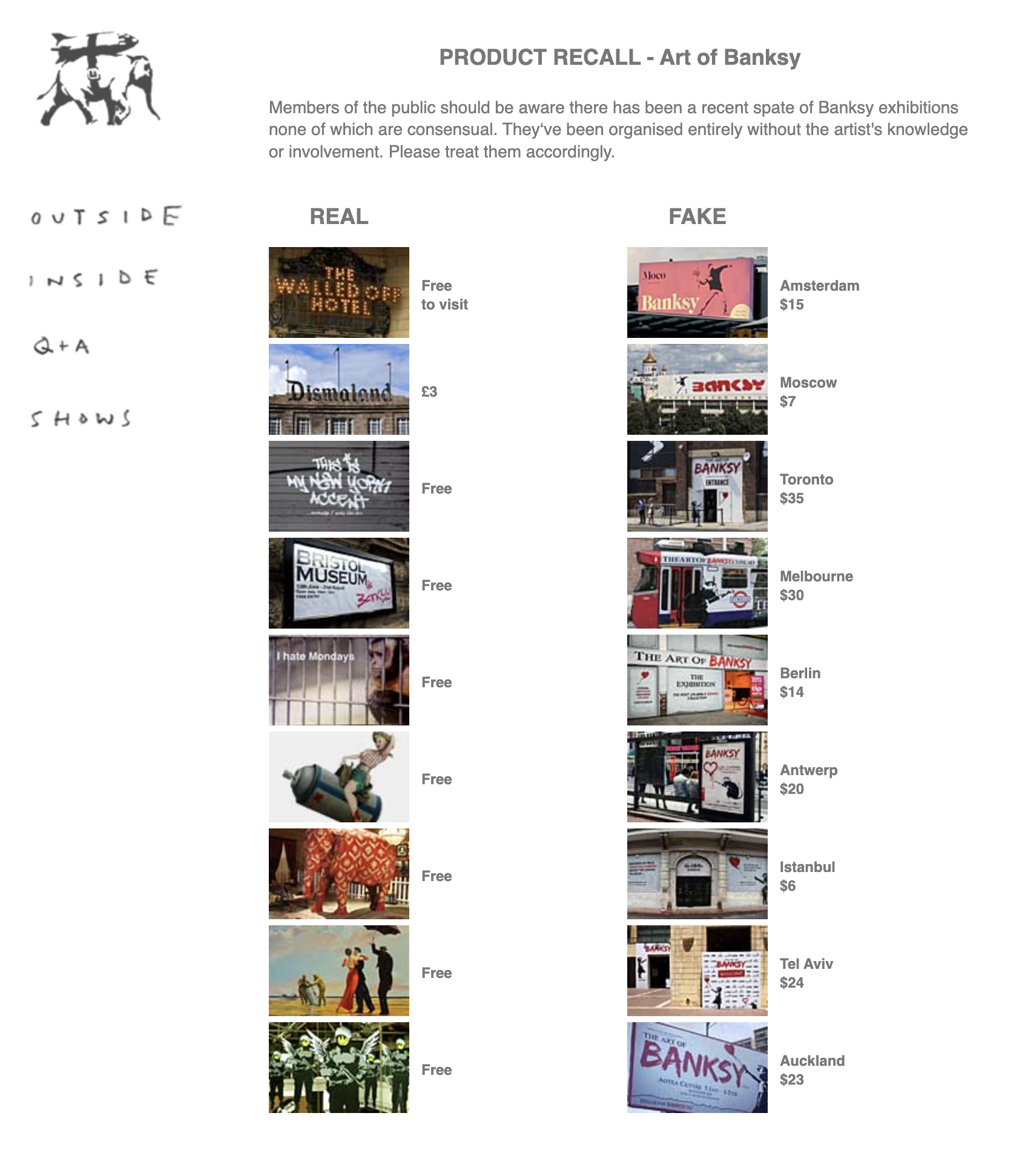
Labeled as ‘REAL’ in the column to the left:
- Walled Off Hotel, 2017
- Dismaland, 2015
- Better Out Than In, 2013
- Banksy vs Bristol Museum, 2009
- Village Pet, 2008
- Cans Festival, 2008
- Barely Legal, 2006
- Crude Oils, 2005
- Turf War, 2003
Since posting this list in 2018, you can add the Gross Domestic Product in Croydon outside London in 2019 and the Cut & Run in Glasgow in 2023.
The twelve major exhibitions have been located at:
- Two in the Bristol area: Banksy vs. Bristol Museum, and Dismaland – Three if we count in Severnshed in 2000 as a major exhibition.
- Four in the London area: Turf War, Crude Oils, The Cans Festival and GDP
- Two in New York: Village Pet and The Charcoal Grill and Better Out than In (BOTI)
- One in Los Angeles: Barely Legal
- One in Palestine: Walled Off Hotel
- One in Scotland: Cut & Run
We can observe that the periodicity of his major exhibitions is approximately every two years. There is a jump between 2009 and 2013, which can be explained by the production of the film Exit through the Gift Shop, which was released in 2010. The jump between 2019 and 2023 can be explain by the pandemic.
What else is there to say about Banksy’s art shows? They are not conventional exhibitions of paintings and sculptures in a gallery or museum.
Groundbreaking and thinking big from the beginning
He did a few smaller warm-up shows in Europe before the Turf War in the summer of 2003, his first big exhibition in London. Turf War was announced a few days before it opened and was a mixture of paintings, sculptures, installations, live animals, crashed cars, etc. Underground artists had done similar exhibitions in derelict warehouses since the late 1950s, but Banksy took the underground expression to another level: more professional, better organised, and with a huge amount of self-irony directed at the same underground movement he came from.
After Turf War, the keywords for his art shows have been unexpected and groundbreaking. Crude Oils in 2005 was Banksy’s caricature of 20 masterworks by Monet, Van Gogh, Warhol, et al. A year later, he did Barely Legal in Los Angeles, a bigger and slightly Americanised version of Turf War. He did a small, extraordinary exhibition in New York in the fall of 2008, exclusively with animatronics. In the summer of 2009, he took over Bristol Museum and filled it with his own oil paintings, sculptures, and installations. To call it a massive effort is a huge understatement. He never replicates the same successful concept; instead, he consistently takes risks and explores innovative ways to showcase his work. Four years later, he organised Better Out Than In, a month-long residency on the streets of New York. Two years later, Dismaland was yet another completely different and unexpected art show. On the same note, who could have expected the Walled Off Hotel in 2017 or GDP in 2019?
Contradictions
A special mention goes to the collective exhibition Dismaland, organised by Banksy in August 2015. Although Banksy only contributed approximately 15 pieces, one can say that Dismaland was a piece of art in itself. And it had one key element, the contradiction: the sad bemusement park, rude stewards, and a helpdesk closed to the public. Everything at Dismaland was the other way around. The Hawaiian music at full volume was played in “minor” and at varying speeds.
The contradictions have been constant in the imagery: the girl hugging a bomb instead of a teddybear, the street fighter throwing a bouquet instead of a molotov cocktail, the copper giving you the finger, Christ with shopping bags, and Virgin Mary feeding her baby with venom. The contradictions have also been part of the overall narrative: Anonymous, but constantly seeking the spotlight. An icon for the alternative, yet one of the best-paid painters in the UK. A high-voltage political figure claiming social justice and transparency is, at the same time, an incarnation of opacity. A constant provocateur of the art establishment, but at the same time selling his studio pieces directly to VIP collectors and hitting ‘all-time highs’ at top auction houses. The contradictions and double entendres are not only essential in his paintings, but they are also the essence of the Banksy phenomenon.
Teamwork
It’s undeniable that there is a production team involved in producing the artwork and the art shows, as well as mounting them on-site. Damien Hirst, Jeff Koons, and other big-thinking artists also have production teams; nothing strange with that. What’s unique about Banksy’s production team is that no one on his team has gone public.
In the summer of 2009, Banksy mounted his most important exhibition, ‘Banksy vs. Bristol Museum’. It was a massive effort, with more than one hundred new pieces, as well as some of the stuff from ‘The Village Pet’ the year before. It became the most visited art exhibition in the United Kingdom ever. Kate Brindley was one of the museum directors at the time. She explains in the book ‘Banksy, the Man Behind the Wall’ by Will Ellsworth-Jones:
“It was like a big sort of Changing Rooms. We shut the museum, and it all came in. The only reason we could do that was because they (The Banksy team) had the manpower and the finances. They were incredibly professional. I am used to putting on exhibitions, but it was done in such a large and accelerated fashion. It was like working with a film crew.”
 Banksy unofficial