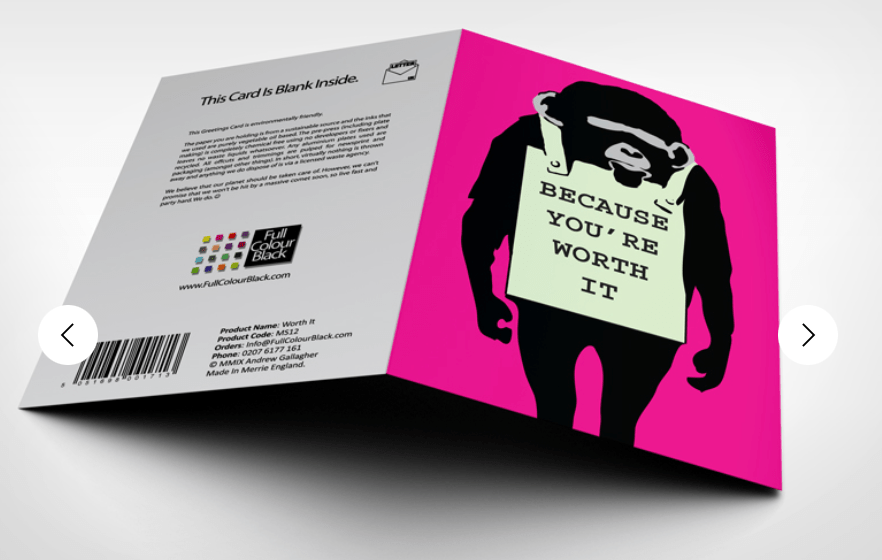
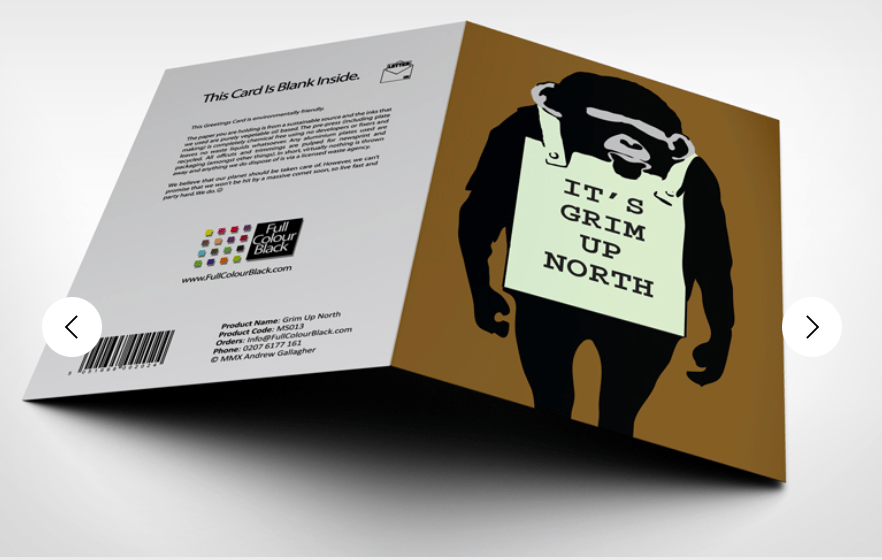
It’s an important twist in an ongoing legal battle between Team Banksy and Full Colour Black (FCB) – a licensing company specializing in popular images for international retailers.
As reported by The Sunday Times on 8 December 2023:
Banksy draws on century-old convention to remain anonymous
The street artist is being sued for defamation but is seeking to maintain his anonymity through a convention from 1886
This week the artist filed an application for anonymity with reference to the Berne Convention, and three other arguments: that his work will become less valuable, that he will no longer be free to criticise others — especially those in power — and that his family will come under increased scrutiny.
A judge has ruled that Banksy can remain anonymous in defamation proceedings after the controversial street artist relied on a 19th-century treaty to remain masked. In the latest development of a £1.4 million claim brought by a greeting cards publisher over a social media post from Banksy, Mr Justice Nicklin gave a boost to the artist’s defence on Friday.
To maintain Banksy’s anonymity, the artist’s legal team had relied on a dusty treaty drafted more than 100 years ago in Switzerland to protect the copyright of artists. While Banksy’s lawyers relied on three other arguments to maintain his anonymity, it is his reference to the Berne Convention that his lawyers found most legally appealing.
Enrico Bonadio, a reader in intellectual property law, said that while the Berne Convention focused on copyright law, it could be interpreted as giving legal backing to anonymity for artists in a range of civil proceedings. However, he said the matter was a “grey area” in law that would need to be decided by the courts.
Andrew Gallagher and his company Full Colour Black (FCB) have filed a lawsuit accusing “the artist known as Banksy” of defamation, with the co-defendant named as Pest Control Ltd, the company that sells his artwork. In written submissions, Gallagher’s lawyers have stated that he “reserves the right to seek an order that [Banksy] identifies himself for the purposes of these proceedings”. Gallagher has the option open to him to make an application to remove the artist’s anonymity. His company, Brandalised, licensed a photograph of Banksy’s work to the fashion retailer Guess last autumn for use in its Regent Street shop window.
In a now-deleted post made on November 18, Banksy’s Instagram account, which has 12 million followers, used an image of a Guess shop window with the words: “Alerting all shoplifters. Please go to GUESS on Regent Street. They’ve helped themselves to my art without asking. How can it be wrong to do the same to their clothes?
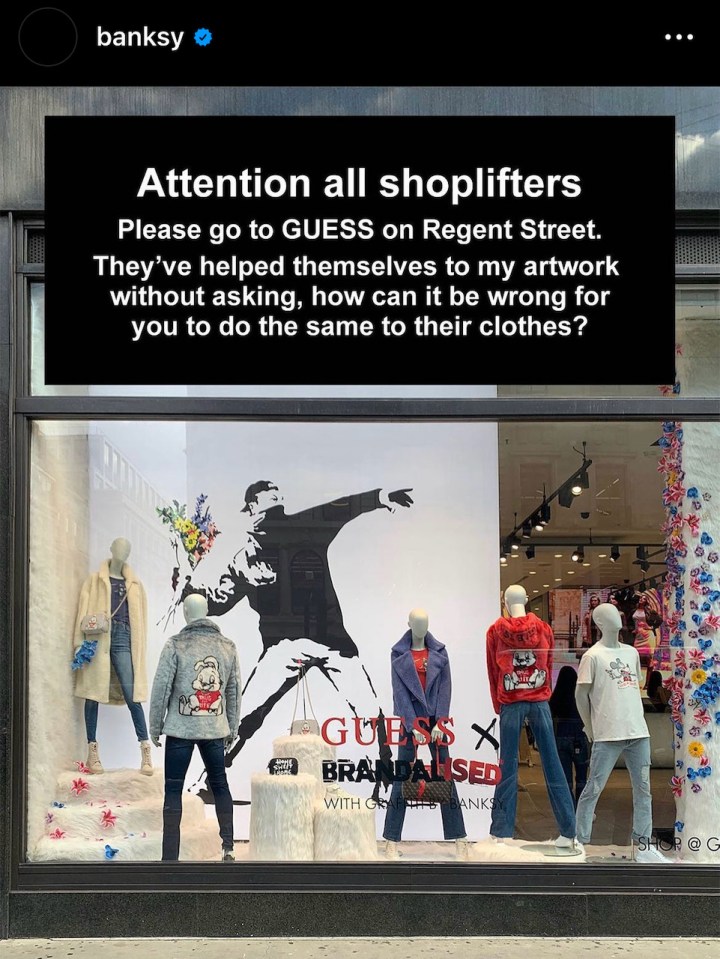
In its High Court claim, FCB, the trading company of Brandalised, alleged that it “contained defamatory words which referred to, and were understood to refer to, the claimant”. Now FCB is seeking damages and an injunction preventing further alleged defamation.
“[Banksy’s] post, by way of innuendo, meant and was understood to mean that the claimant had stolen Banksy’s artwork by licensing images to Guess without permission or other legal authority,” argues the company in its claim.”


 Banksy unofficial