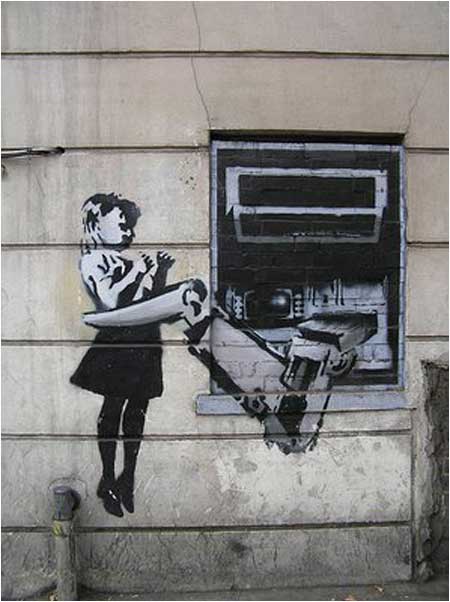
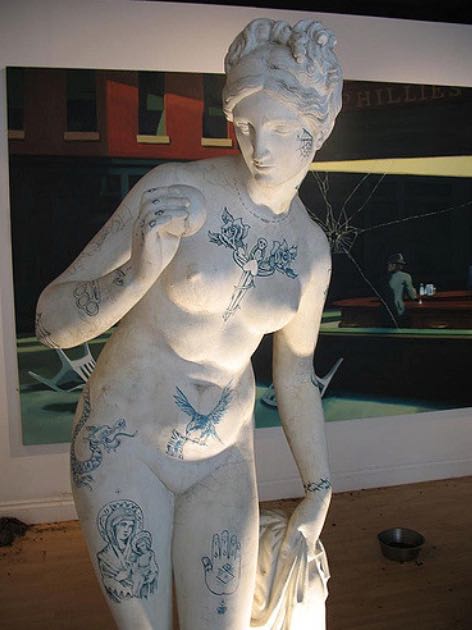
The Cans Festival. London, May 2008

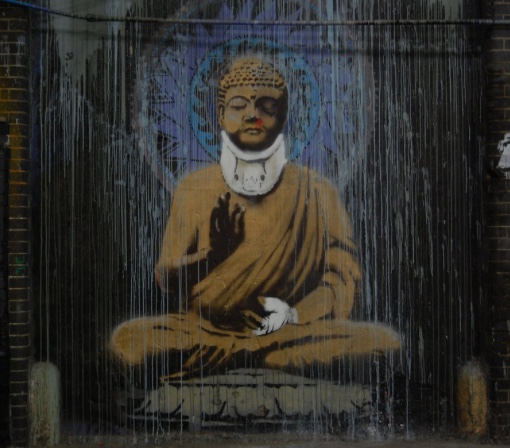
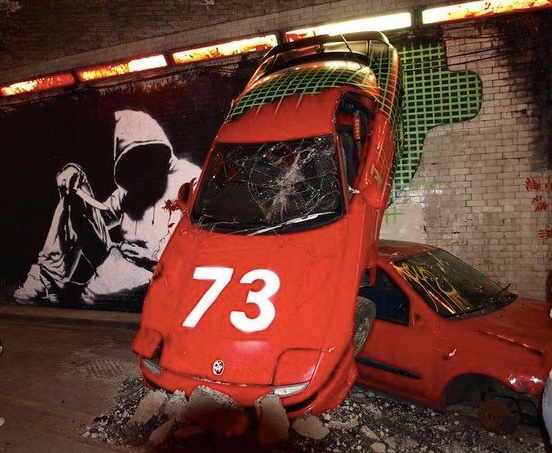
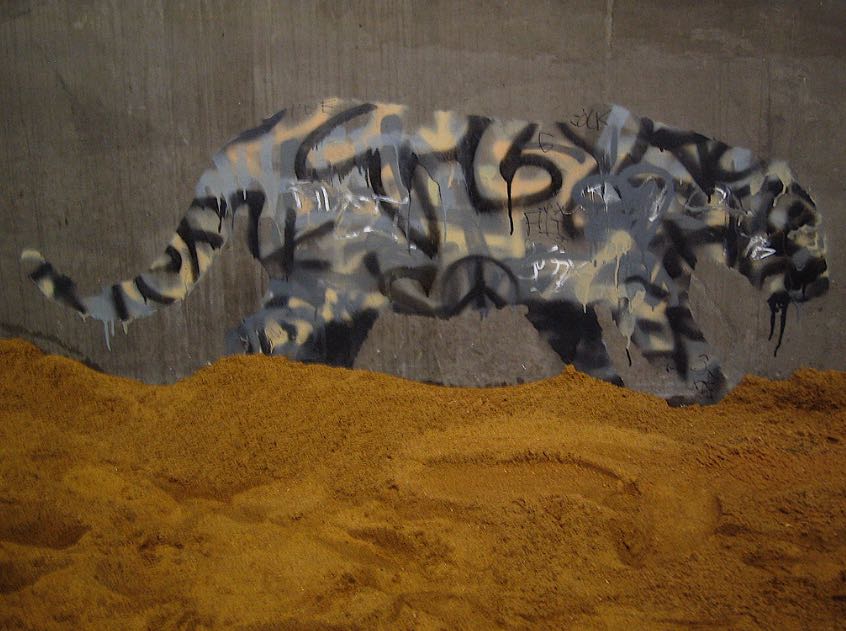
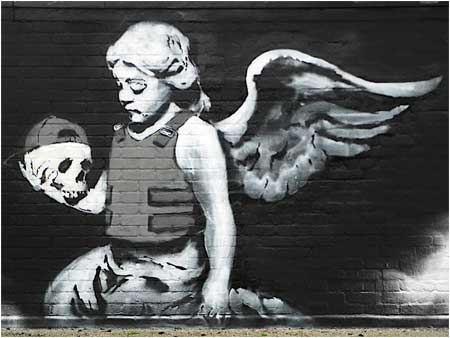
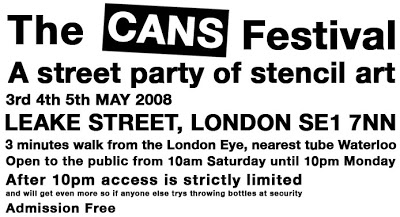
Banksy organised The Cans Festival London over the weekend of May 3–5, 2008. The event took place at Leake Street, a tunnel beneath London Waterloo station formerly used by Eurostar. Team Banksy invited approximately 40 street artists from around the world to participate in the exhibition.
Photos: Romany WG and others

Can Festival programme

A PDF of the official Cans Festival programme can be downloaded here: 

As reported by the Guardian on 6 May 2008:

Looking for radical art? Try the South Bank, not Banksy

Banksy’s Cans festival, bringing together 40 of the world’s best stencil artists, can’t compete with the 40-year-old posters in the Hayward Gallery

Dazzling but blunt … Banksy’s Cans festival. Piss Alley, we call it. The Times this weekend dubbed it “London’s hottest venue“. For most, Leake Street has always been Leake Street by name, Leake Street by nature. For Banksy, though, this tunnel road was just the kind of “filth pit” he’d been looking for. Remembering to ask permission from owners Eurostar, he gathered together the world’s best stencil artists to spray paint the tunnel in time for the bank holiday, and lo, the Cans festival was born.

That was one exhibition of street art you could have seen over the weekend. The other was May 68: Street Posters from the Paris Rebellion at the Hayward Gallery’s Project Space.

Despite the poised irreverence and iconoclasm of the Cans festival, it was the posters in the Hayward that – despite all the failed hopes of the ’68 generation, despite the simplicity and even naivety of the images – still grip, still provoke. Truth be told, radical art today is anything but: it may look sharp, but its edge is blunt.

“Gentrify this” was the up-yours slogan greeting the crowds at Banksy’s festival. But gentrification is exactly what these artists had achieved. The closest you came to barricades at this event were the security barriers channelling punters inside. The score was laid down on the festival’s website: after detailing the opening hours (for Piss Alley! – I never thought I’d live to see the day), it sternly warns “After 10pm access is strictly limited … and will get even more so if anyone else tries throwing bottles at security”.

And just in case anyone thinks about making a spontaneous contribution, the website makes clear that artists coming to stencil need to report to reception and be shown where to paint, with a disclaimer explaining that “painting outside the designated area may well result in prosecution”.

But there we have it. For all the brilliance of the stencil artists, the messy, apocalyptic feel of the thing was so in tune with our general sense of the world going to hell in a handcart that it confirmed the status quo rather than challenged it. This was iconoclasm with an unremitting ironic twist. Don’t like religion? Here’s the Pope morphed with Marilyn Monroe in the Seven Year Itch. Wanna take a pop at film icons? Here’s a cat scratching Audrey Hepburn’s eyes out. Apart from some notable exceptions – such as the central tree sculpture sprouting surveillance cameras – it was the backwards-looking creed that was striking.

Whether looking for icons to smash or to praise, it was the past that informed. In the brochure the political icon held aloft is Stuart Christie, the Scottish anarchist who was a member of the Angry Brigade in the 1970s. William Blake is misrepresented as an outsider hounded by the establishment who labelled him mad and buried him in a heretics’ graveyard (Blake was buried by choice in the dissenters’ graveyard at Bunhill Fields, with the standard Church of England service). Truth is, the Cans festival’s rebels without a cause cannot bear to look into the future. They don’t trust it and have more in common with the self-named ancients who gathered around Blake in his later years, bemoaning the modern industrial world and conservatively clutching at a “golden age”.

How different from the Paris posters of ’68 which brim with the possibilities of tomorrow. Whatever the disappointments of the uprisings, these images convey powerful and provocative messages. The outline of a cross drilling into the profile of a head communicates the perceived problem with religion. Irony – that constant bugbear of art today – works very differently here. It is a device to drive the message home, most often in the juxtaposition of text and image. A poster bearing the words “Retour à normale …” has row upon row of identical sheep heading back to the pen. A young face swathed in bandages and secured with a safety pin through the mouth is captioned “Une jeunesse que l’avenir inquiète trop souvent …” (“Youth worries too often about the future”). The future was what young people would make if they would be heard. Today, our radical young artists are jeunesse-ancients, world-weary before their time. To paraphrase Blake, the Cans festival was of the devil’s party without knowing it.

Source: https://www.theguardian.com/artanddesign/artblog/2008/may/06/lookingforradicalarttryth

Street Art in the UK. 2007

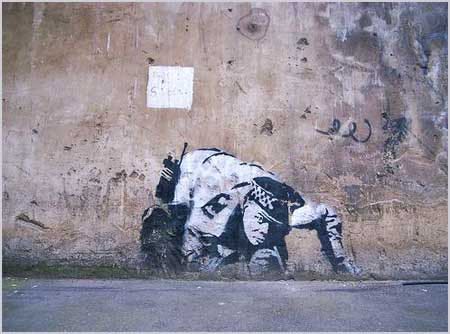
One can perceive several changes in Banksy’s street art from 2007 onwards: Fewer, but more elaborate. Banksy went to Bristol in October to paint a police sniper and a boy with a paper bag waiting to burst into his ears.

BANKSY AT GLASTONBURY. JUNE 2007

Banksy revisited the Glastonbury festival, where he erected “Boghenge”, a version of Stonehenge. He also stencilled “cop frisking a little girl”.

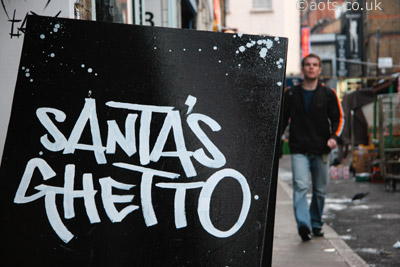
Santa’s Ghetto 2006. December 2006

The 2006 edition of Santa’s Ghetto took place in Oxford Street, near Tottenham Court Road. It had works of David Shrigley, Jamie Hewlett, Ericailcane, and a host of other up-and-coming artists in the urban/street art universe.

Also present were some interesting works by Kennard Phillips—the collaboration between Cat Phillips and Peter Kennard. One of Banksy’s most important influences is undoubtedly Peter Kennard.

Hansel & Gretel

Banksy didn’t contribute as many works as previous editions of Santa’s Ghetto. But he had one interesting oil painting — ‘Hansel & Gretel’ with Michael Jackson. The motif is copied from a painting by Tom Ormond (b. 1974) called ‘From Beyond the Stars’ from 2005. But, is it a “vandalised oil”, or is Banksy’s Hansel & Gretel painted from scratch?

From Beyond the Stars. Tom Ormond, 2005. And to the right: Hansel & Gretel. Banksy, 2006

Participants. Santa’s Ghetto 2006

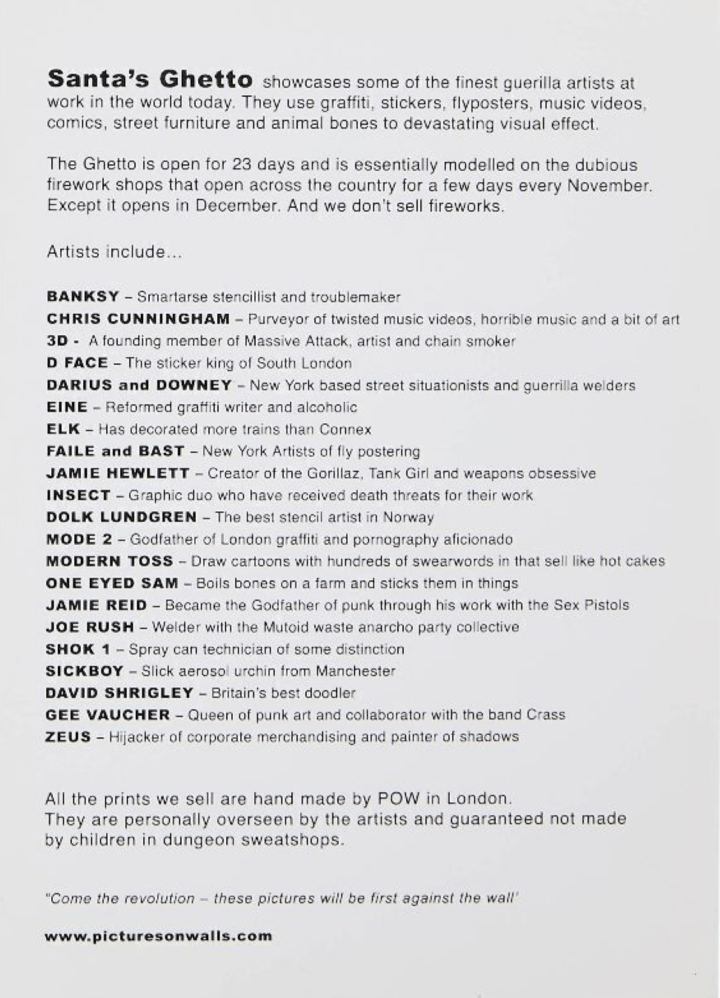
List of participants. Santa’s Ghetto 2006.

As reported by Sean O’Hagan in The Guardian:

Art brats put the cool in Yule

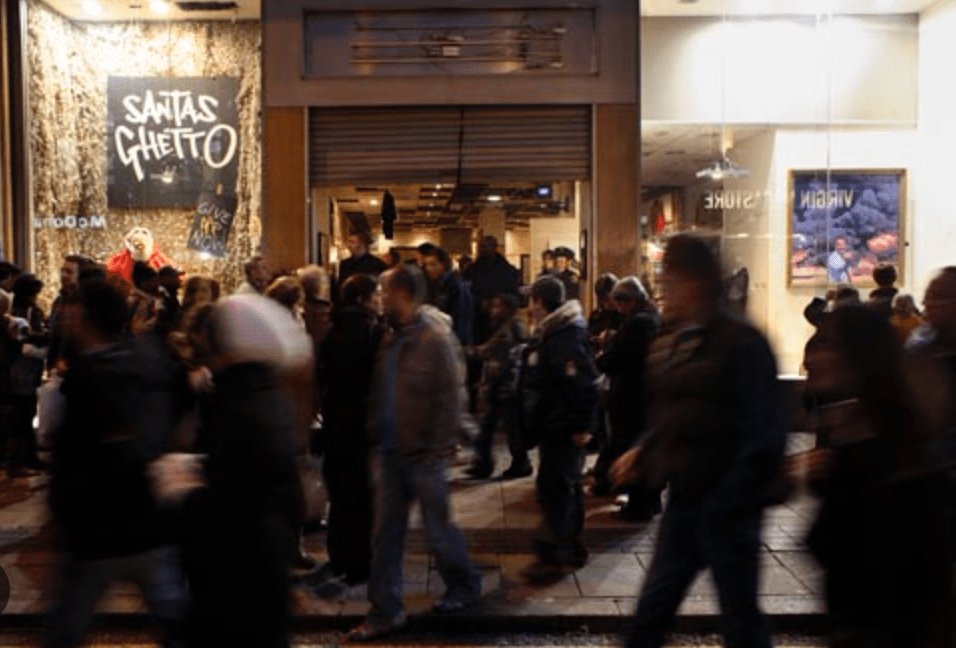
A squatted shop on Oxford Street selling works by Banksy? So long Christmas tat

Only 14 shopping days to Christmas and, unlike many major department stores on London’s Oxford Street, ‘Santa’s Ghetto’ is doing a roaring trade. The Banksys sold out in the first hour of opening, the Hewletts followed suit, and there were unseemly scraps over the Shrigleys. The word on the street is that sales in the first week hit £300,000. Not bad for a squatted shop only advertised via a website and word of mouth.

Now 10 days into its three-week run, ‘Santa’s Ghetto’ is the brainchild of Banksy, the suddenly ubiquitous but still invisible graffiti artist, whose work also graces the more august Serpentine Gallery across town, part of the Damien Hirst ‘Murderme’ collection. Part art gallery, part print shop, part good old-fashioned happening, ‘Santa’s Ghetto’ has been a fixture in the capital for the past five years but this is its first pitch in the West End. It is organised by a collective called Pictures On Walls, who describe themselves as ‘more like a record company than a print house’.

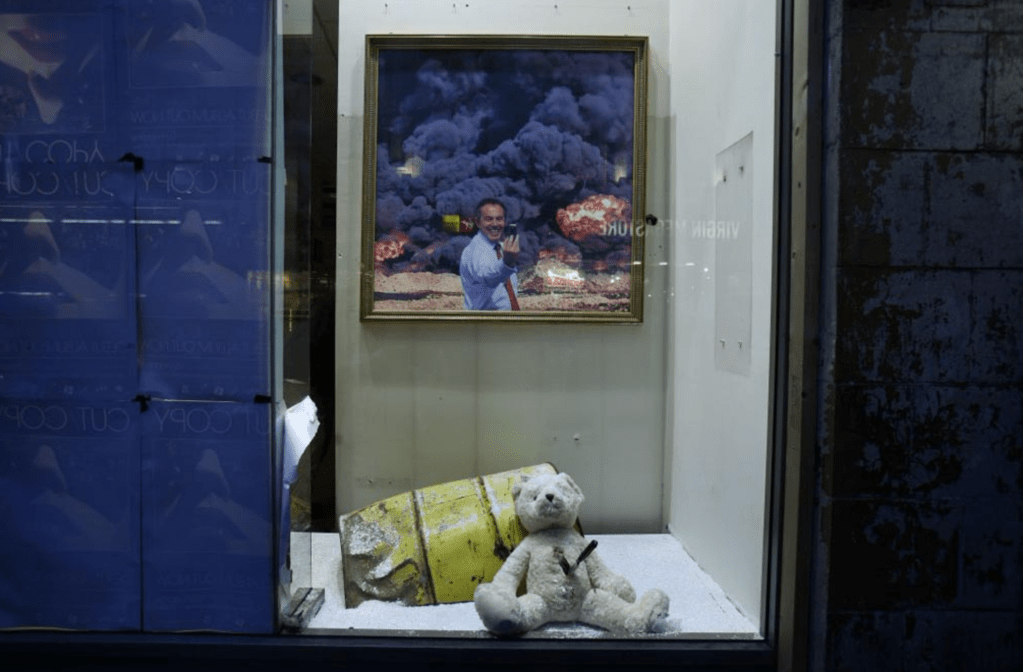
This is unlike any other seasonal shopping expedition. There are two burly, besuited bouncers on the door, and the main window display features a huge photographic print of a grinning Tony Blair snapping himself on his mobile against a backdrop of a firestorm in Iraq. An inebriated lifesize Santa with bug eyes also jerks like a man in the throes of almighty comedown. Inside, there’s a Mona Lisa flashing her arse, her enigmatic smile now revealed as a bawdy come-hither look.

The art is determinedly ‘street’, edgy in tone, and brutalist in form. The buzz is palpable, and, having just come from the almost empty, energy-sapping space that houses this year’s Turner Prize non-event, I found it oddly uplifting. In among the crowds of mostly young and trendy visitors there are some life-size sculptures resembling many of the punters – hoodies, baggy jeans, sneakers. One such figure seems to be peering though the wall into Waterstone’s next door; another could be a homeless beggar but, beneath the hood, there is no face, just a dark cavernous hole.

Amid the posters, prints and original artworks on the walls there are some arresting images, particularly Ben Turnbull’s ominous sculpture of a gun in a glass case embossed with the words ‘Break In Case of Emergency’. We’re talking visual overload here, though, and a lot of the graphic work needs more room to breathe. The most arresting piece in this wilfully overcrowded space is Emma Heron’s vending machine, which sells artifical limbs. A black boy on crutches, one leg blown off at the knee, peers longingly inside. Amid all the irony and the mischief, it is the only piece that stops people in their tracks.

It’s brilliant art because it makes you think,’ says Si, aged 18, who has journeyed into the West End from Tottenham with his mates. None of them has ever set foot in an art gallery before, save for a school outing to Tate Modern, whichleft Si unimpressed. ‘Some of it was all right, but a lot of it was boring,’ he says. ‘This is more the sort of stuff I’d buy if I won the lottery.’ He stands briefly in front of Banksy’s latest allegorical piece: two tiny Hansel and Gretel figures lingering uncertainly by the threshold of the Wicked Witch’s house, tempted by a stick of candy. ‘It’s Michael Jackson,’ he whoops. ‘Oh man, that’s naughty.’

That’s exactly the word for most of the work in ‘Santa’s Ghetto’: ‘naughty’, as in mischievous, gleefully shocking, and unhindered by the heavy baggage of conceptual art – though Hirst obviously sees Banksy as a fellow traveller on the road to world domination.

As art events go, ‘Santa’s Ghetto’ is an uneasy mix of provocation, old-fashioned radicalism and trendier-than-thou, Hoxton-style posturing. The organisers have what they call on their website ‘a unique artist development programme’ that includes ‘returning sketches with “what the fuck is this?” scrawled over the top’. Cork Street it isn’t. They are currently trying to trace the interventionists who spraypainted the front windows of the shop with anti-globalisation graffiti in the early hours of last Sunday morning – just to credit their work on the website, you understand. Try as I might, I can’t see Charles Saatchi or Jay Jopling running with that one just yet, but Malcolm McLaren would certainly be proud of them.

· ‘Santa’s Ghetto’, Oxford Street (next to Tottenham Court Road Station), until 23 December; picturesonwalls.com

Street Art UK. 2006

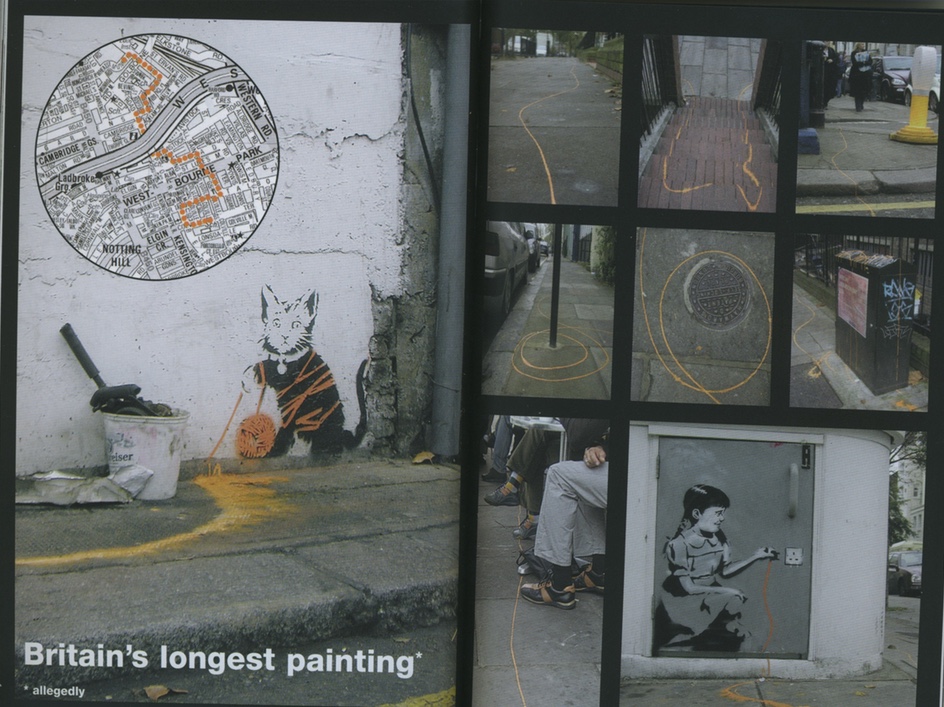
In June 2006, Banksy went back to Bristol to paint the iconic Well Hung Man on Frogmore Street. Other notable work includes the vandalised telephone booth and 18 Minutes, the maid sweeping the dust under the carpet.

Santa’s Ghetto 05. London, December 2005

Team Banksy organised the 2005 edition of The Santa’s Ghetto at Berwick Street in Soho. The show featured, among others, Eine, 3D, Solo One, David Shrigley, Jamie Hewlett, Sickboy, Space Invader, Mode 2, Paul Insect, Dface, Polly Morgan, and Banksy.

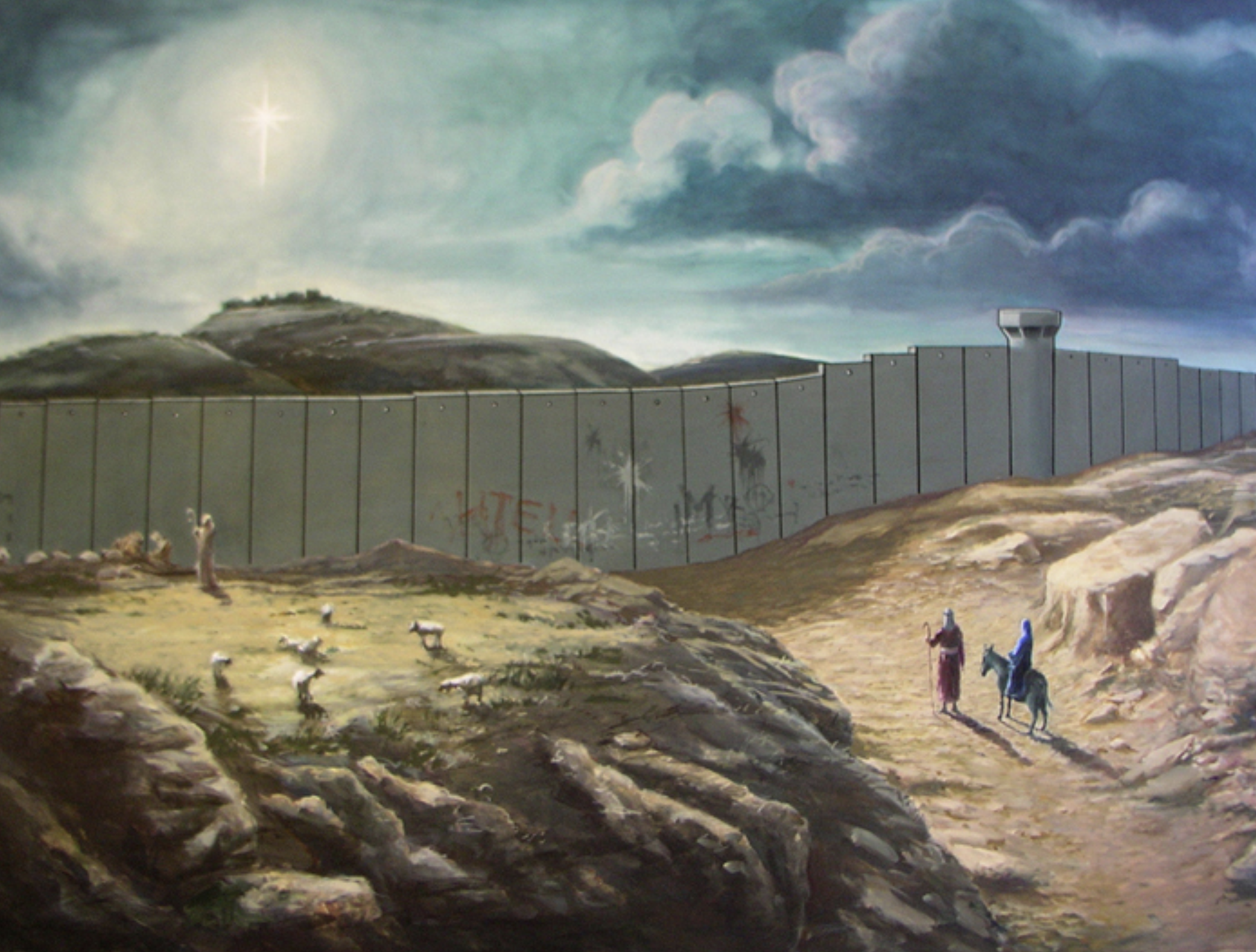
The show had an impressive oil painting of the Segregation Wall in Palestine. Most likely influenced by the journey to Palestine a few months earlier and the big murals on the wall.

Photos: Prescripion Art. http://www.artofthestate.co.uk and others

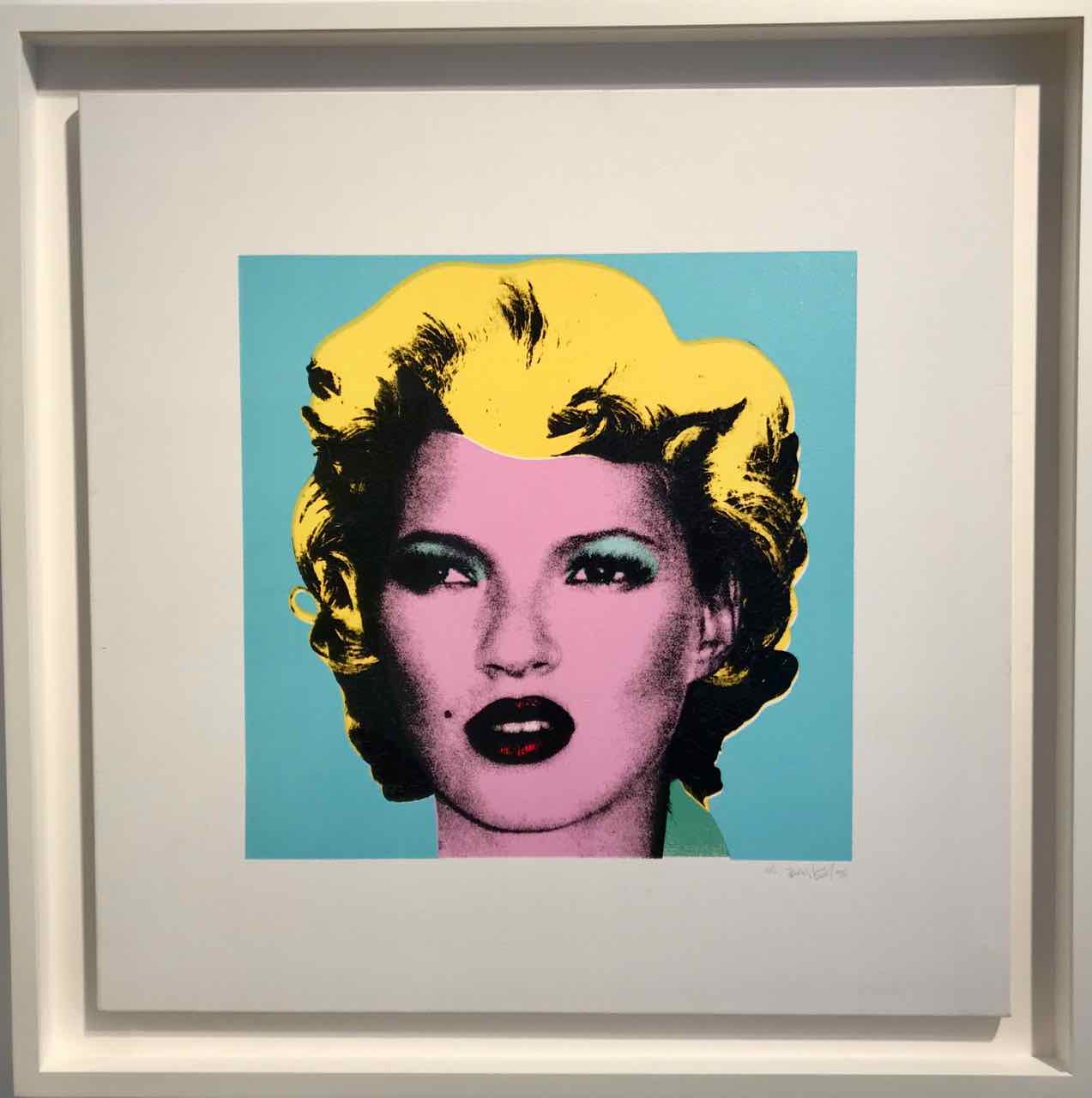
The Kate Moss print saw the light

Santa’s Ghetto 05 also had several colourways of the Kate Moss screenprint for sale:

Collaboration with Simon Munnery

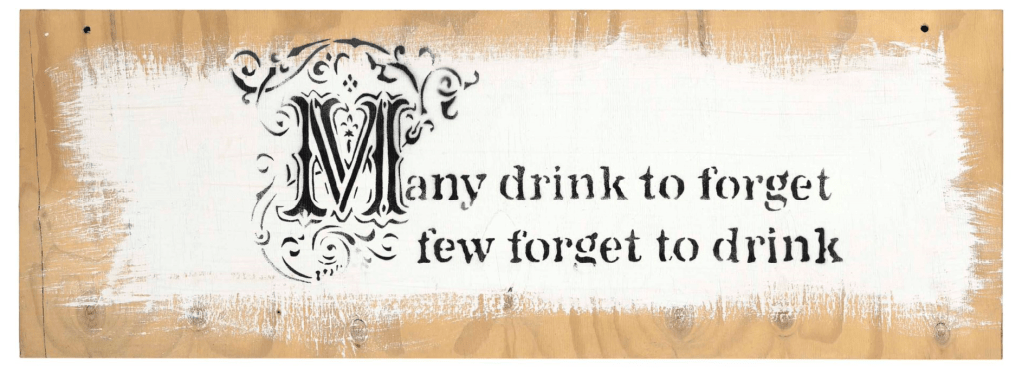
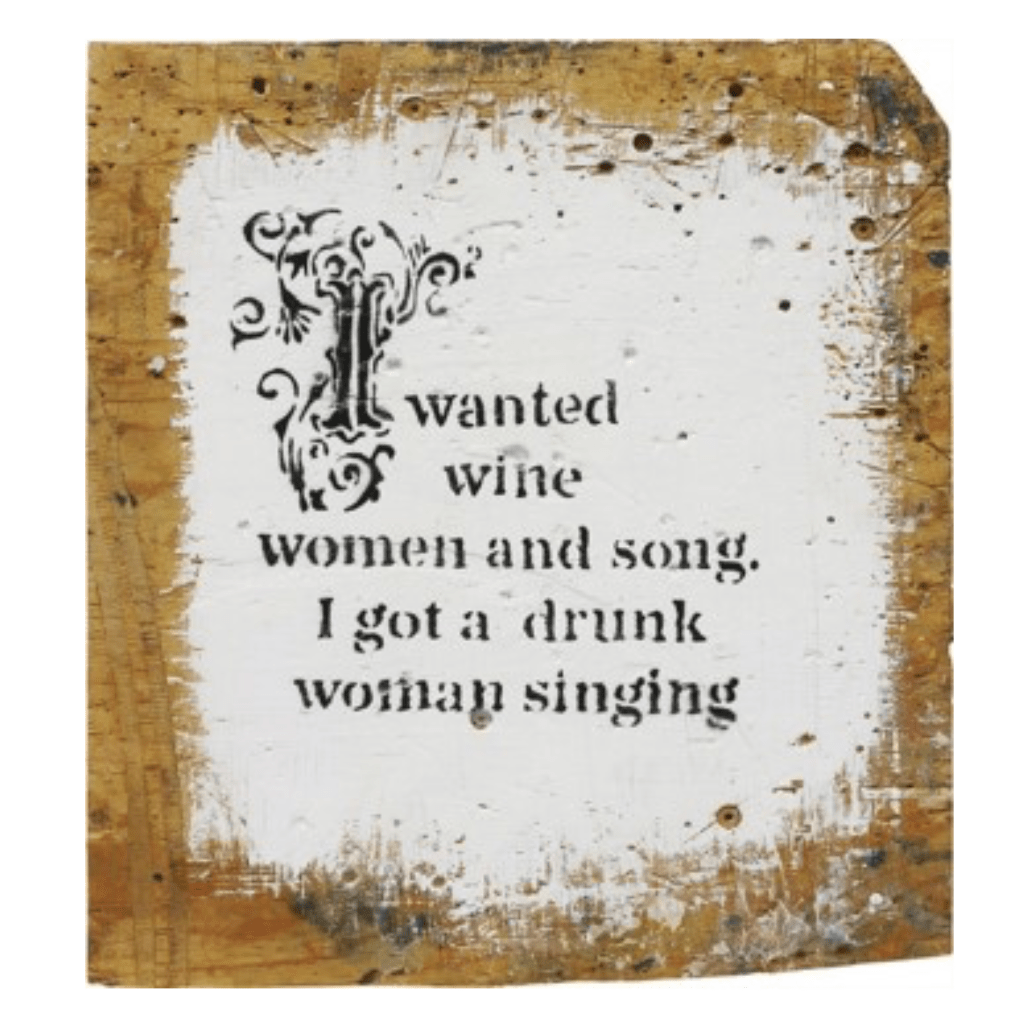
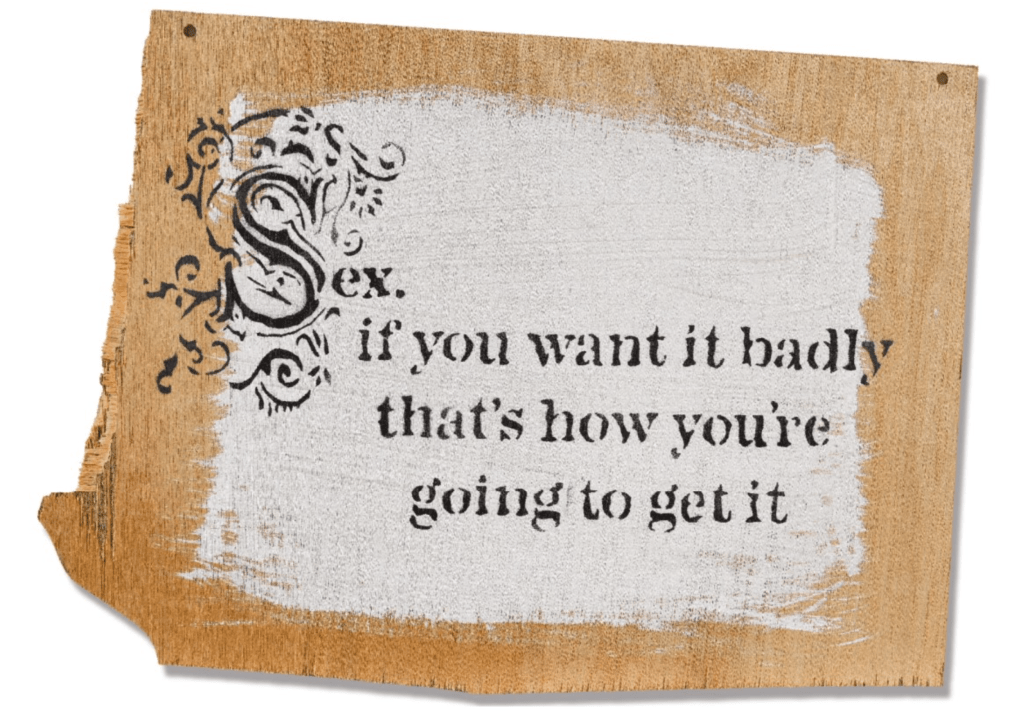
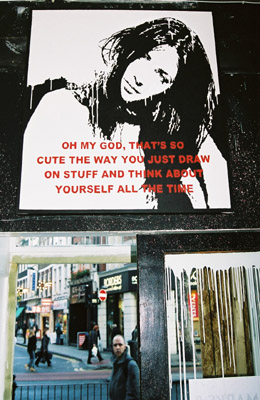
The collaboration with comedian Simon Munnery resulted in a number of poems stencilled on plywood.

Short poems by Simon Munnery & Banksy:

Photos: Phillips, Sotheby’s and Bonhams

Participants, Santa’s Ghetto 2005:

Source: http://www.picturesonwalls.com

Street Art UK. 2005

Apart from the works in Palestine in August 2005, Banksy concentrated on London this year. An interesting development in this period is the street installations in the London urban landscape.

Crude Oils. London, 22 – 24 October 2005

Crude Oils opened on 22 October 2005 at 100 Westbourne Grove in London and was Banksy’s third major exhibition after Severnshed and Turf War in 2003. It featured 20 + versions of classical oil paintings by Van Gogh, Hopper, Warhol, Turner, and Monet. Also present were 200 live rats and some interesting sculptures.

Channel 4 did a feature on the exhibition:

Santa’s Ghetto 04. London, December 2004

The 2004 Santa’s Ghetto was located in a run-down former porn shop on 121 Charing Cross Road, next to Foyles bookshop in Central London. The pop-up art exhibition opened daily from 10am to 8pm until Christmas Eve.

It contained intriguing new works from all of the artists on Pictures of Walls. Banksy participated with a few modified oils and the first version of Napalm. The counterfeit ten-pound notes featuring Lady Di, also referred to as the Di-Faced tenners, saw the light.

The last of the small black books, Cut It Out, was launched at the exhibition.

Photos: http://www.artofthestate.co.uk, Andipa catalogue

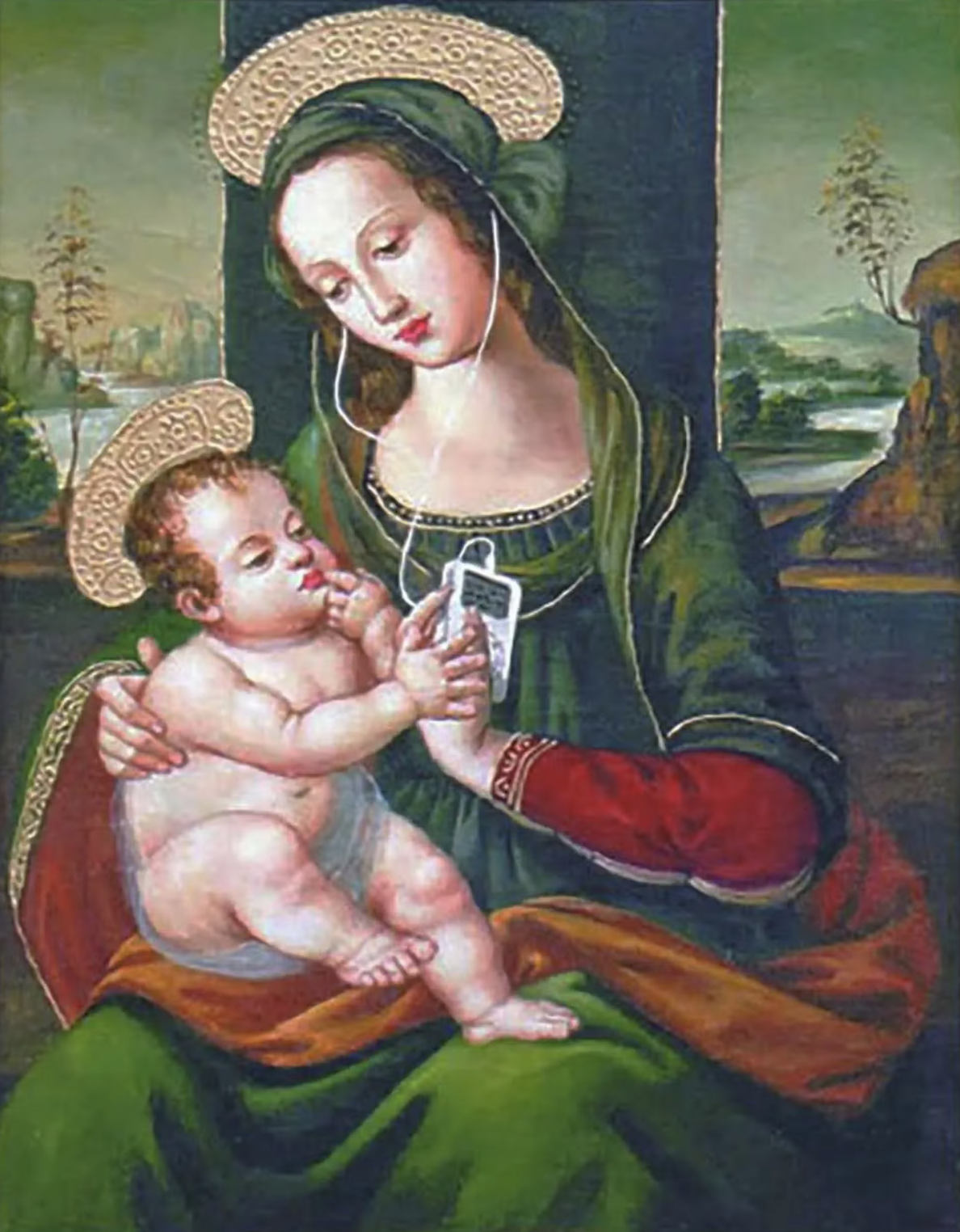
Of particular interest were the modified oil paintings, some of which reappeared the following year at the Crude Oils exhibition. Here, three examples in clockwise order: Silent Night, Congestion Charging, and Countryside CCTV.

Photos: Bonhams and Christies

List of participants – Santa’s Ghetto 04:

THE THIRD BOOK “CUT IT OUT”. DECEMBER 2004

Cut it Out was launched during Santa’s Ghetto 2004 and was the last of the three little black books. It has some interesting street art, loads of rats, and a few lovely canvases. Among them is “Suicide bombers just need a hug” from the Turf War exhibition.