Banksy published two new pieces on Instagram today together with the following announcement:
“Opened a gift shop today – situated at the back of the Walled Off Hotel. Not to be confused with the “Banksy shop” next door – which has nothing to do with me at all. Hand painted mini souvenir separation walls now available. http://www.walledoffhotel.com”
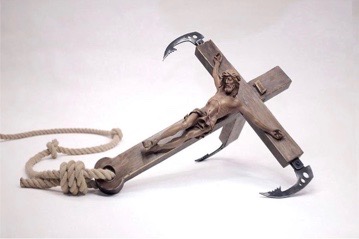
The description of the piece to the right goes like this: “Military grade grappling hook and combination spiritual ornament. All proceeds stay in the local community.”
Donald Trump’s visit to Bethlehem was announced on Banksy’s Instagram account on 24 May 2017. The picture of the presidential suite and the video clip of the Trump motorcade were removed a week later.
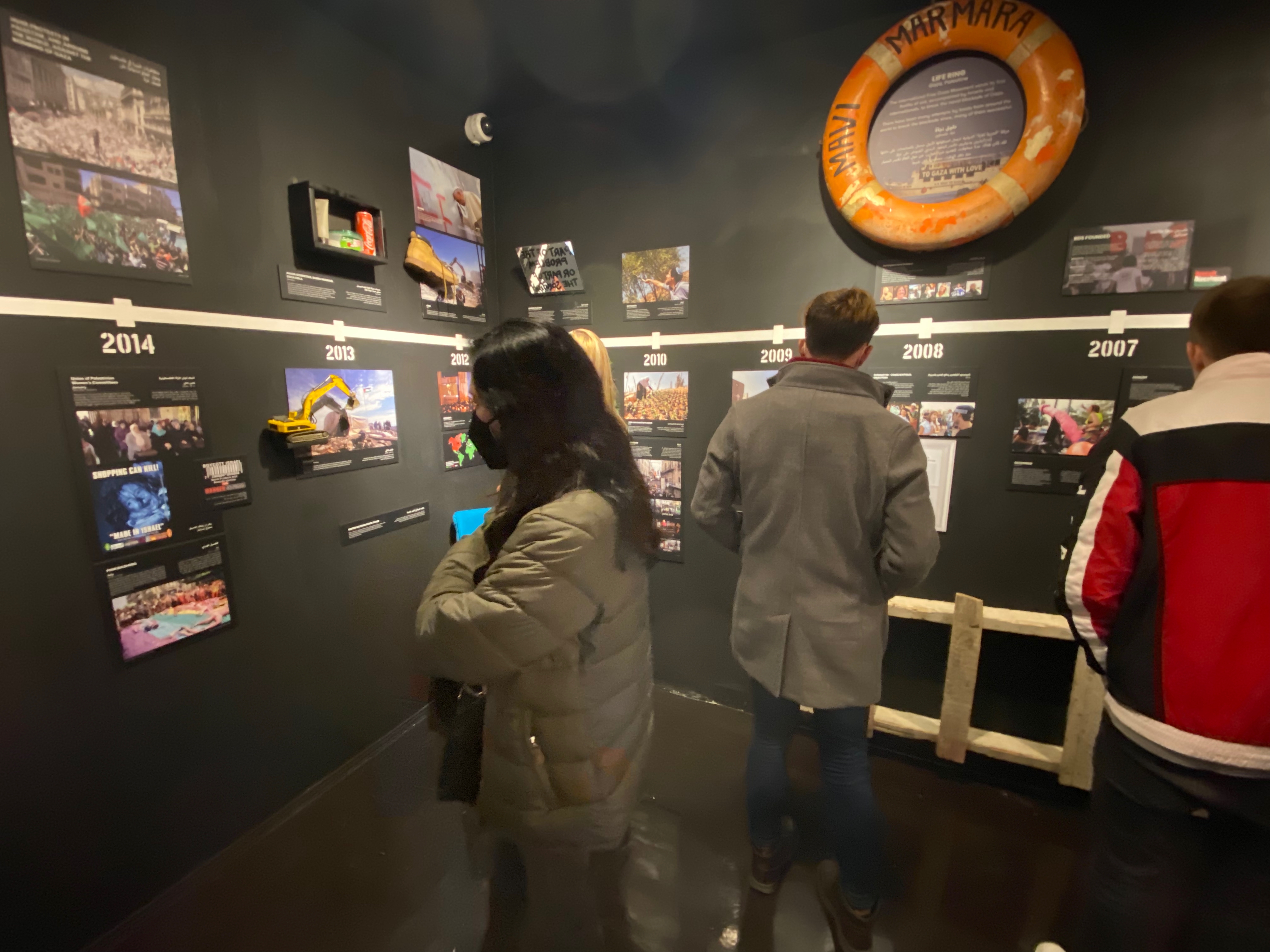
The Walled Off Hotel is the latest big exhibition by Banksy. The unique boutique hotel is a piece of art in itself and effectively mixes art, politics, and tourism. On the ground floor are approximately 15 new Banksy studio pieces and a museum commemorating “a hundred years since the British took control of Palestine and helped kick start a Century of confusion and conflict”.
The hotel is located just a few meters from the Israeli West Bank Barrier, the controversial segregation wall that divides Bethlehem from Jerusalem. Downtown Jerusalem is only 7 km away.
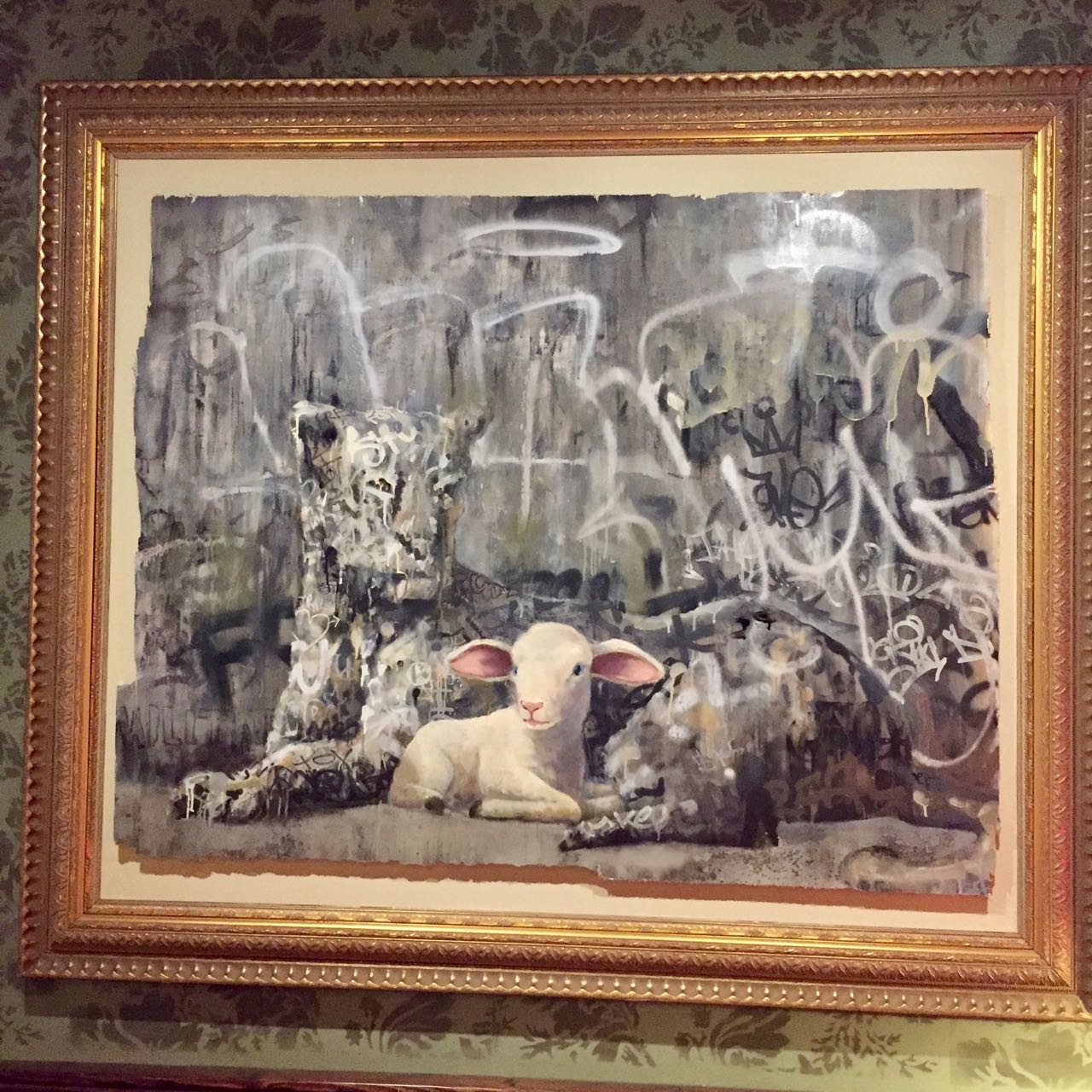
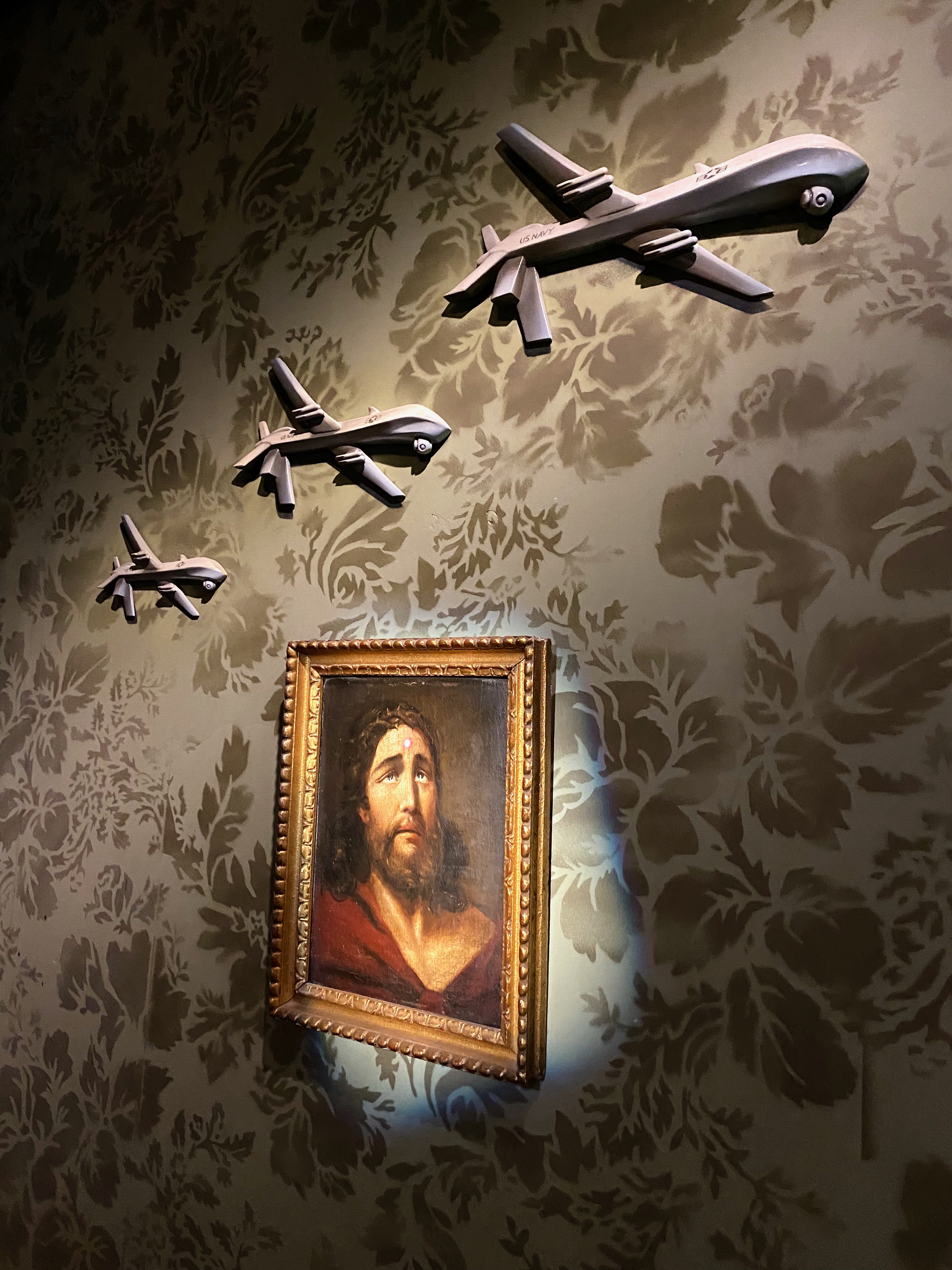
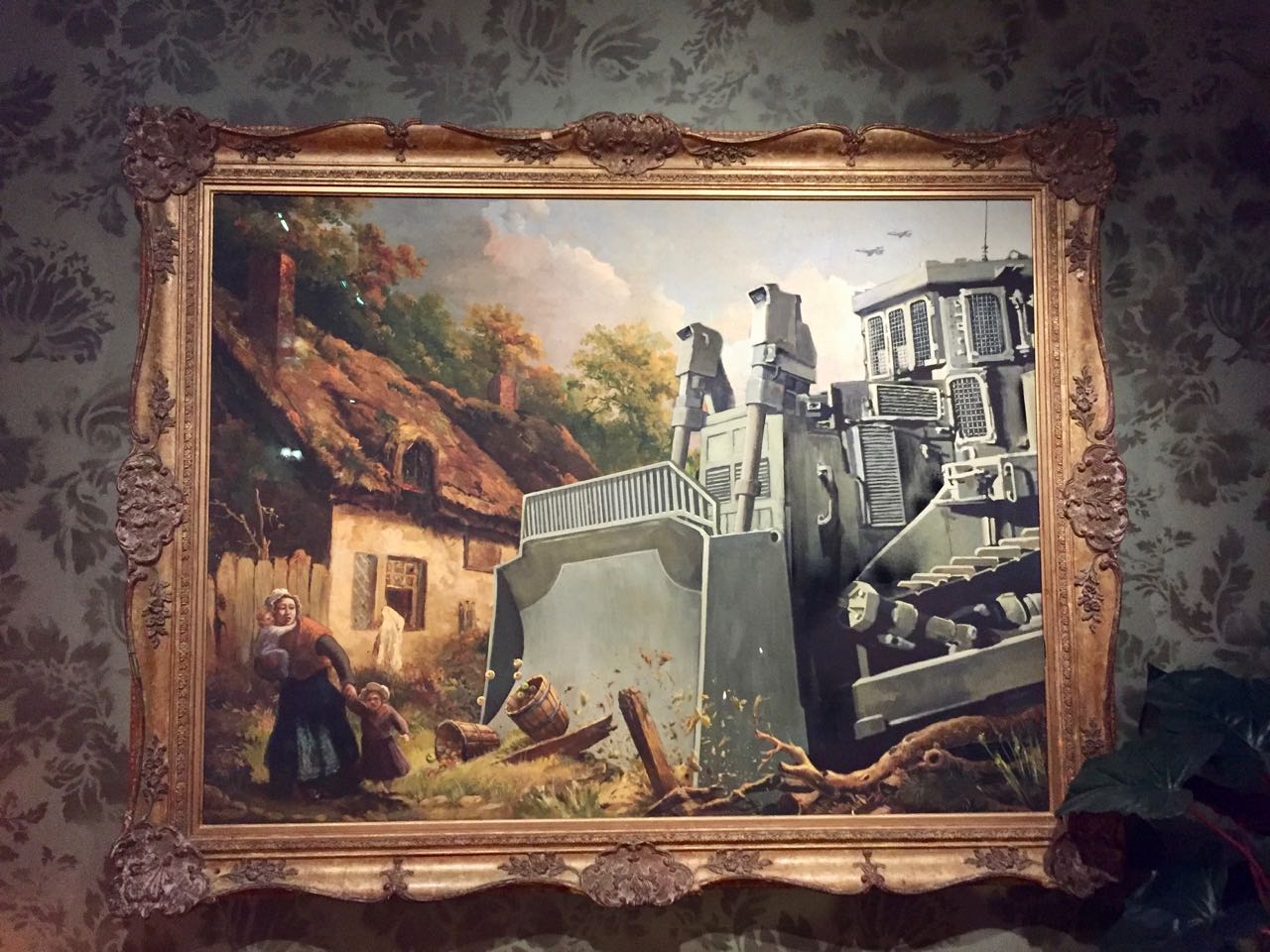
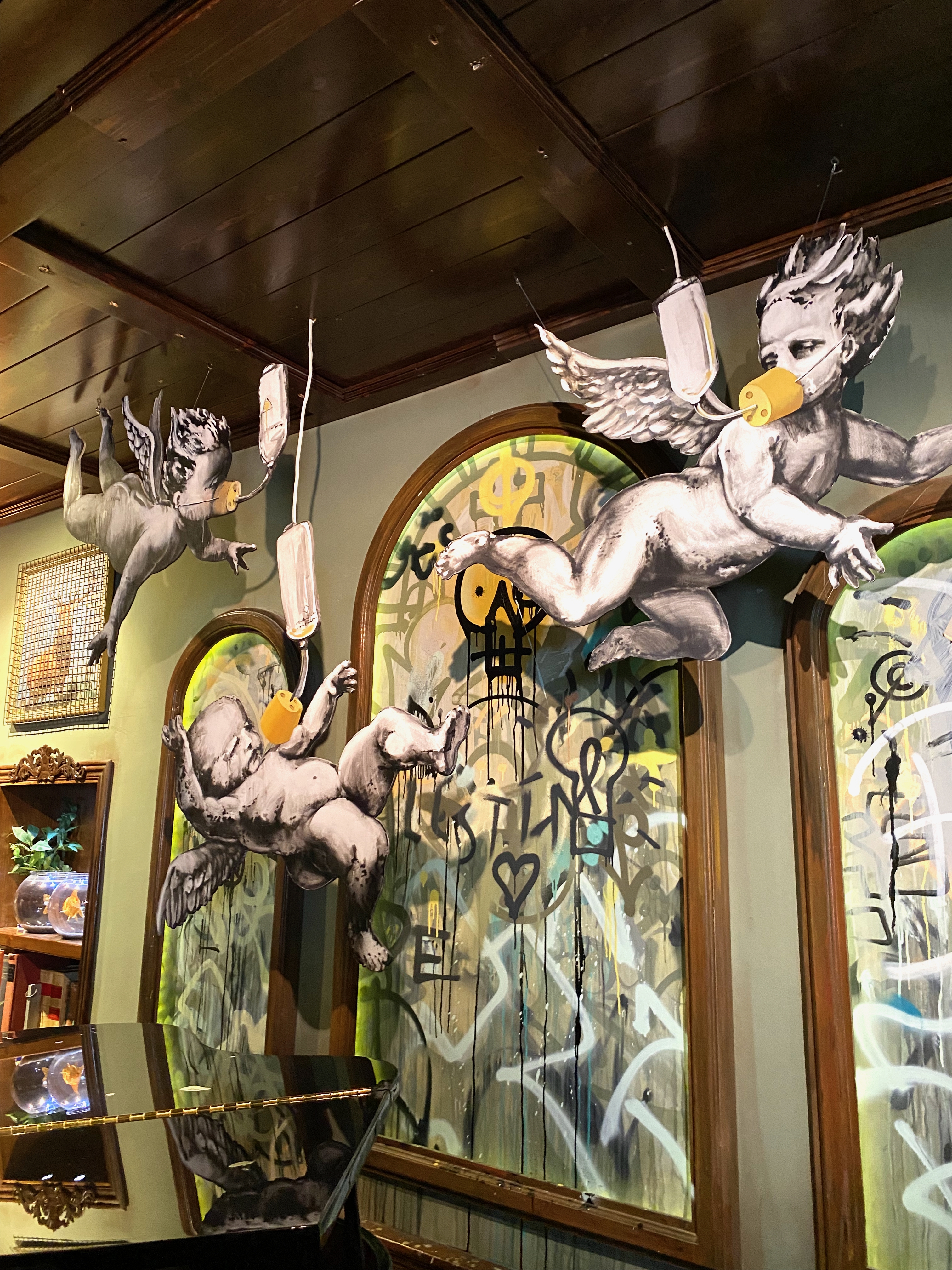
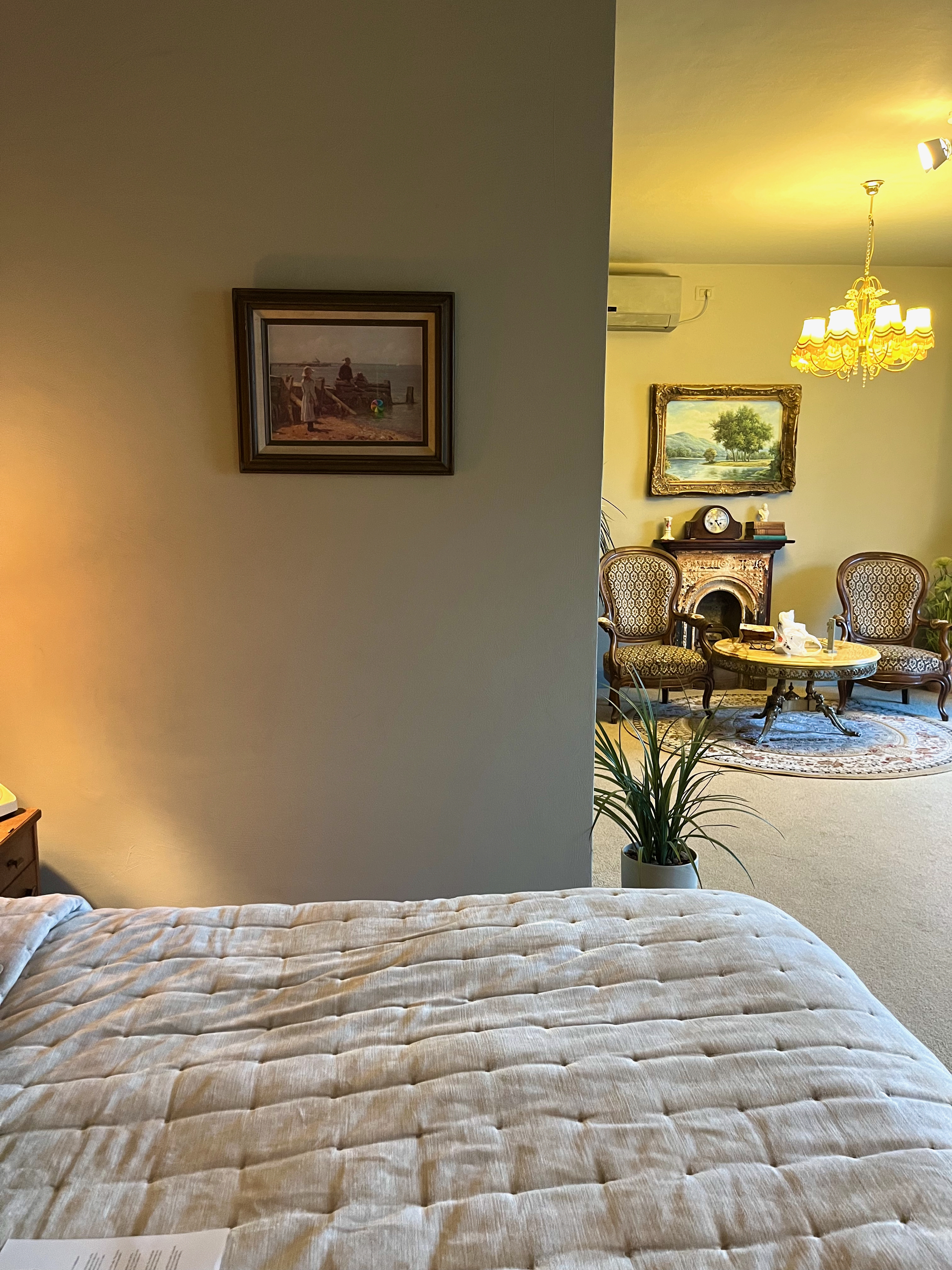
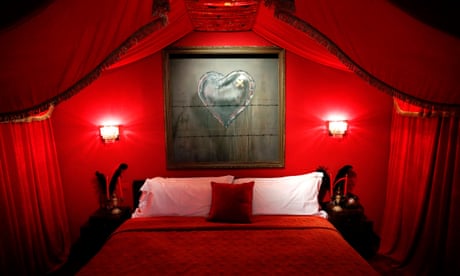
The hotel has ten rooms, including a presidential suite with a bullet-riddled water tank feeding a hot tub, budget bunk-bed rooms sourced from old military barracks, and custom-designed spaces by Banksy and other artists like Sami Musa and Dominique Petrin. The decorative style is colonial, nodding to Britain’s historical role in the region, particularly the 1917 Balfour Declaration, which marked the beginning of British control over Palestine. Everywhere in the hotel, you will find Banksy’s provocative artwork—such as an Israeli soldier and a Palestinian protester engaged in a pillow fight, cherubs wearing gas masks or Jesus Christ being bombed by drones. .
Initially intended as a temporary project to mark the centenary of British involvement in Palestine, the hotel has since become a lasting fixture, attracting nearly 140,000 visitors by 2020. The hotel welcomes visitors from all sides, including Israelis. As of late 2023, it is temporarily closed due to the situation between Gaza and Israel, but its website and booking platforms suggest it may reopen depending on the situation.
It’s easy to get to the hotel. If you arrive at the Tel Aviv airport, take the fast train that goes directly to the new Jerusalem Central Station. From there you can take a bus down Hebron Road to Checkpoint 300. The hotel is only 600 metres from the checkpoint. The exact address is 182 Caritas Street, Bethlehem, Palestine.
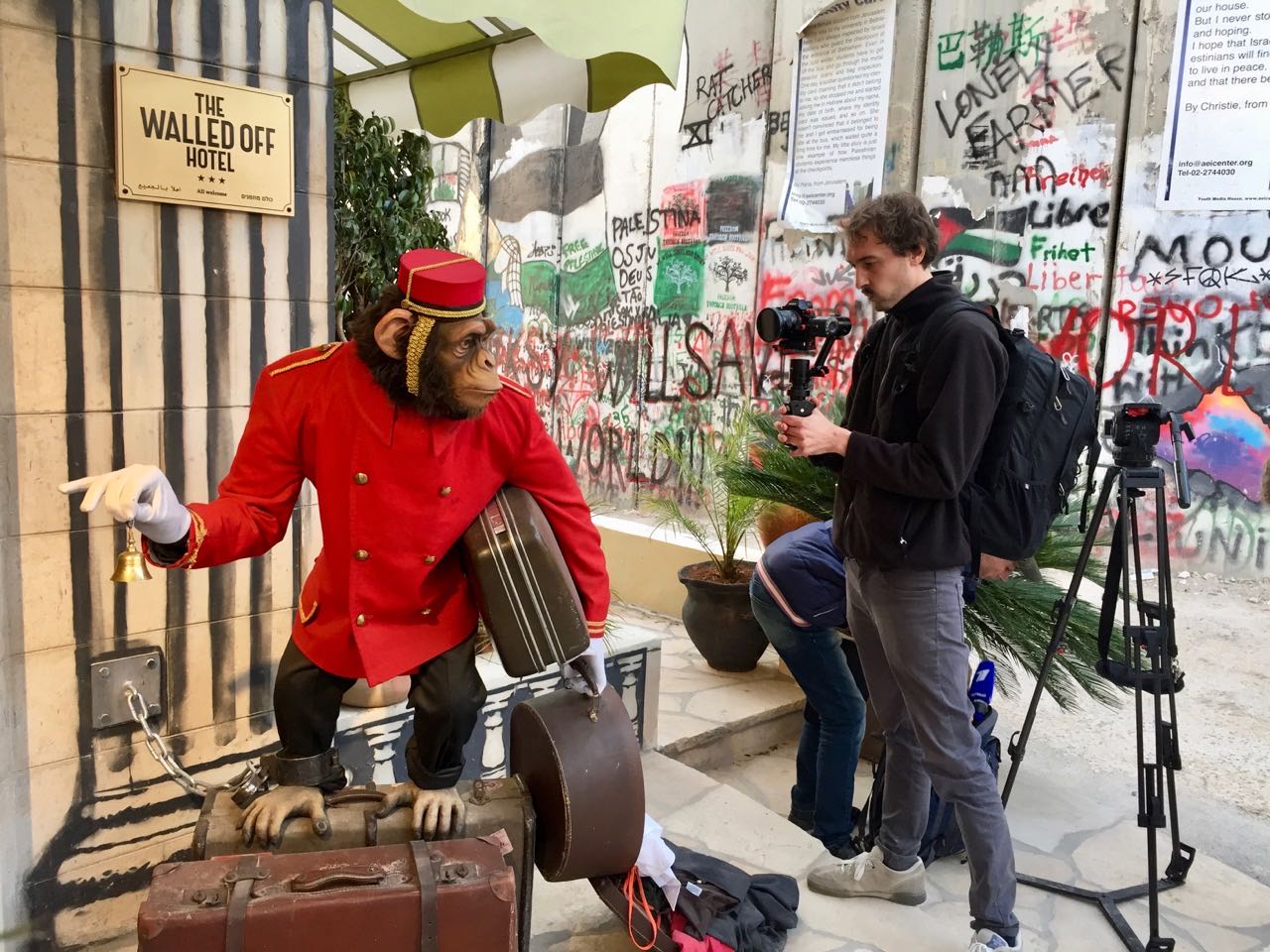
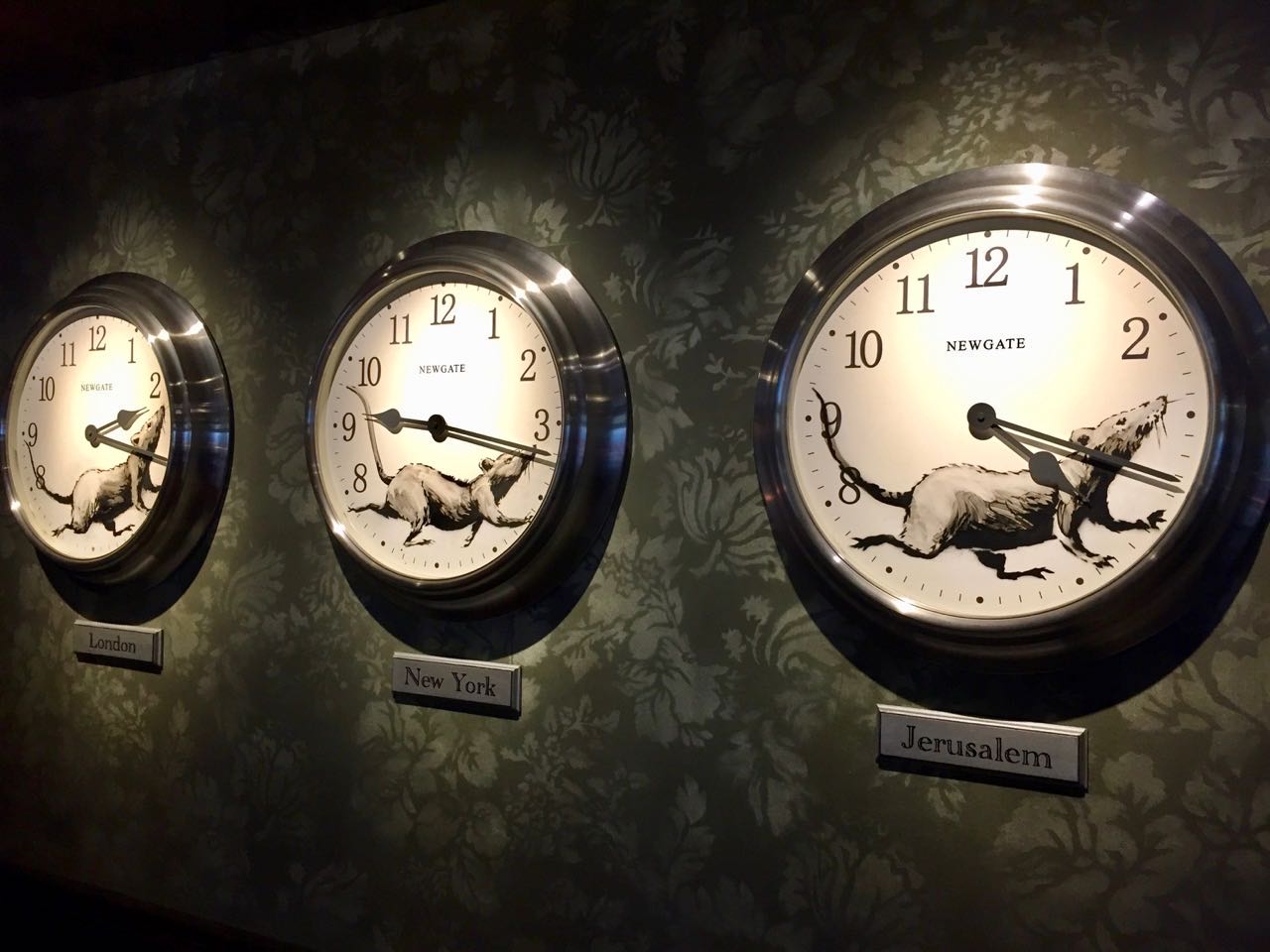
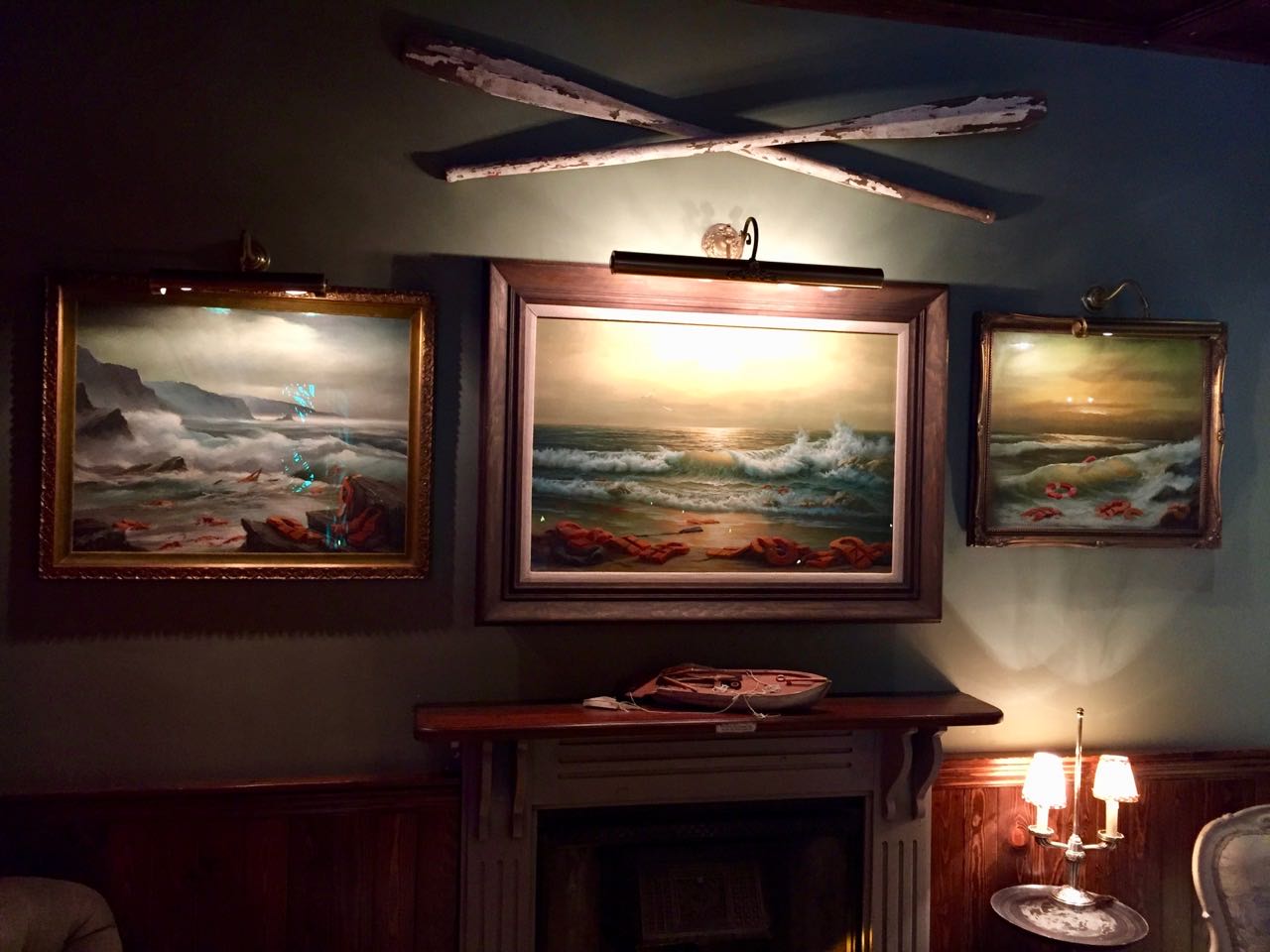
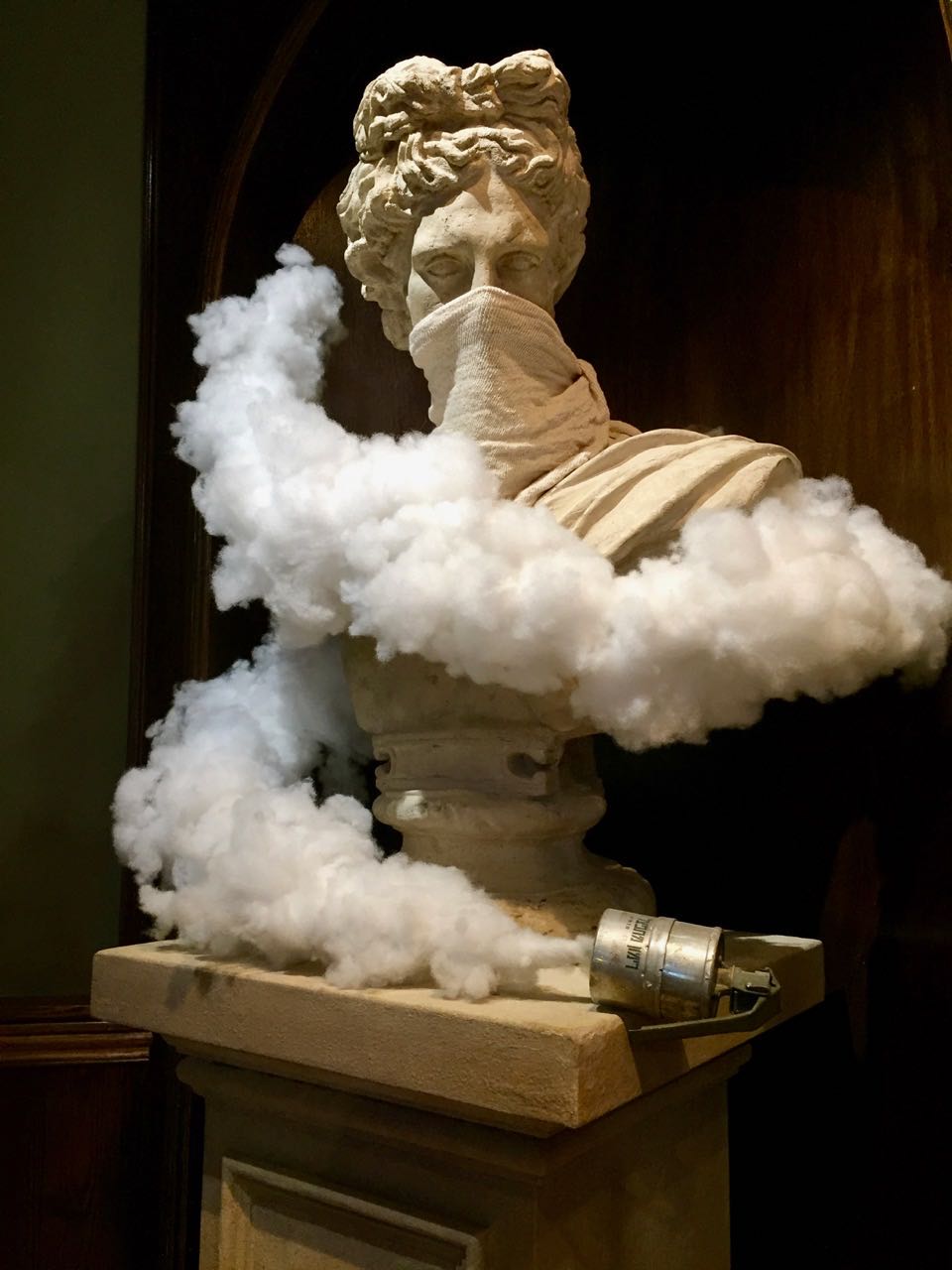
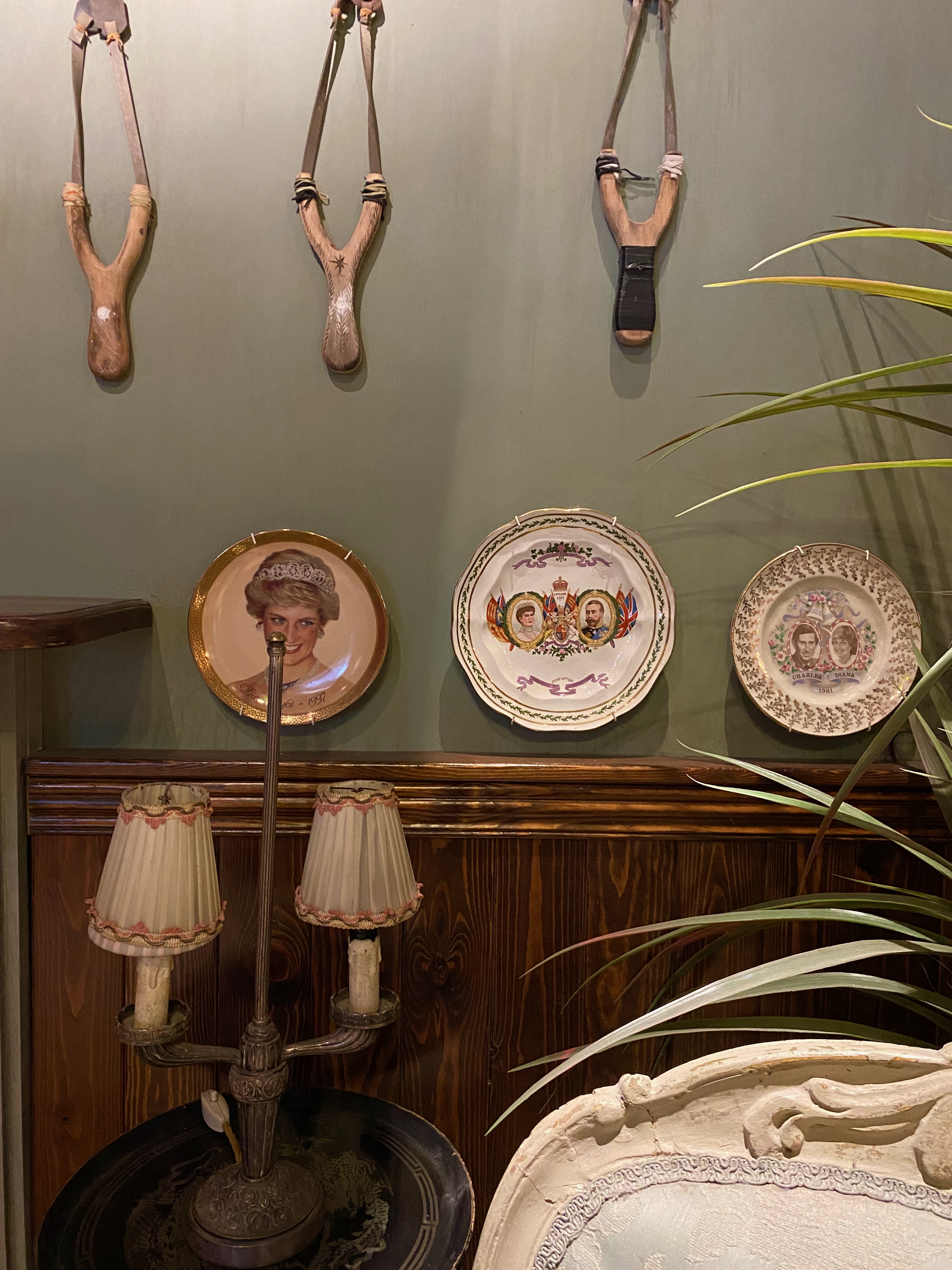
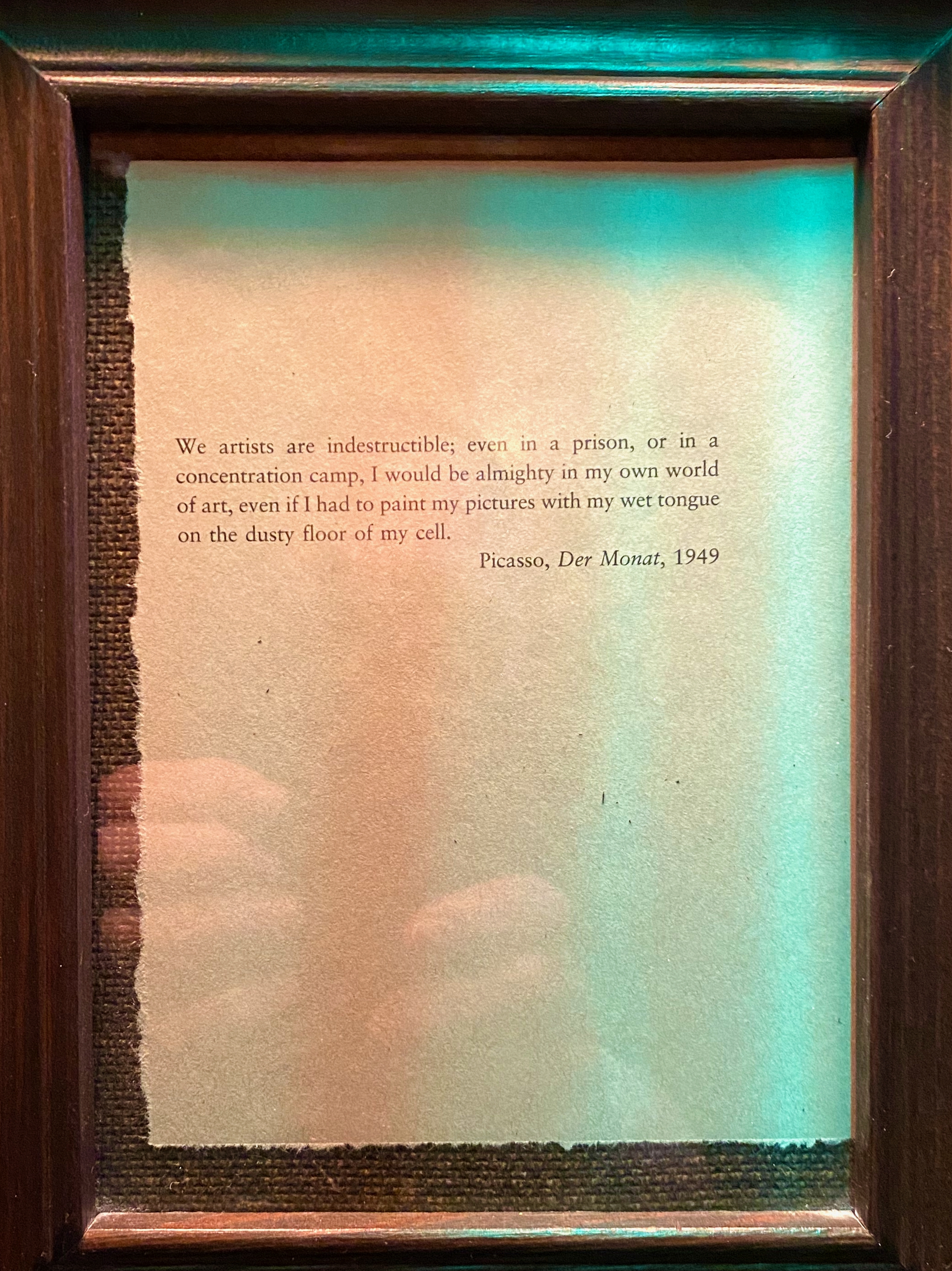
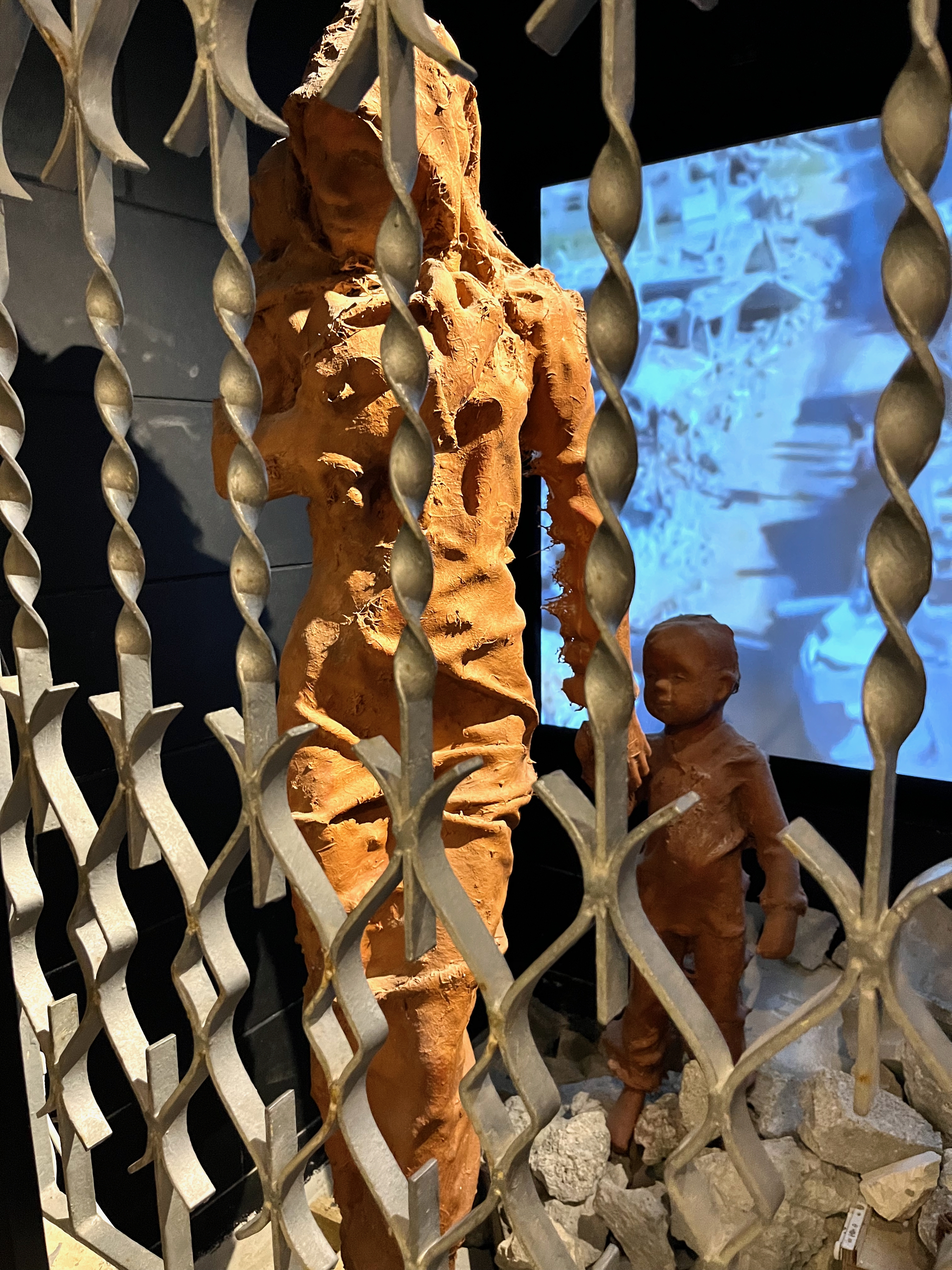
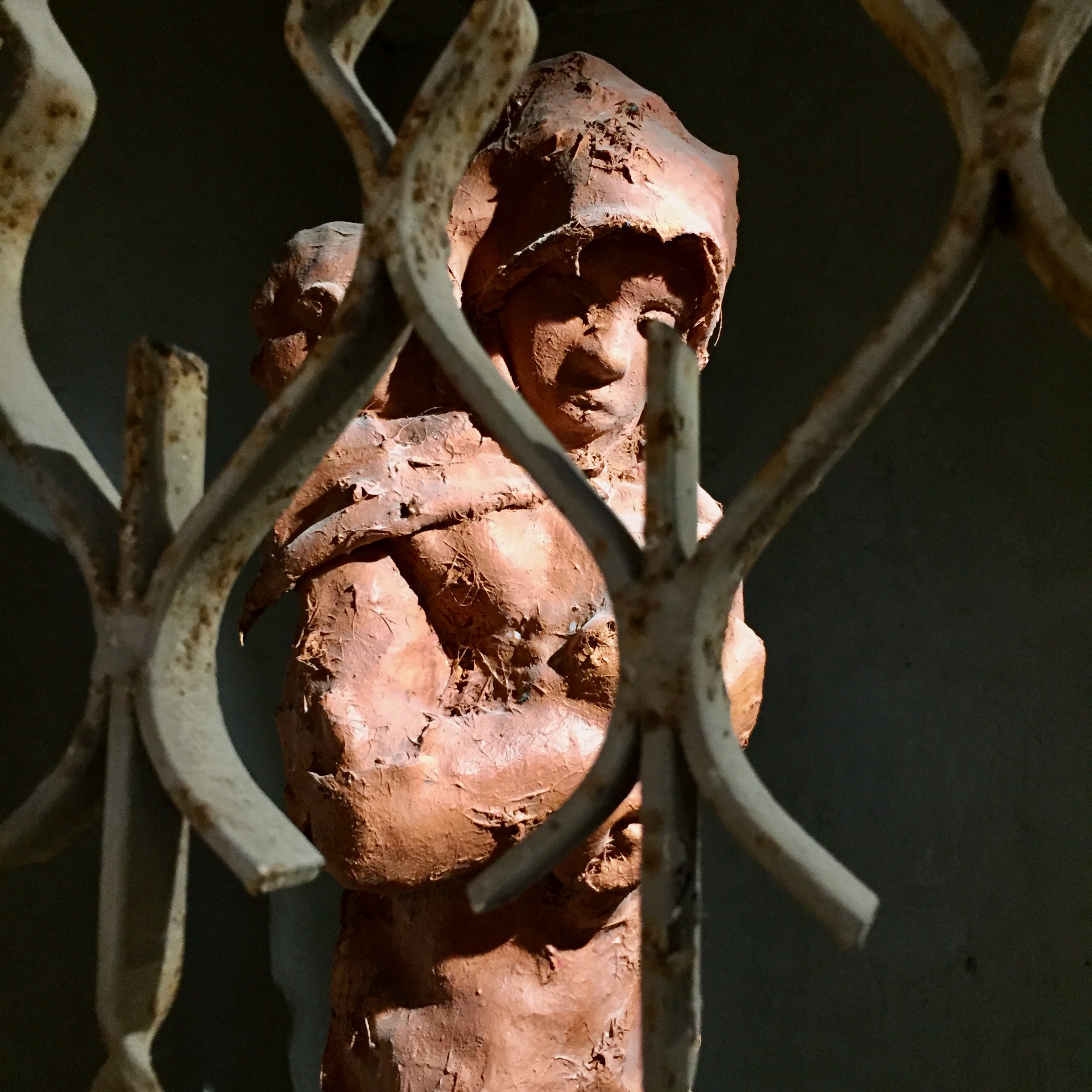
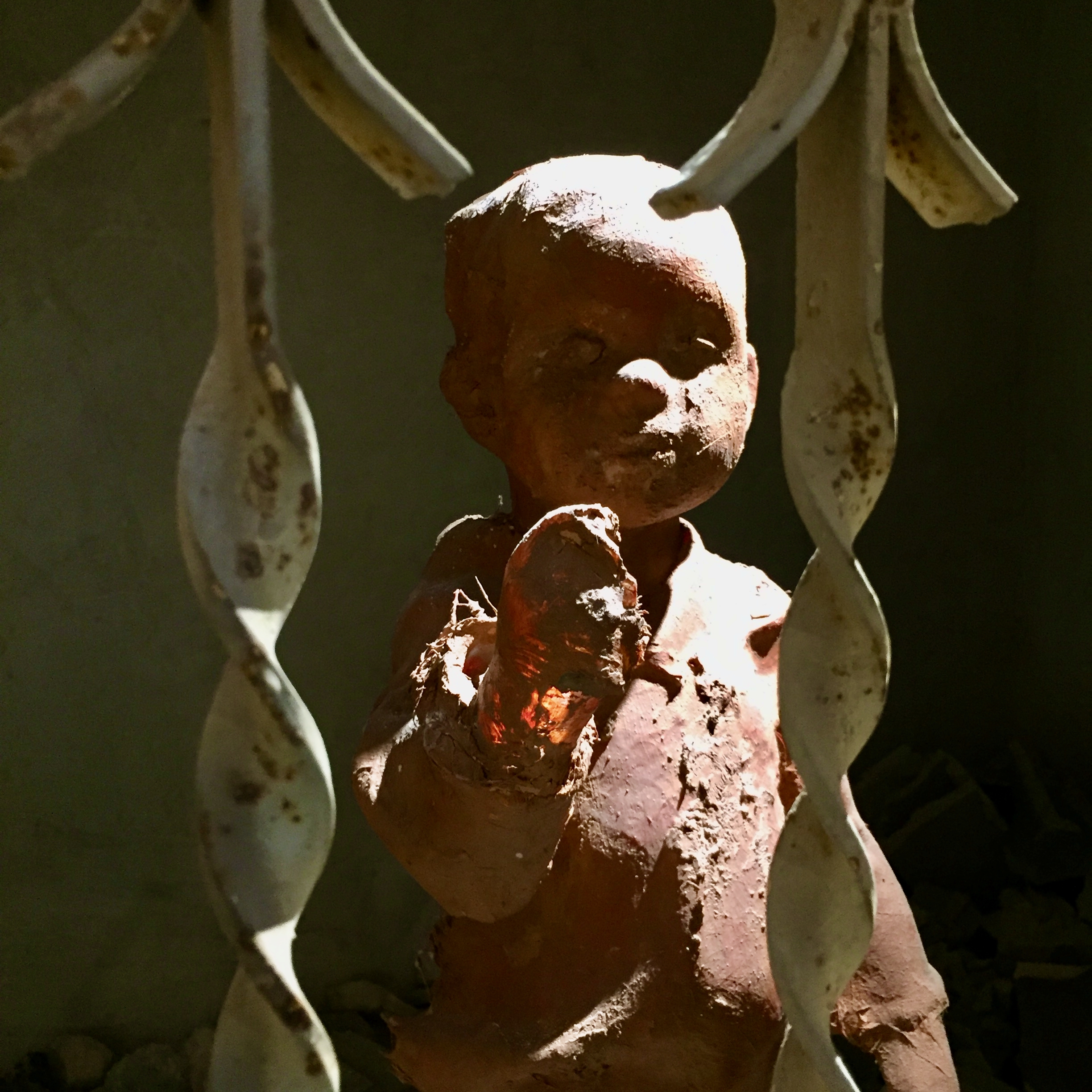
Some photos from the ground floor area at Walled Off Hotel:
Photos: R.A.
Some photos from the upper floor area:
Some artworks from different rooms on the upper floor:
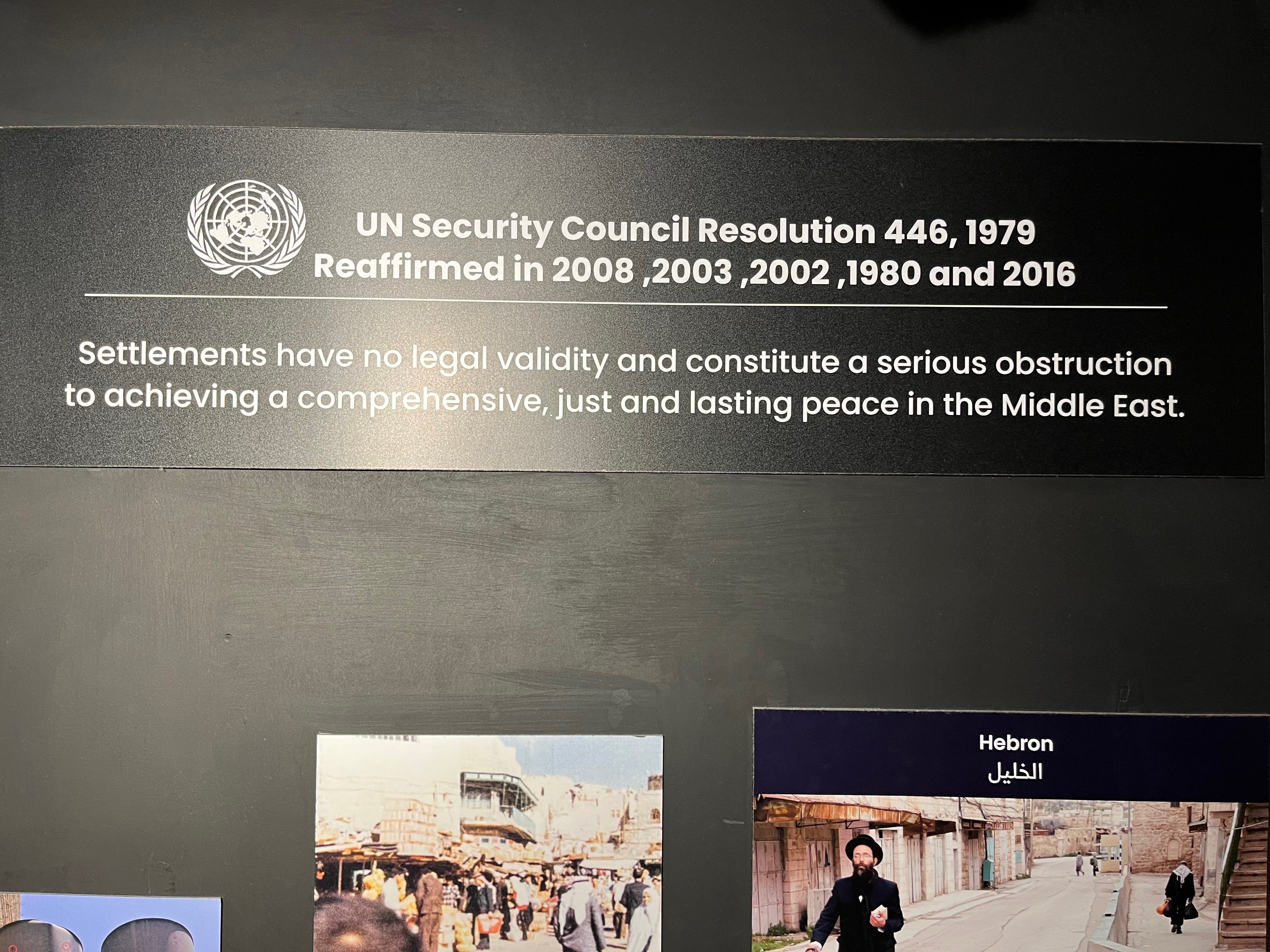
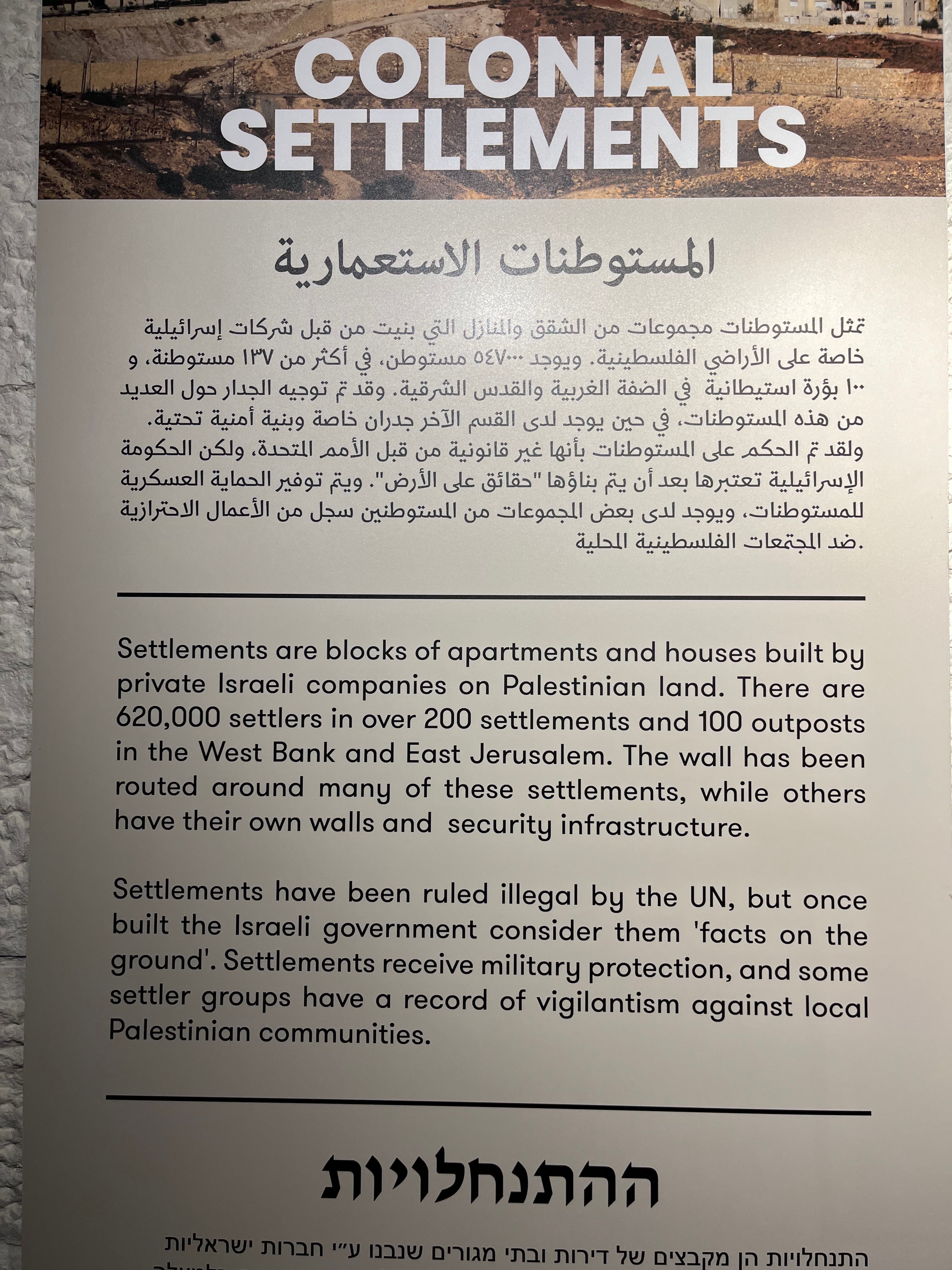
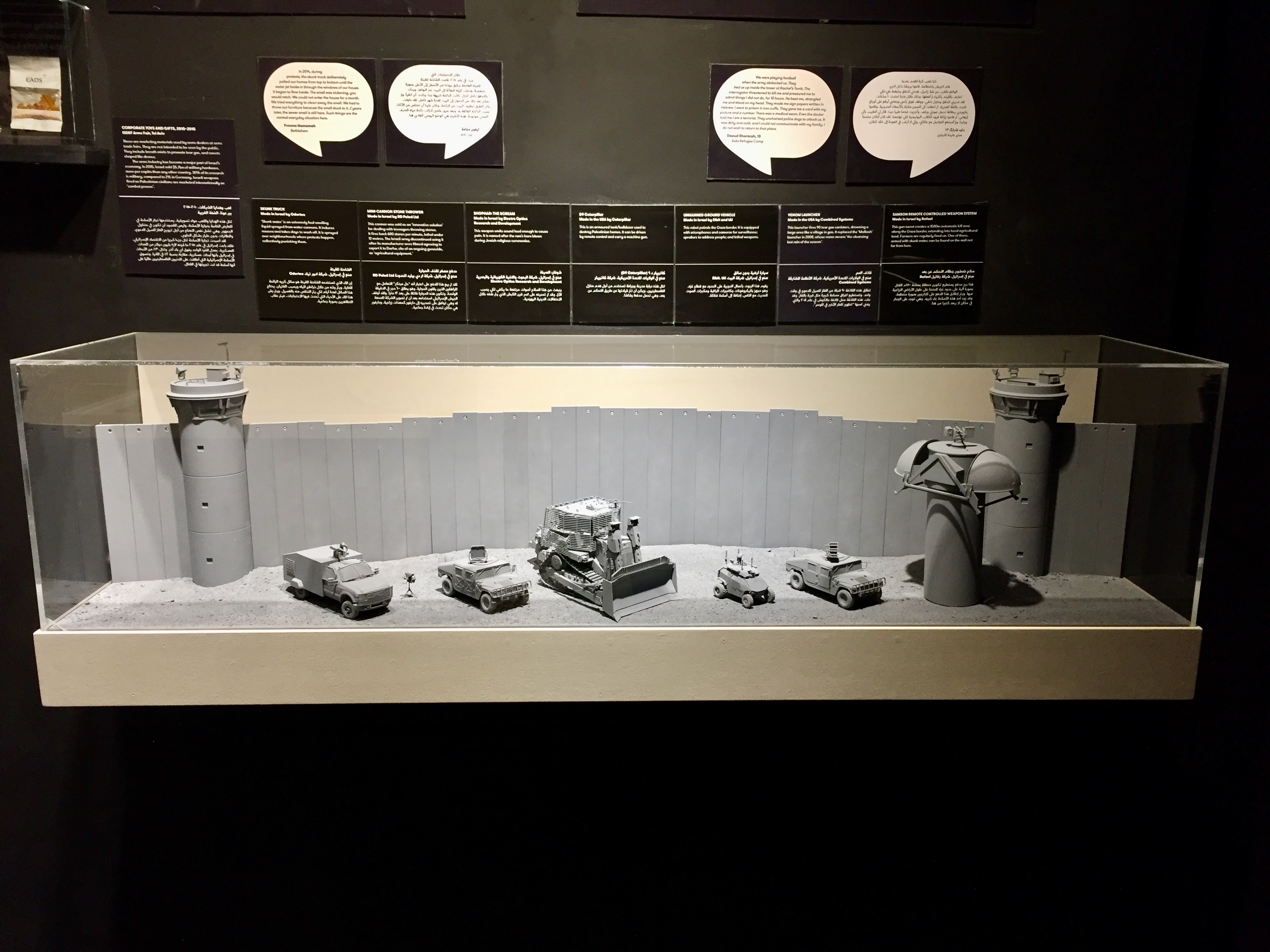
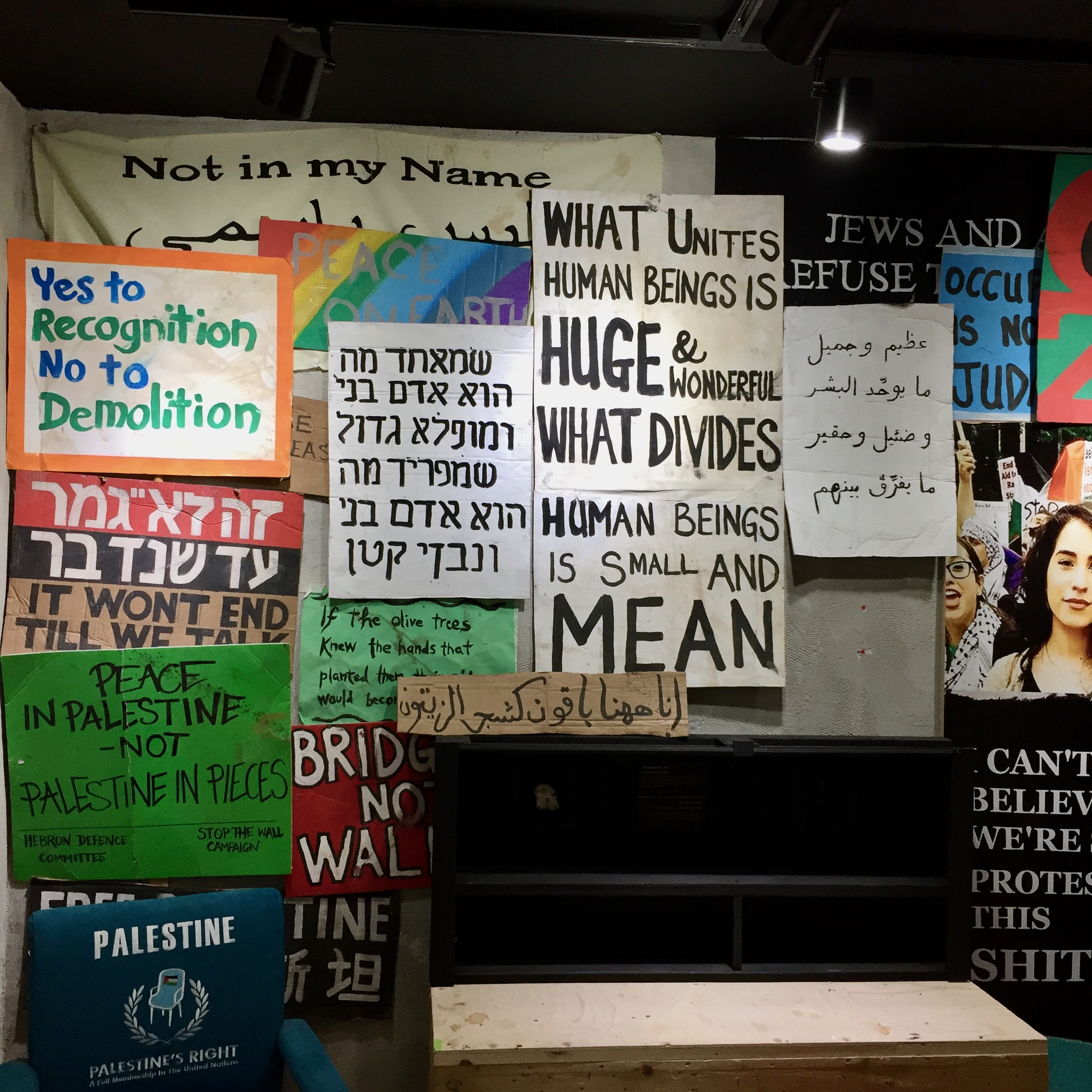
Some photos from the museum of the wall on the ground floor:
The museum on the ground floor is dedicated to the history of the segregation wall. Dr Gavin Grindon from Essex University collaborated in its design. It gives you a very clear picture of what has happened since the occupation started.
The official video clip from the opening of Walled Off Hotel:
Channel 4 did a lengthy feature on the opening of the hotel:
As reported by The Guardian on 3 March 2017:
‘Worst view in the world’: Banksy opens hotel overlooking Bethlehem wall
By Emma Graham Harrison
Exclusive: British artist launches Walled Off hotel in hope of bringing Israeli tourists – and dialogue – to West Bank city
The Walled Off hotel may sound utilitarian, even bleak. Its owner says it has “the worst view of any hotel in the world”, while its 10 rooms get just 25 minutes of direct sunlight a day. But, nestled against the controversial barrier wall separating Israel from the Palestinian territories, the West Bank’s answer to the Waldorf offers travellers something more elusive than any luxury destination.
The lodging in Bethlehem is a hotel, museum, protest and gallery all in one, packed with the artworks and angry brilliance of its owner, British street artist Banksy. From the disconcertingly lavish presidential suite where water splashes from a bullet-strafed watertank into the hot tub, to the bunk-beds in the budget room scavenged from an abandoned army barracks, the hotel is playful and strongly political.
All the rooms look out on to the concrete slabs of the wall and some have views over it to pill boxes and an Israeli settlement – illegal under international law – on the hillside beyond.
“Walls are hot right now, but I was into them long before [Donald] Trump made it cool,” said Banksy in a statement. The artist, who fiercely guards his anonymity, first came to Bethlehem more than a decade ago, leaving a series of paintings on the barrier that have become a tourist destination in their own right. Since then, the town’s pilgrim and sightseeing-based economy has been ravaged by ever-tighter Israeli controls on travel between Israel and the Palestinian territories, so the new hotel is expected to provide a welcome boost in jobs and visitor numbers.
Banksy’s reputation is likely to keep all rooms fully booked, but he wants guests to leave with more than just a selfie. “(It’s) a three-storey cure for fanaticism, with limited car parking,” he added in the statement. The hotel opens to guests on 20 March, with bookings via the website. The team hope Israelis, who rarely see the barrier wall up close or visit Palestinian towns, will be among the guests, even though visiting means breaking the law.
“I would like to invite everyone to come here, invite Israeli civilians to come visit us here,” said manager Wisam Salsaa. “We want them to learn more about us, because when they know us it will break down the stereotypes and things will change.”
Israelis are banned from visiting Bethlehem and its famous sites. And although Banksy has chosen a site officially under Israeli military control – meaning it is legal for Israelis to stay there – all the roads to reach it involve an illegal journey through Palestinian-controlled territory.
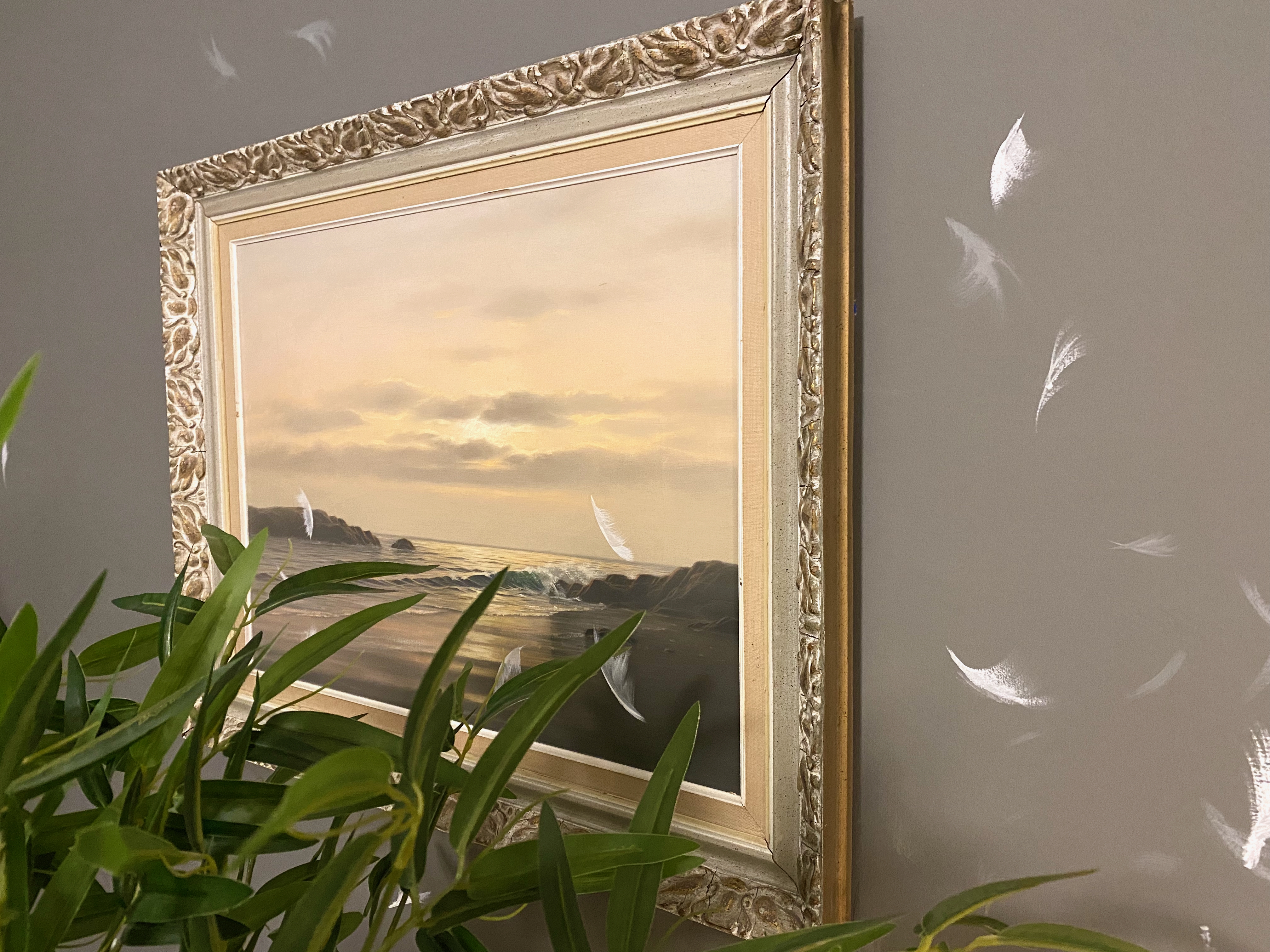
The hotel, a former pottery workshop, has a dystopian colonial theme, a nod to Britain’s role in the region’s history, the reception and tea-room a disconcerting take on a gentlemen’s club where a self-playing piano provides an eerie soundtrack. The fire flickering in the grate glows under a pile of concrete rubble, like a blaze at a bomb site, a classical bust in a niche is wreathed in clouds of gas snaking out of a tear gas canister and, in traditional seascapes, the beaches are littered with life-jackets discarded by refugees.
“It’s exactly 100 years since Britain took control of Palestine and started rearranging the furniture – with chaotic results,” Banksy said. “I don’t know why, but it felt like a good time to reflect on what happens when the United Kingdom makes a huge political decision without fully comprehending the consequences.”
Upstairs, original Banksy artworks decorate several of the rooms. In one, an Israeli soldier and a Palestinian protester thump each other with pillows, the feathers fluttering down towards the real pillows of the bed below. In another, a pack of cheetahs crouch over a zebra-print sofa, where padded entrails snake out of a cushion. The bookshelves are packed with carefully chosen titles – A Room With a View at the end of one, Cage Me a Peacock on another stack. The elevator is walled off, too, the doors jammed half open to show concrete breeze blocks, hung with an “out of service” sign.
A small museum explains the wall, the controls on movement and the troubled history of the region, curated together with Essex University professor Gavin Grindon. “If you are not completely baffled, then you don’t understand,” the presenter of a video history signs off.
Also in the building, part of a plan to promote dialogue, is a gallery showing the work of Palestinian artists. It is the first in Bethlehem, says curator Housni Alkateeb Shehada, and a way for artists, who often find it hard to travel, to reach a wider audience.
He wanted to project art on to the barrier wall which lies just five meters away, but decided in the end that it would be too risky, a reminder of the conflict and restrictions that looms over all the people living in Bethlehem. “We are very afraid,” said Shehada. “We don’t know what is going on there with the soldiers and it is forbidden.”
Banksy dismissed worries that security concerns would keep people away, pointing out that he had packed out a “bemusement park” in an unglamorous English seaside town for weeks.
“My accountant was worried some people will be too scared to travel to the West Bank, but then I remind him – for my last show they spent a whole day in Weston-super-Mare.”
In February 2015, Banksy published a 2-minute video titled “Make this the year YOU discover a new destination” about his trip to the Gaza Strip. During the visit to Gaza in early 2015, Banksy painted at least four exquisite works, among them a weeping Niobe, and a kitten on the remains of a house destroyed by an Israeli air strike. He also did a text-based piece, a quote from Christian philosopher Paolo Freire, of Brazilian origin: “If we wash our hands of the conflict between the powerful and the powerless, we side with the powerful; we don’t remain neutral. ”
In his own words, in a statement to the New York Times:
“I wanted to highlight the destruction in Gaza by posting photos on my website — but on the internet people only look at pictures of kittens . I don’t want to take sides. But when you see entire suburban neighborhoods reduced to rubble with no hope of a future — what you’re really looking at is a vast outdoor recruitment center for terrorists. And we should probably address this for all our sakes.”
“Gaza is often described as ‘the world’s largest open air prison’ because no-one is allowed to enter or leave. But that seems a bit unfair to prisons – they don’t have their electricity and drinking water cut off randomly almost every day.”
Greek goddess Niobe, weeping for her dead offspring
“A local man came up and said ‘Please – what does this mean?’ I explained I wanted to highlight the destruction in Gaza by posting photos on my website – but on the internet people only look at pictures of kittens.”
Pictures on Walls published the following statement:
“Bethlehem is one of the most contentious places on earth.
Perched at the edge of the Judaen desert at the intersection of Europe, Asia and Africa in the state of Palestine it was governed by the British following the collapse of the Ottoman Empire. After World War II the United Nations voted to partition the region into two states – one Jewish, one Arab and there’s been fighting ever since.
It’s obviously not the job of a loose collection of idiot doodlers to tell you what’s right or wrong about this situation, so you’re advised to do further reading yourself (this month’s National Geographic has an excellent article all about Bethlehem).
We would like to make it very clear Santa’s Ghetto is not allied to ANY race, creed, religion, political organization or lobby group. As an organisation the only thing we’ll say on behalf of our artists is that we don’t speak on behalf of our artists. This show simply offers the ink-stained hand of friendship to ordinary people in an extraordinary situation.
Every shekel made in the store will be used on local projects for children and young people. Not one cent will go to any political groups, governmental institutions or, in fact, any grown-ups at all.
Banksy contributed with quite a few pieces, among them some very rare canvases, among them The ‘Peace Dove with Bulletproof Vest’ and ‘Stop and Search’, as can be seen in the photo below of the store front on Manger Square:
Photo: monstris_uk on Flickr
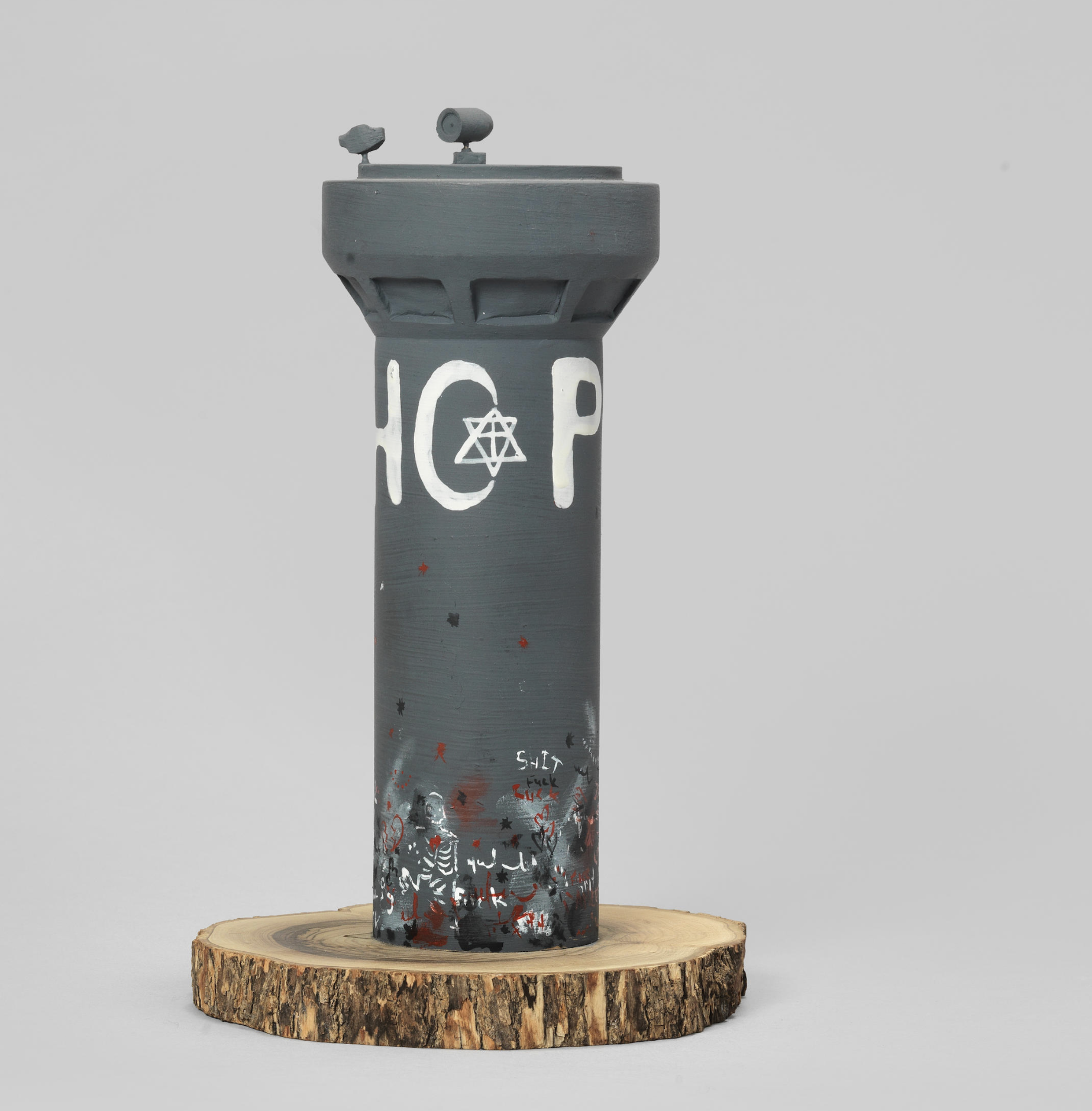
The Watchtower collaborations
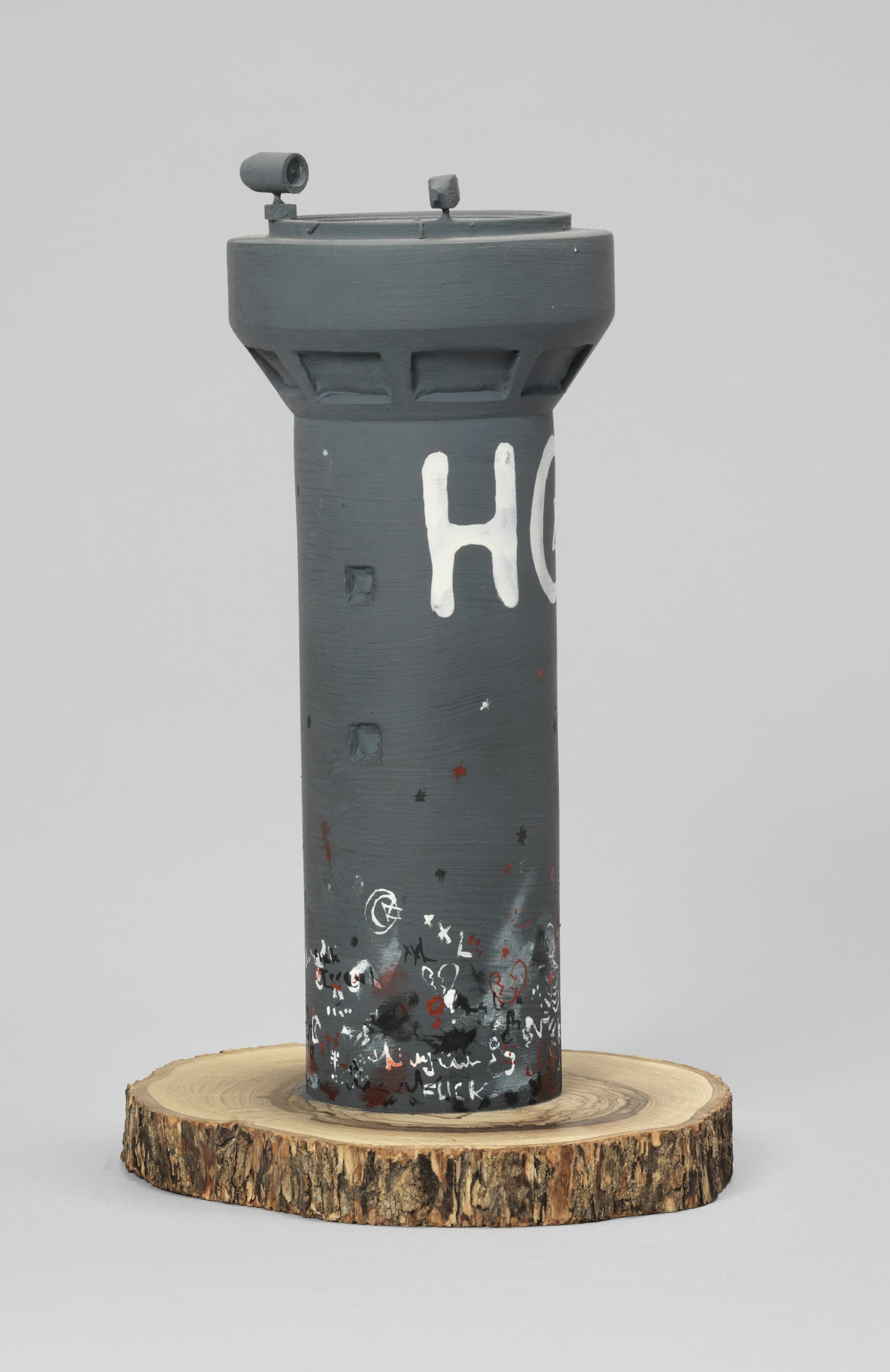
The watchtowers were an interesting collaboration at Santa’s Ghetto 2007. Banksy created a limited edition of 15. A few invited artists decorated unique towers – some sources say at least 15 unique towers were made by different artists. The late Tawfiq Salsaa, an accomplished olive wood carver from Bethlehem, appears to have carved the original.
Here are a few of the unique towers. From left to right: Peter Kennard, Blu, Kelsey Brooks (2 x Hope) and Tawfiq Salsaa:
Photos: Bonhams
Another intriguing piece was the monumental olive wood sculpture of the Old Town in Jerusalem, a collaboration by Banksy and the late Tawfiq Salsaa. Two years later, the same Old Jerusalem model appeared at Banksy vs Bristol Museum:
Jerusalem Old Town by Tawfiq Salsaa and Banksy. Photographed at Walled Off Hotel in 2022. Photo R.A.
List of artists at Santa’s Ghetto 07:
3D Abdul Rohman Elmzyen Adam Koukoudakis Aiko Ayed Arafah Banksy Bast Ben Turnbull Blu Conor Harrington Eine Erica il Cane Faile Gee Vaucher James Cauty Jonathan Yeo Karim Dabbah Kelsey Brookes Lucy McLauchlan Mark Jenkins Antony Micallef Paul Insect Sir Peter Blake Peter Kennard Kat Phillips Ron English Sam 3 Sickboy Souleiman Mansour Swoon Yousef Katalo
On the same journey to the Bethlehem area, Banksy painted five stencils, among them the Armoured peace dove.
As reported by CNN on 3 December 2007:
By Brie Schwartz
(CNN) — British graffiti artist Banksy has launched an art exhibition in Bethlehem that he hopes will focus attention on the poverty of the West Bank and draw tourists to the traditional birthplace of Christianity.
A Palestinian man walks by Banksy’s camel, painted on the security barrier near Bethlehem.
As part of the project, Banksy has adorned the controversial security barrier around the West Bank town with spray paint and plaster works of art in a comment on the Israel-Palestinian conflict.
Israel says the purpose of the barrier is to prevent terrorist attacks being launched from the West Bank. Palestinian leaders however say the barrier amounts to an illegitimate land grab by Israelis, setting unilateral borders for an eventual Palestinian state.
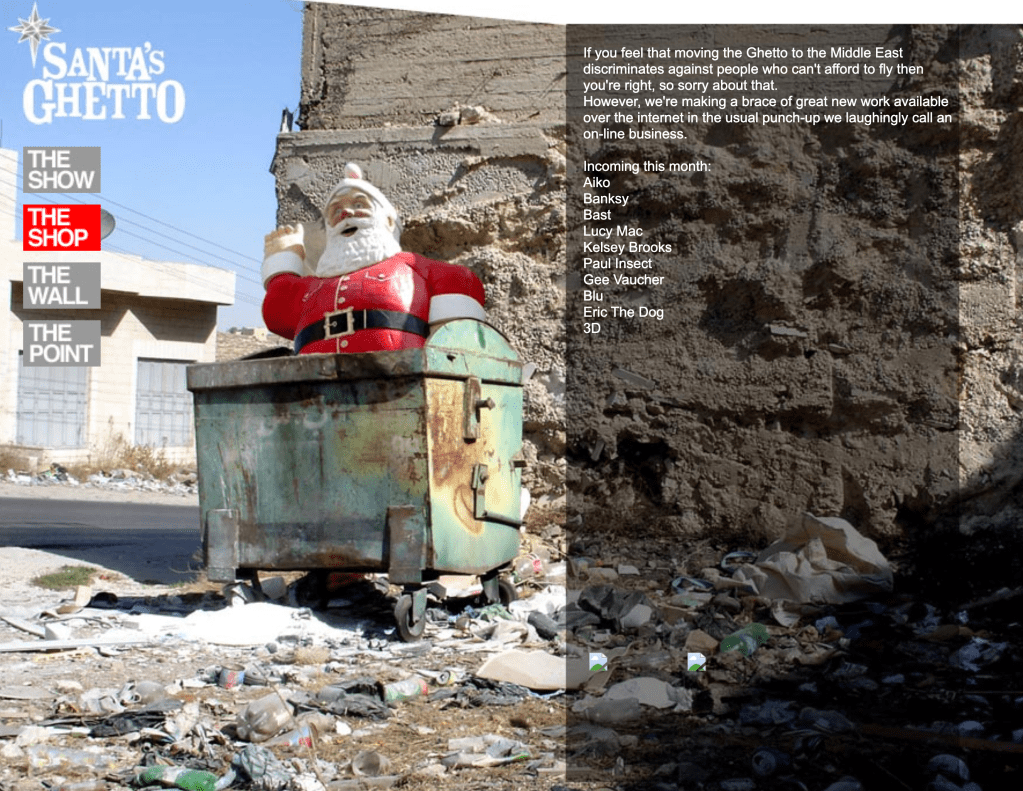
The new exhibition, called “Santa’s Ghetto Bethlehem 2007,” is a collaboration by artists who say they are trying to revitalize tourism to Bethlehem and “offer the ink-stained hand of friendship to ordinary people in an extraordinary situation.”
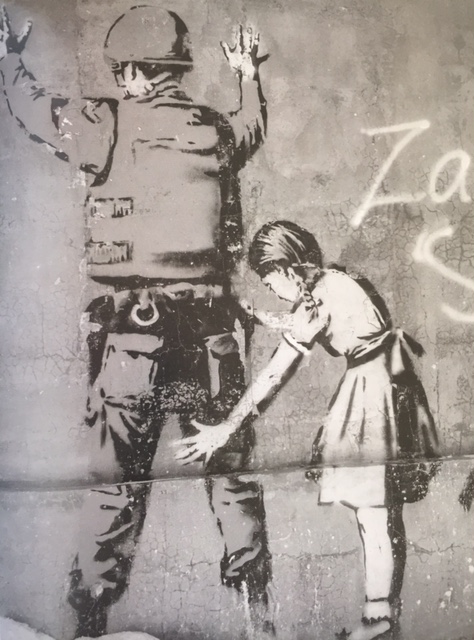
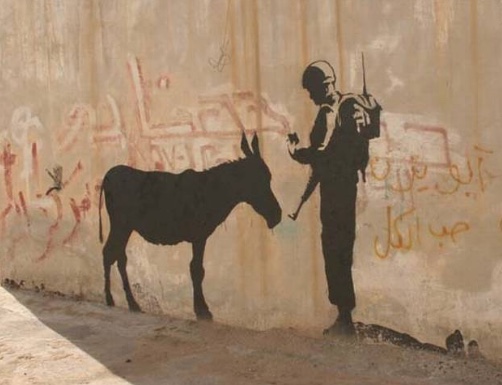
Banksy’s sketches on the security barrier flow towards Manger Square, across from the Church of the Nativity, where Christians believe Jesus was born. His images include a dove wearing a bullet-proof vest, a young girl in a frilly pink dress frisking a soldier and a donkey being checked for its identity papers.
According to the Web site for Santa’s Ghetto, Banksy thought he was making an ironic commentary with the donkey picture, but locals told him the animals are frequently asked for ID papers. Santa’s Ghetto typically operates during the month of December out of a small store on Oxford Street in London, where underground artists showcase their work.
Banksy, who started the initiative six years ago, says: “I felt the spirit of Christmas was being lost. It was becoming increasingly uncommercialized and more and more to do with religion, so we decided to open our own shop and sell pointless stuff you didn’t need.”
His exhibition in Bethlehem is rife with the same satirical sentiments. Beyond the barrier graffiti, the work of Santa’s Ghetto’s diverse artists spread across three floors of a building in Manger Square.
Inside, examples include a painting by Palestinian artist Suleiman Mansour in which a man carries the city of Jerusalem on his back, and London artist Peter Kennard’s montage of dollar bills printed on pages from the Jerusalem Post. Proceeds from Santa’s Ghetto sales go to charity.
Little is known about Banksy other than that he was born in Bristol, western England. Collections of his original work, which attract the likes of Angelina Jolie and Brad Pitt, have sold for more than $1 million (almost £500,000).
Banksy’s previous political statements have included hanging a picture of a cave man pushing a shopping cart in the British Museum and placing a doll of a Guantanamo Bay detainee in Disneyland. The doll was removed, but the “primitive” portrait became a part of the British Museum’s permanent collection.
Tourism — even in the traditional Christmas peak season — has been hard hit in recent years with Israeli checkpoints keeping most of the local Palestinians in and all but the most determined tourists out. As a result levels of unemployment are high.
Speaking through the Web site, Banksy says tourists need not fear visiting the West Bank. “It would do good if more people came to see the situation here for themselves.
“If it is safe enough for a bunch of sissy artists then it’s safe enough for anyone.”
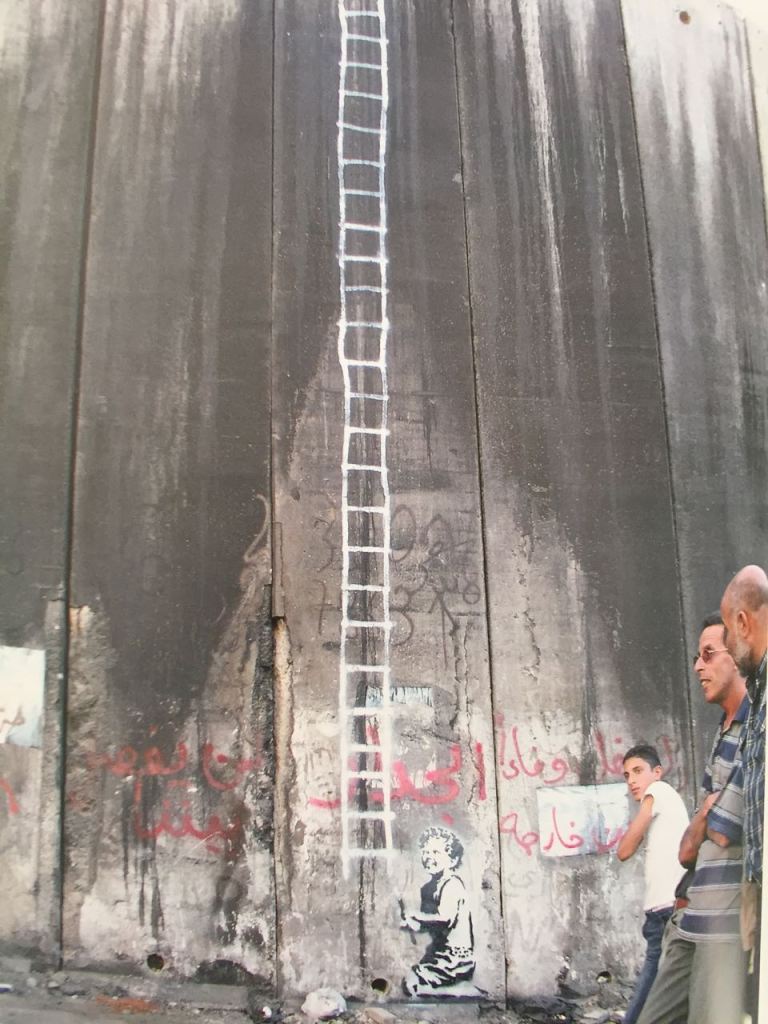
In August 2005, Team Banksy visited Palestine, where they painted nine large murals on the segregation wall. Banksy commented that the wall “essentially turns Palestine into the world’s largest open prison.” Banksy’s website reminded readers that Israel’s 425-mile-long West Bank barrier, separating Israel from the Palestinian territories, is considered illegal by the United Nations.
During the visit to Ramallah and surrounding areas, Banksy reported some tense moments. His spokeswoman, Jo Brooks, said: “The Israeli security forces did shoot in the air threateningly, and there were quite a few guns pointed at him.”

































 Banksy unofficial